
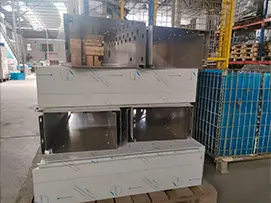
Custom Sheet Metal OEM
For machine housings where noise is a specification, see our sound insulated enclosures.
Custom Metal Enclosure Manufacturer for OEM Projects
Fulei Metal provides custom metal enclosure manufacturer for equipment brands and system integrators that need customized housings with cable openings, doors, hinges, locks, vents, brackets and branded finishes. We support OEM projects from drawings, samples and early DFM review through production, finishing, inspection and export packing.
Custom Metal Enclosure Manufacturer Specifications
| Material Options | SPCC, SECC, SGCC, SUS304, SUS316 and aluminum |
|---|---|
| Thickness Range | 0.8-3.0mm for most enclosure projects |
| Typical Tolerance | +/-0.1mm for cabinet body unless drawing specifies tighter features |
| Manufacturing Process | laser cutting / CNC bending / welding / grinding / powder coating / hardware assembly |
| MOQ | Prototype and low-volume orders can be reviewed; batch MOQ depends on size, tooling and finish |
| Lead Time | Quoted after drawing review and process confirmation |
| Drawing Formats | PDF, DWG, DXF, STEP, IGES, SolidWorks files or clear samples |
| Trade Terms | FOB Ningbo, EXW, CIF or project-based terms after quotation |
Approach to Building Metal Enclosure
Good custom metal enclosure manufacturer work starts before production. Our team reviews the drawing, material grade, sheet thickness, bend radius, weld access, hole positions, hardware requirements and surface finish before confirming the manufacturing route. This helps purchasing and engineering teams avoid late design changes, tolerance surprises and assembly problems.
For OEM buyers, the important question is not only whether a supplier can make one sample. The real test is whether the same dimensions, surface appearance and assembly fit can be repeated in a batch order. Fulei Metal builds each project around drawing review, controlled fabrication steps, in-process inspection and final packing checks.
Keeping Metal Enclosure Consistent Across Batches
The usual route includes laser cutting or punching, CNC bending, welding or riveting when required, deburring, surface preparation, powder coating or other finishing, and final assembly. For enclosure and cabinet projects, we pay close attention to doors, seams, hinges, locks, vents, cable openings, mounting plates and coating coverage.
When drawings include critical dimensions, we mark them before production and check them during the first article stage. If a tolerance, hole pattern or bend design may increase cost or production risk, we can provide DFM suggestions for the buyer to review before the quotation is finalized.
Checking Metal Enclosure Before Shipping
Inspection can include incoming material checks, first-article dimensional inspection, bend angle checks, welding appearance checks, coating surface review, assembly confirmation and packing photos. For projects that require documents, buyers can request material certificates, inspection records or photos of key production steps with the RFQ.
Engineering Notes for Metal Enclosure Buyers
To make the quotation faster and more accurate, please mark functional surfaces, visible cosmetic surfaces, threaded holes, inserted hardware, grounding points and any areas that cannot be coated. If the part connects with another assembly, share the mating drawing or key interface dimensions so the production team can check fit before manufacturing.
For export projects, packing should be considered early. Large panels, powder-coated doors and welded cabinet bodies may need foam protection, corner guards, pallet packing or separated hardware bags to reduce transport damage. Clear packing requirements help us quote a more realistic cost and avoid changes after sample approval.
Enclosure Choices That Move Cost and Lead Time
Two enclosures of the same overall size can differ considerably in price. The difference is almost always in the door, the sealing arrangement, the finish and the packing — not in the sheet metal itself. Knowing which of these drives your project helps both sides quote realistically, and it is the part of the engineering review that saves the most time.
| Door and access | Single door, double door, hinged cover or removable panel. This drives hinge and latch cost, assembly time and the flatness the door has to hold. |
|---|---|
| Sealing | Gasket in a formed channel, foam gasket, gland plate or sealed cable entry. Labour is the main cost, and the sealing target has to be stated before we can quote it. |
| Material | SPCC where the cabinet will be painted, SUS304 for wet, outdoor or food-area use, aluminium where weight matters. Material changes the welding method and the surface finish as well as the raw cost. |
| Finish | Powder coat colour and texture, brushing, polishing or silk screen. Each extra operation adds handling, masking and inspection time. |
| Internal mounting | Back plate, DIN rail, welded studs or captive hardware. More line items mean more BOM control, and more chances for a part to be missing at assembly. |
| Cable entry | Cut-outs in the body, a removable gland plate or knockouts. A separate plate lets the cable layout change without reworking the whole cabinet. |
| Packing | Carton, pallet or wooden case. Cost depends on size and on how easily the finish marks in transit — see our export packaging options. |
The sealing target is the item that causes the most rework. A cabinet that has to shed water outdoors needs a formed gasket channel, a door that closes evenly along its full length, and cable entries that are sealed — and it still has to be verified on the finished machine. We build to the design you specify and verify the parts we make; formal ingress testing is performed on the complete product by you or by a testing laboratory.
If you are replacing an enclosure that is already in production, send the sample or photographs with overall dimensions and detail shots of the cut-outs, door and mounting. Measuring a real part is faster and more reliable than working from a drawing that may have been rounded when it was copied. Recent enclosure work is shown with the other product cases.
Typical Uses for Metal Enclosure
- electrical enclosures
- EV charger housings
- battery cabinets
- network cabinets
- medical and beauty equipment shells
- transport, trackside and rolling stock enclosures – quoted to EN 45545-2 and IEC 61373 where the drawing names them (enclosures for the transportation industry)
Information Needed to Quote Metal Enclosure
- 2D drawing and 3D model if available
- Material, thickness, finish, color and surface requirement
- Quantity for prototype, first batch and annual demand
- Critical tolerances, assembly requirements and inspection documents
- Destination country, target delivery time and preferred trade term
Metal Enclosure Questions, Answered
Can you manufacture custom metal enclosure manufacturer from our drawing?
Yes. Send PDF, DWG, DXF, STEP, IGES or SolidWorks files. We review manufacturability, material, thickness, tolerance and finishing requirements before quotation.
Prototype and Volume Runs for Metal Enclosure
Yes. Prototype and low-volume projects can be reviewed first. Batch production lead time depends on structure, quantity, hardware, coating and packing requirements.
Material and Finish Choices for Metal Enclosure
Yes. Carbon steel, galvanized steel, stainless steel, aluminum and selected non-ferrous metals can be discussed. Finishing options may include powder coating, plating, anodizing, brushing, polishing or silk screen according to the application.
DFM Help for Metal Enclosure
Yes. If we see a risk in bend radius, weld position, hole distance, tolerance stack-up, coating area or assembly sequence, we can share DFM suggestions before production.
Details That Make a Metal Enclosure Quote Accurate
Please send drawings, target quantity, material, thickness, finish, application, inspection requirements and destination. Photos or samples are helpful when drawings are not complete.
Other Sheet Metal Work Alongside Metal Enclosure
Yes. Related services and products include Electrical Enclosure Manufacturer China, EV Charger Power Cabinet Enclosure, powder coating, deburring, assembly and custom packaging for export projects.
Can you match an existing enclosure from a sample?
Yes. A sample, or photographs with overall dimensions and detail shots of the cut-outs, door and mounting, is enough for us to measure the part and produce a drawing for your approval. We confirm material, thickness and finish before making the first part.
Can you build to a specific IP rating?
We build to the design you specify — gasket type and compression, gland plates, door closure and seam treatment — and we verify the metalwork we produce. Formal ingress testing is carried out on the finished assembly by you or by a testing laboratory, because the rating covers the complete product and not only the sheet metal.
Request a Quote for Custom Metal Enclosure Manufacturer
Send your drawings, quantity and finish requirements. Fulei Metal will review the manufacturing route and confirm the information needed for quotation.
Related Metal Enclosure Pages
Payment Terms
How a project is paid for is agreed before production starts, and the structure that applies to your order is stated on the quotation and on the order confirmation, so there is no ambiguity later.
- 30% advance payment with the order and the 70% balance before shipment — our standard structure.
- 70% advance payment with the order and the 30% balance before shipment — used for some projects.
- 100% payment in advance before production starts — used for some projects.
If your finance team works to a fixed structure, say so in the first enquiry and we will confirm what applies to your order before you commit. Request a quotation.
Questions buyers ask before sending drawings
The nine questions that come up most often before a project starts, answered the way we answer them by email.
What do you need from me to quote a part?
2D drawings as PDF, DWG or DXF, or 3D files as STEP, IGES or SolidWorks, together with material grade, sheet thickness, surface finish, quantity and destination country. If the drawing is not finished yet, send a photo, a sketch or the existing part instead — we review what can be measured from it and reply with the questions that still need answering.
How long does a quotation take?
Enquiries are answered within one business day. Quotation time depends on the part. Simple components we can price straight from the drawing — laser-cut and bent sheet metal, brackets, panels, covers, machine guards — are quoted within 24 hours. Complex work such as assembled kiosks, welded frames and multi-part structures is quoted after the drawing review and process confirmation, because the scope cannot be judged from the drawing alone; the date is confirmed in our reply.
Is there a minimum order quantity?
Prototypes are made from a single piece, and small batches of 10–50 pieces are routine. Prototype, first batch and repeat volume are quoted in one staged quotation so the numbers stay consistent as the project scales. See low MOQ sheet metal fabrication.
Can you work from a sample or a photo if I have no drawing?
Yes. Send the part itself, clear photographs with a rule or caliper in frame, or a dimensioned sketch. We measure what can be measured, list the features that are still undefined, and confirm them with you before production rather than assuming them.
Will you sign an NDA before I send drawings?
Yes. If your process requires one, say so in the first message and we will confirm what we can sign before any file is transmitted. Customer drawings are treated as confidential and used only for the project they were sent for. See our NDA page.
What payment and trade terms do you work with?
The standard structure is 30% advance payment with the order and the 70% balance before shipment. Some projects run on 70% advance payment with the 30% balance before shipment, and some on 100% payment in advance before production. Quotations are issued under EXW, FOB Ningbo, CIF or DDP, whichever your logistics team already works with.
What quality documents come with the parts?
Inspection documents are agreed with the order. Reports are provided on request, and material certificates and traceability can be supplied for the grades we purchase. Tell us in the enquiry which documents your own quality system requires, and we will confirm what we can provide before you order rather than after.
Who will handle my project?
One contact from drawing review through to shipment. Violet, our sales manager, coordinates drawings, DFM questions, quotation, samples, production updates and shipping documents, so you are not handed to a different person between quotation and delivery.
Can you scale from prototype to repeat production?
Yes. Prototype quantity and expected annual volume are quoted together, so tooling, nesting and packaging are planned once and the sample and production prices stay consistent. See prototype to production quotation and sheet metal DFM engineering review.
Trade Terms and Delivery
We quote under the standard Incoterms your logistics team already works with, and build the packing and documentation around the one you choose.
- EXW — you collect from our Ningbo facility and run export clearance through your own forwarder.
- FOB Ningbo — we deliver to the vessel at Ningbo port and handle export clearance.
- CIF — we cover carriage and insurance to your named destination port.
- DDP — we handle carriage, insurance, import clearance and duties through to your door.
Send your destination country, target delivery date and preferred trade term together with the drawing. Request a quotation.
Quotation Time
We quote from your drawings. How long that takes depends on what the part asks for:
- Simple parts — quoted within 24 hours. Laser-cut blanks and bent components, supplied with complete 2D or 3D drawings. Mon–Fri, GMT+8.
- Complex assemblies — quoted after the drawing review. Payment kiosks, multi-part welded frames, enclosures with purchased hardware, or anything needing a coating or assembly trial. We confirm a quotation date once the scope is clear.
Production lead time is quoted separately, after drawing review and process confirmation. Send your drawings.
Standards, certification and inspection
These are the standards we work to and the documents we issue. If your project needs a specific standard or a test report from a named body, tell us at enquiry stage and we will confirm what we can provide before you commit.
| Standard / document | What it means for your order |
|---|---|
| ISO 9001 | Quality management system certified. Certificate available on request. |
| TÜV Rheinland | Certificate no. MIC-ASI243729. Test report available. |
| IEC 62208 | Empty enclosures for low-voltage switchgear — the standard we work to for general-purpose housings. |
| IEC 61439 | Type-tested assemblies where the enclosure forms part of a switchgear or controlgear assembly. |
| EN 62368 | Safety standard applied where the enclosure houses IT, audio/video or similar electronic equipment. |
| IP ratings | IP54 to IP65 verified on request, depending on gasket, cable entry and door design. |
| IK ratings | IK08 to IK10 for enclosures in public or vandal-exposed locations. |
| Material certs | EN 10204 3.1 material certificates supplied with every production batch. |
| First article | FAI / ISIR report issued before production release, covering the drawing characteristics. |
Certificates and test reports are issued with the shipment or earlier on request. Copies of current certificates are available before you place an order.
For US projects
Working to US drawings, NEMA types and gauge callouts
Most of our enclosure work is quoted from inch drawings with NEMA and gauge callouts. These are the conversions and the boundaries we work to — send us the drawing the way it is and we will confirm every number on the drawing review sheet before quoting.
Gauge converted to millimetres, by material
A gauge number is not the same thickness in every metal. Carbon steel follows the Manufacturers’ Standard Gauge, stainless the US Standard Gauge and aluminum the Brown & Sharpe gauge, so 14 ga is 1.90 mm in steel but 1.63 mm in aluminum. We convert on the material your drawing calls for, not on a single table.
| Gauge | Carbon steel | Stainless | Aluminum |
|---|---|---|---|
| 20 ga | 0.91 mm | 0.95 mm | 0.81 mm |
| 18 ga | 1.21 mm | 1.27 mm | 1.02 mm |
| 16 ga | 1.52 mm | 1.59 mm | 1.29 mm |
| 14 ga | 1.90 mm | 1.98 mm | 1.63 mm |
| 12 ga | 2.66 mm | 2.78 mm | 2.05 mm |
| 11 ga | 3.04 mm | 3.18 mm | 2.30 mm |
| 10 ga | 3.42 mm | 3.57 mm | 2.59 mm |
NEMA types and where they are used
NEMA 250 and IEC 60529 overlap but are not interchangeable: NEMA also covers corrosion resistance, icing and construction, which IP codes do not. The IP column below is the working equivalent we quote to, not a certifiable conversion.
| NEMA type | What it covers | Working IP equivalent | Typical use |
|---|---|---|---|
| NEMA 3R | Outdoor, rain and sleet, ice resistant | commonly taken as IP24 | Roadside cabinets, meter and service enclosures |
| NEMA 4 | Indoor or outdoor, windblown dust and hose-directed water | commonly taken as IP66 | Washdown areas, exposed plant equipment |
| NEMA 4X | Type 4 plus corrosion resistance | IP66 for ingress; corrosion is not covered by IP | Coastal, chemical and food-plant siting in 316 or 4X constructions |
| NEMA 12 | Indoor, dust and dripping non-corrosive liquids | commonly taken as IP54 | Factory-floor control panels and machine housings |
| NEMA 13 | Indoor, dust plus oil and coolant seepage | commonly taken as IP54 | Machine tool cabinets and coolant-exposed panels |
| NEMA 6 / 6P | Temporary or prolonged submersion | commonly taken as IP67 / IP68 | Pits, tunnels and below-grade installations |
Materials, certificates and the UL question
We work to the specification you put on the drawing: stainless to ASTM A240 in 304, 316 and 430, aluminum to ASTM B209 in 5052-H32, 5754, 6061-T6 and 3003-H14, carbon steel to ASTM A1008 or A1011. Material certificates and inspection records ship with the order.
On UL: we do not hold a UL or cUL listing, and no enclosure fabricator does — the listing is issued on the finished assembly with the equipment installed inside it. What we supply is the enclosure built to the NEMA type, the material and the hardware you specify, documented so that your own listing process has the paperwork it needs. If your drawing calls out a welding code — AWS D1.1 for carbon steel, D1.6 for stainless, D1.2 for aluminum — send it with the enquiry and we will confirm procedure and inspection before quoting.
Drawings accepted in STEP, DWG, DXF, PDF and SolidWorks, inch or metric, under NDA on request. Lead times are quoted after drawing review, not pulled from a table.