
Repeat production program
Powder-Coated Book Return Cabinets for OEM Programs
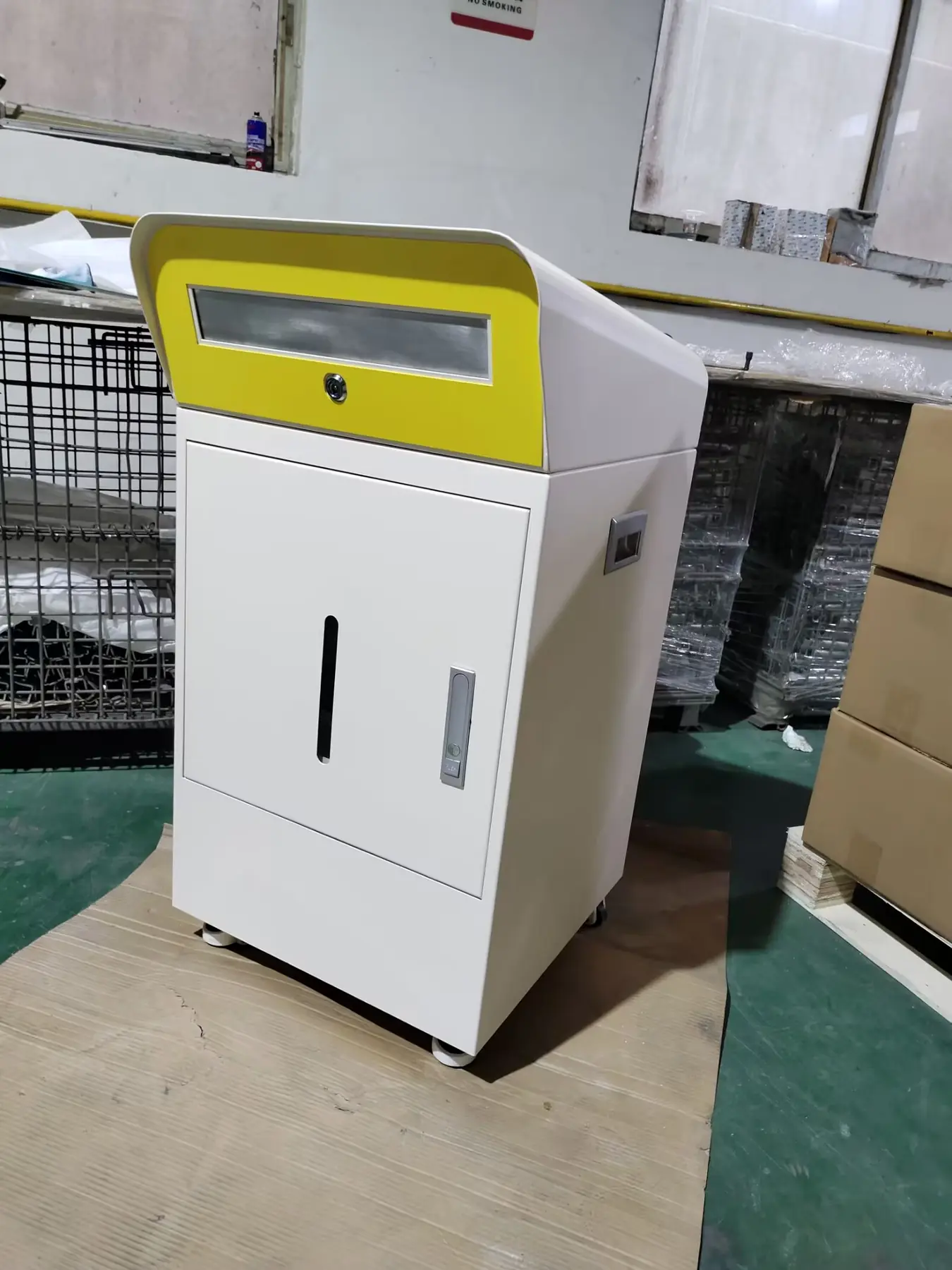
These cabinets are produced in 2.0 mm SUS201 with a powder coating, for mobile book return units used by libraries and schools.
What the Book Return Programme Has Already Fixed
| Product type | Powder-Coated Book Return Cabinets |
|---|---|
| Material and thickness | SUS201, 2.0 mm |
| Surface finish | Powder coating |
| Drawing formats accepted | STEP, DWG, DXF, PDF and SolidWorks |
| Project tolerances | Confirmed against the buyer drawing and manufacturing review |
Application context
What a Book Return Cabinet Has to Survive
A book return cabinet combines visible exterior panels, a lockable service door, a receiving opening, internal support parts and casters. Buyers therefore evaluate more than appearance: door gaps, hardware alignment, smooth movement, assembly access and packaging protection all affect the delivered result.
It is also a piece of public furniture. The cabinet is pushed across a floor several times a day, opened by staff with their hands full, and left where a reader can reach it. That means the caster mounting, the stiffness of the base and the behaviour of the receiving slot matter more to service life than the panel gauge does. A slot that catches book corners generates complaints long after the coating still looks new.
Because the unit is mobile, the base is the first thing to review: caster plate spread, the load path into the cabinet floor, and whether the unit is expected to travel over a threshold or lift.
Engineering review
Decisions That Change the Cost of a Book Return Cabinet
The project review should confirm overall dimensions, receiving-slot geometry, internal collection method, door swing, lock and handle models, caster load, colour reference and assembly responsibility. Panel joints and fastener access must be planned before powder coating. Visible surfaces also need handling protection between finishing, assembly and packing.
Five decisions drive most of the price movement on this product type:
- Receiving slot construction — formed from the panel, or a separate wear strip that can be replaced
- How the interior collects books — a fixed bin, a removable tote, or a chute into a trolley
- Whether the unit is assembled and packed as one cabinet, or flat-packed for final assembly on site
- Hardware sequence: which holes receive inserts before coating and which are masked or tapped after
- Whether the colour is matched to an existing furniture range, which sets the reference and the approval route
Related: DFM engineering review → hardware and PEM insert installation → enclosure assembly service →
Installation Location Decides the Material and Finish
The same cabinet shell goes into an air-conditioned library lobby and into a covered entrance that sees rain blown in from the street. Specifying both the same way is the most common source of coating complaints on this product type, so the drawing should say where the unit will stand before the material is fixed.
| Where it stands | What the design must answer | Typical consequence |
|---|---|---|
| Indoor lobby or reading room | Colour match, scuff resistance, cleaning method | Standard pretreatment and powder coating on the specified substrate is sufficient; cosmetic faces are defined on the drawing. |
| Covered entrance or canopy | Blown rain, damp floor, condensation under the unit | Drainage and a base detail that keeps the cabinet floor off a wet surface; coating system chosen with the buyer. |
| Fully exposed outdoor drive-up | Standing water at the slot, UV exposure, overnight condensation | A weather detail at the receiving opening and a coating system agreed explicitly for outdoor service. |
| Coastal or pool-side site | Salt-laden air, frequent washdown | Substrate and system need to be reviewed together; the buyer states the expected service life and we quote to it. |
We do not issue a durability guarantee by location. The coating system is selected with the buyer against the stated environment, and the acceptance reference is the approved colour sample and the agreed specification on the drawing.
Related: powder coating and surface finishing → surface preparation before coating → surface treatment options for steel →
Manufacturing route
From Flat Blank to Finished Cabinet
- RFQ reviewDrawing, quantity, material, finish, destination and assembly scope. Colour reference and the cosmetic face list are agreed here, because they change how parts are handled downstream.
- First-piece confirmationKey geometry and interfaces checked before batch production: slot opening, door fit, lock and handle cut-outs, caster plate positions and the internal bin or chute.
- Batch manufactureCutting, forming, joining, finishing and assembly as required by the project. Welded joints on cosmetic faces are dressed before coating; hardware holes are confirmed against the insert plan.
- Inspection and export packingDrawing-defined checks, accessory count and transport protection, with the packing list matched to the order.
See the individual operations: bending → welding → thin sheet cutting →
Quality approach
What Is Checked Before Powder Coated Book Return Cabinets Leaves the Shop
The actual production photos show assembly, fit checking and pallet packing. Inspection can include cabinet squareness, door operation, gaps, lock and handle function, caster installation, coating appearance and final accessory count. The approved colour and acceptance sample remain the project reference.
- Cabinet squareness and the gap line around the service door
- Receiving slot opening measured with a representative book, not only with a calliper
- Lock and handle function with the supplied key set, and key coding if the buyer specifies it
- Caster installation: plate fixings, swivel, and brake operation on the braked units
- Coating appearance on the faces defined as cosmetic, checked against the approved sample
- Coating thickness measured against the value stated on the buyer’s drawing
Read our enclosure inspection checklist →
Sheet metal quality inspection service →
Export packaging for metal enclosures →
Packing a Cabinet That Arrives Ready to Place
A book return cabinet is a large, mostly hollow box with a painted finish and protruding hardware. That combination is easy to damage and easy to protect, if the packing is specified early enough to be quoted. Corner protection, a base that keeps casters off the pallet deck, and a decision about whether the unit ships assembled or flat-packed should all be on the RFQ rather than discovered at the loading bay.
- Corner and edge protection on every painted external corner
- Caster support so the load path does not run through the wheels in transit
- Separation between door face and adjacent panels or cartons
- Keys, locks and loose hardware bagged, labelled and counted against the order
- Stack or no-stack instruction printed on the carton for the destination warehouse
Looking at other library units? book return cart → library book cart with wheels → library bookshelf →
Request a project review
Planning a Similar Library Furniture Program?
Send drawings, trial quantity, estimated annual demand, material, finish, assembly scope and destination. We will review the information needed for a practical quotation.
What stands behind this quotation
- Manufacturing since 20162,500 m² Ningbo plant — 3 laser cutting machines (including newer TRUMPF), 4 CNC press brakes and 10 welding stations.
- Shipped to more than 30 export marketsEnclosures, cabinets and formed parts supplied to OEM buyers across Europe, North America and Asia.
- 123 documented product casesMedical device housings, HVAC and heat pump enclosures, agricultural and livestock equipment, industrial hydraulics, material handling trolleys and EV charging cabinets.
- Factory evidence you can checkTUV Rheinland audit reference MIC-ASI243729 and Bureau Veritas reference MIC-ASR263630 available for buyer review under NDA.
Before you send drawings: an NDA is signed on request · first-article inspection is carried out before a batch continues · pricing is staged from prototype quantity to repeat volume · pre-shipment photos and packing records are prepared when the project needs them.