

Library Bookshelf
SKU: FL-LB-003
Heavy-duty library bookshelf, 5 shelves, 200kg load, powder-coated steel.
| Material | SPCC cold-rolled steel (1.0-1.2mm) |
|---|---|
| Manufacturing Process | Laser cutting + bending + welding + powder coating |
| Surface Finish | Powder coating (white RAL 9016 standard) |
| Tolerance | ±0.5mm |
| Dimensions | 900×300×2000mm |
| Shelves | 5 (adjustable) |
| Load | 200kg |
| Color | White/grey/beech |
| MOQ | 50 units |
| Lead Time | Quoted after drawing review and process confirmation |
| Sample Time | Quoted after drawing review and process confirmation |
| Sample Fee | USD 200 |
| Price Range | USD 110-180/unit |
| Applications | Libraries, schools, offices |
| Compliance | BIFMA, EN 16121 |
| Export Markets | USA, Germany, Korea, Japan |
How This Library Bookshelf Is Fabricated and Checked
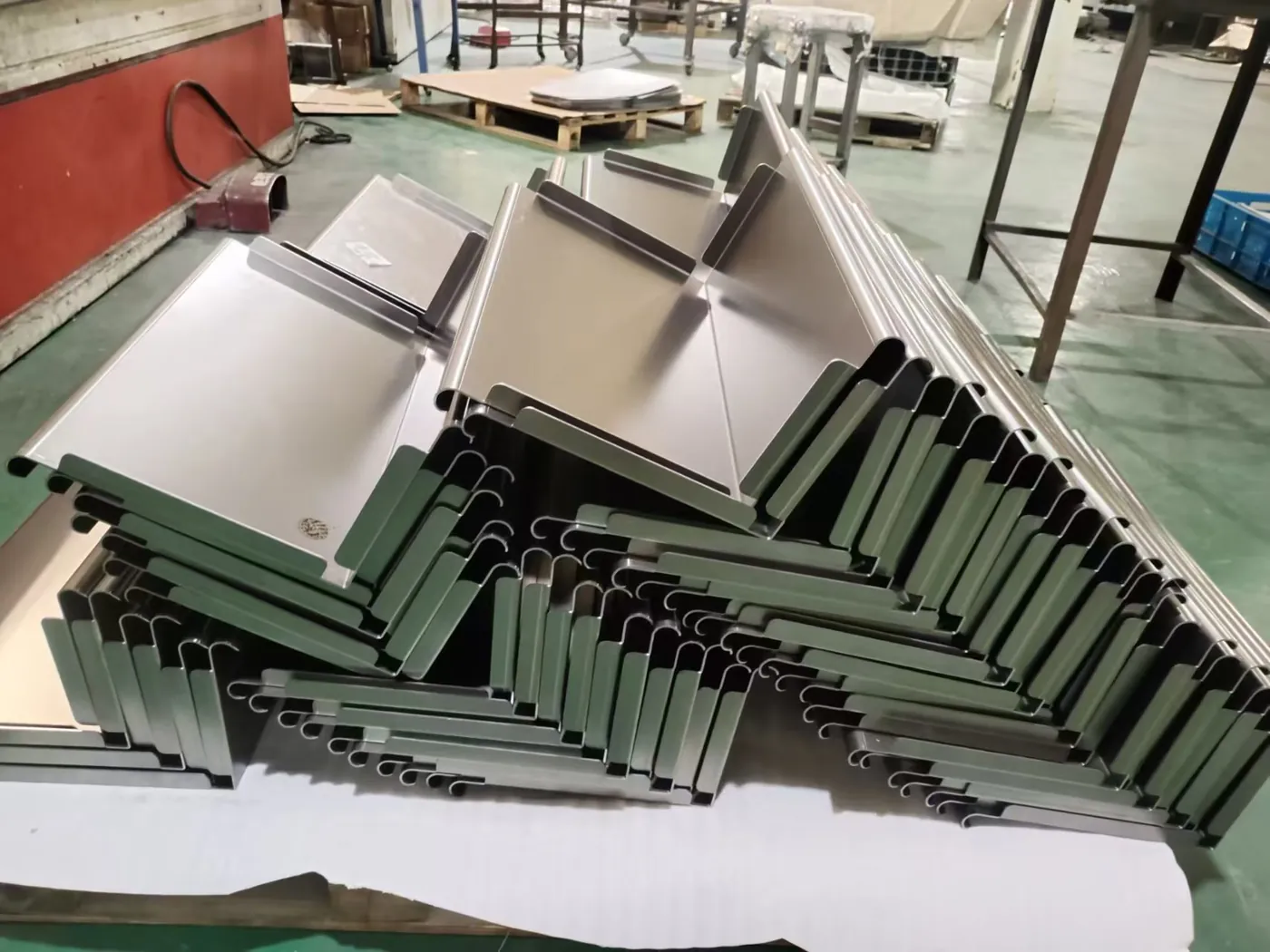
A bookshelf is judged on three things: whether the shelves stay level under load, whether the unit stands plumb against a wall, and whether the shelf height can still be changed once the shelves are loaded.
| Stage | What happens | What is verified before the job moves on |
|---|---|---|
| Panel and shelf forming | Side panels, top, base and shelf panels laser cut and formed, with shelf edges folded | Panel square and shelf flatness. A shelf that bows under load shows as a gap along the front edge, which is the first thing seen in a reading room |
| Shelf stiffening | The edge fold deepened or a stiffener added to suit the span and the load | Fold depth against the span. A shelf rigid at 600 mm is not rigid at 900 mm on the same sheet |
| Frame welding and squaring | Carcass welded or mechanically joined to the design | Diagonals, overall square, and that the unit stands without rocking on its adjusters |
| Shelf support provision | Support holes or brackets made at the adjustment pitch | Pitch consistency along the height. If one position drifts, that shelf cannot sit level with its neighbours |
| Back panel fit | Back panel fitted and squared to the carcass | That the back panel squares the unit rather than bowing it, since the back is what holds a tall shelving unit in shape |
| Surface preparation and coating | Degrease, phosphate, then powder coat to the agreed colour | Film thickness and colour, plus coverage on the shelf front edges, which are handled most |
| Assembly and load check | Unit assembled, shelves fitted and loaded; packed | That shelves sit level under the intended load and the unit does not rock, then the packed unit against its specification |
Revisions That Skip New Tooling on Library Bookshelf
A shelving unit is customised through its spans and its shelf pitch, and those two decide almost everything else.
| What can be changed | What it affects | What it does not affect |
|---|---|---|
| Height, width and depth | Panel sizes, shelf span, stiffening and the packing | The shelf adjustment pitch, provided the support positions stay |
| Number of shelves and their pitch | Support hole positions and the number of forming operations | The carcass |
| Shelf load | Shelf thickness, edge fold depth and whether a stiffener is needed | The coating process |
| Fixed or adjustable shelves | Whether support holes or welded brackets are used | The panel geometry |
| Back panel: solid, perforated or open | Appearance, airflow and whether the unit is freestanding or against a wall | The shelves |
| Colour and finish | Powder specification, and whether shelves are colour-coded by section | Nothing structural |
Questions Buyers Ask About Library Bookshelf
How much does one shelf hold?
It depends on the span as much as on the sheet. The same 1.0 mm shelf that is rigid at 600 mm will sag at 900 mm unless the edge fold is deepened or a stiffener is added. Give us the load and the span together and the shelf is sized to both, rather than quoting a shelf rating on its own.
Why does the adjustment pitch have to be consistent?
Because if one shelf position is out, that shelf cannot be set level with the others, and the error is visible from across the room. The pitch comes from the tooling so it repeats; what has to be controlled is that it does not drift along the height.
Can we have a different back panel?
Yes, and it changes what the unit is for. A solid back suits a wall unit, a perforated back suits shelving where airflow or visibility matters, and an open back suits a freestanding island. It is a decision to make before the panels are cut, not after.
Shelf span and shelf pitch are what makes a shelving unit fit for a room, and both are set at the cutting stage. Send the room dimensions and the load through the RFQ form and the shelf is sized to them. Related: CNC bending, surface finishing and the inspection checklist.
Shelf Deflection and the Case for Anti-Tip Fixing
A library bookshelf rated at 200 kg over five adjustable shelves is carrying roughly 40 kg per shelf, and 40 kg of books on a 900 mm span in 1.0 to 1.2 mm steel will show a visible sag unless the shelf is formed to resist it. The usual solution is a folded front edge and a return at the back, which turns a flat sheet into a shallow channel and increases stiffness several times over for very little extra material. Flat shelves are the single most common reason a bookshelf looks tired after a year.
- Adjustable shelves need a consistent hole pitch and a clip or support that does not work loose when a shelf is loaded and unloaded repeatedly.
- At 2000 mm high and 300 mm deep, the unit has to be fixed to the wall or to its neighbours. A free-standing shelf of that proportion with a child pulling on it is an overturning risk, and restraint is a design requirement rather than an installation preference.
- White RAL 9016 is standard because it keeps a reading space bright; grey and a beech-effect finish are common alternatives where the scheme calls for it.
Why Depth and Pitch Are Library Decisions, Not Product Ones
Shelf depth of 300 mm suits paperbacks and standard octavo books. It does not suit oversize art books, and it wastes space for paperbacks. Shelf pitch – the vertical spacing – is decided by what the library actually holds. A shelf unit that is right for a school library is wrong for a law library, and the difference is the pitch, not the frame. We build to the pitch the drawing specifies and we ask what the collection is, because it is the one question that changes the product.
Units are usually installed in rows, which means the end panels and the way adjacent units join matter more than the individual unit. If your layout runs units together, tell us whether they share an end panel or butt up, because that changes the component count and the cost. Lead time is quoted after drawing review and process confirmation.
Need a Similar Part?
Most enquiries that start on a page like this are not an order for Library Bookshelf — they are a search for a factory that can make something like it. Send us your drawing, 3D model or sample and we will review the manufacturing process and the quotation requirements, then come back with a process plan, a price and a lead time.
We work from 2D drawings, STEP / DWG / DXF / PDF files, or a physical sample if that is all you have.
No complete drawings yet? Describe the part, send photos or a sketch, or send a sample — we can start from there. Discuss your project.
Payment Terms
How a project is paid for is agreed before production starts, and the structure that applies to your order is stated on the quotation and on the order confirmation, so there is no ambiguity later.
- 30% advance payment with the order and the 70% balance before shipment — our standard structure.
- 70% advance payment with the order and the 30% balance before shipment — used for some projects.
- 100% payment in advance before production starts — used for some projects.
If your finance team works to a fixed structure, say so in the first enquiry and we will confirm what applies to your order before you commit. Request a quotation.
Questions buyers ask before sending drawings
The questions that come up most often before a project starts, answered the way we answer them by email.
What do you need from me to quote Library Bookshelf?
2D drawings as PDF, DWG or DXF, or 3D files as STEP, IGES or SolidWorks, together with material grade, sheet thickness, surface finish, quantity and destination country. If the drawing is not finished yet, send a photo, a sketch or the existing part instead — we review what can be measured from it and reply with the questions that still need answering.
How long does a quotation take?
Enquiries are answered within one business day. Simple laser-cut and bent parts are quoted within 24 hours. Welded frames, assembled units and multi-part structures are quoted after the drawing review and process confirmation, and the date is confirmed in our reply.
Is there a minimum order quantity?
Prototypes are made from a single piece and small batches of 10–50 pieces are routine. Prototype, first batch and repeat volume are quoted together so the numbers stay consistent as the project scales.
Can you work from a sample or a photo if I have no drawing?
Yes. Send the part itself, clear photographs with a rule or caliper in frame, or a dimensioned sketch. We measure what can be measured, list what is still undefined, and confirm it with you before production.
Trade Terms and Delivery
We quote under the standard Incoterms your logistics team already works with, and build the packing and documentation around the one you choose.
- EXW — you collect from our Ningbo facility and run export clearance through your own forwarder.
- FOB Ningbo — we deliver to the vessel at Ningbo port and handle export clearance.
- CIF — we cover carriage and insurance to your named destination port.
- DDP — we handle carriage, insurance, import clearance and duties through to your door.
Send your destination country, target delivery date and preferred trade term together with the drawing. Request a quotation.
Quotation Time
We quote from your drawings. How long that takes depends on what the part asks for:
- Simple parts — quoted within 24 hours. Laser-cut blanks and bent components, supplied with complete 2D or 3D drawings. Mon–Fri, GMT+8.
- Complex assemblies — quoted after the drawing review. Payment kiosks, multi-part welded frames, enclosures with purchased hardware, or anything needing a coating or assembly trial. We confirm a quotation date once the scope is clear.
Production lead time is quoted separately, after drawing review and process confirmation. Send your drawings.
What stands behind this quotation
- Manufacturing since 20162,500 m² Ningbo plant — 3 laser cutting machines (including newer TRUMPF), 4 CNC press brakes and 10 welding stations.
- Shipped to more than 30 export marketsEnclosures, cabinets and formed parts supplied to OEM buyers across Europe, North America and Asia.
- 123 documented product casesMedical device housings, HVAC and heat pump enclosures, agricultural and livestock equipment, industrial hydraulics, material handling trolleys and EV charging cabinets.
- Factory evidence you can checkTUV Rheinland audit reference MIC-ASI243729 and Bureau Veritas reference MIC-ASR263630 available for buyer review under NDA.
Before you send drawings: an NDA is signed on request · first-article inspection is carried out before a batch continues · pricing is staged from prototype quantity to repeat volume · pre-shipment photos and packing records are prepared when the project needs them.