


Goat Fence Panel
SKU: FL-LF-010
Tight-mesh goat fence panel, prevents head entrapment. 1.5m wide, 1.2m tall.
| Material | Galvanized steel (Q235, square tube 30×30×1.5mm) |
|---|---|
| Manufacturing Process | Tube welding + hot-dip galvanizing |
| Surface Finish | Hot-dip galvanized |
| Tolerance | ±2mm |
| Dimensions | 1500×1200mm |
| Mesh openings | 100×50mm |
| Vertical bars | 8 pcs |
| Frame | 30×30mm square tube |
| MOQ | 100 panels |
| Lead Time | Quoted after drawing review and process confirmation |
| Sample Time | Quoted after drawing review and process confirmation |
| Sample Fee | USD 150 |
| Price Range | USD 50-70/panel |
| Applications | Goat farms, dairy goats, sheep farms |
| Compliance | ISO 1461 |
| Export Markets | USA, Australia, Spain |
How This Goat Fence Panel Is Fabricated and Checked
A goat panel is a fence panel with one difference: goats climb and rub. The panel has to take side and downward loads, which means the infill fixing and the corner joints matter more than on a cattle panel.
| Stage | What happens | What is verified before the job moves on |
|---|---|---|
| Tube cutting | 30 x 30 mm square tube cut to length for the frame and members | Cut length and end squareness. The tube is smaller than on a cattle panel, so a length error is a larger proportion of the frame |
| Frame welding and squaring | Frame welded in a fixture with the diagonals held | Diagonals and overall size. A panel that is out of square will not line up with the next one in a run |
| Infill fixing | Bars or mesh fixed to the frame at the design pitch | The fixing point at every intersection rather than only at the ends, because a goat leaning on the middle of the infill loads the fixing, not the frame |
| Corner and joint reinforcement | Corner joints reinforced or gusseted where the design calls for it | That the corners can take a side load. Corners are where a panel bent by an animal shows first |
| Drain and vent provision | Holes drilled in closed sections before dipping | Hole positions, so the tube is coated inside and the bath drains |
| Hot-dip galvanising | The panel is dipped, drained and cooled | Zinc thickness and drain condition |
| Post-galvanising check and packing | Panels checked for square and stacked with spacers | That the panels still line up after dipping, and that they are not stacked wet |
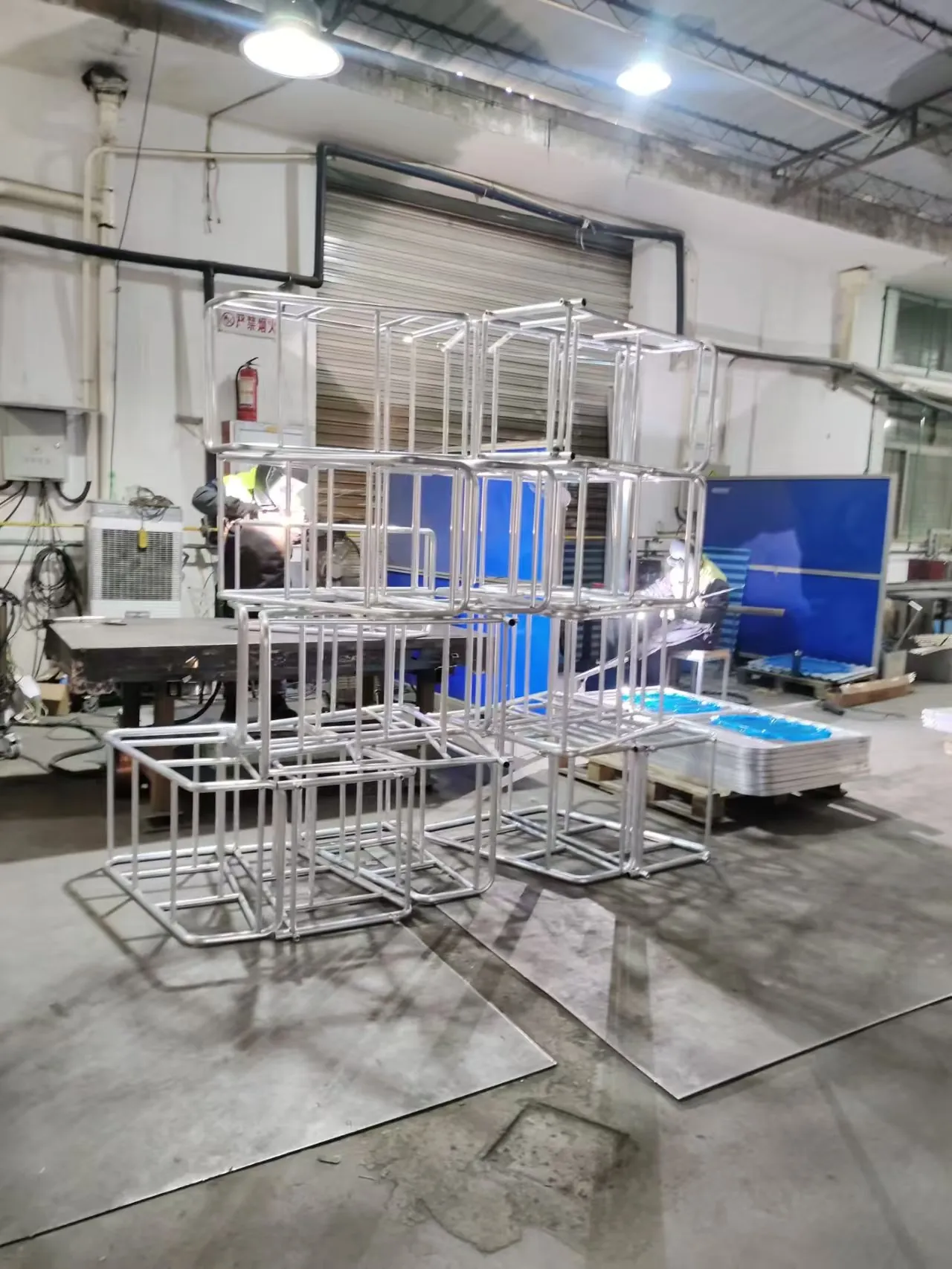
Changes Goat Fence Panel Can Absorb Without New Tooling
Height, infill and how the panels join are the decisions that matter in a run.
| What can be changed | What it affects | What it does not affect |
|---|---|---|
| Height, length and member spacing | Tube lengths, member count and the packing | The tube section |
| Infill: bars, mesh or sheet | What it keeps in, and how much an animal can lean on it | The frame |
| Panel-to-panel connection | How the run is aligned and whether it can be reconfigured | The panel geometry |
| Finish: galvanised as standard | Life in a wet, abrasive environment | Nothing structural |
| Corner post or free-standing end | What the end of the run fixes to | The panel itself |
| Bundling and packing | How the panels are handled and stored on site | The panel |
FAQ on Goat Fence Panel
Why does the infill fixing matter more on a goat panel?
Because a goat leans and climbs rather than just pushing. That puts the load into the middle of the infill and into the fixing points along it, not only into the frame members. Fixing the infill only at its ends is the common shortcut, and it is what gives way first.
What spacing suits goats?
It follows the age and the breed, and a gap that a kid can put its head through but not withdraw is the usual problem. Give us the animal and the purpose – holding, sorting or exclusion – and the spacing is set to that rather than to a standard panel.
Can the panels be made to match a run we already have?
Yes, and the dimensions that have to match are the panel size, the tube section and the joining detail. Send a drawing or a sample of the existing panel and the new ones are made to the same footprint so they can be used in the same run.
Infill fixing and corner strength are what make a panel survive goats. Send the animal, the run length and the joining method through the RFQ form and the panel is made to them. Related: welding, surface finishing and quality inspection.
Why Goat Fencing Is Built Differently From Sheep Fencing
Goats climb, push and test. A fence panel that holds sheep will often lose to goats, because the load is not a steady lean – it is an animal standing on the lower rail with its front feet up the mesh, plus repeated pushing at the same spot. That is why the frame section and the mesh attachment matter more than the wire gauge. On a 30 x 30 mm square tube frame with 100 x 50 mm openings, the joints between mesh and frame are the failure point, and they have to be welded rather than clipped if the panel is going to be leaned on year after year.
- Hot-dip galvanizing after welding is the right sequence here: the coating covers the welds too, so the joints that get tested are the joints that are protected.
- Mesh opening size is a containment decision. 100 x 50 mm suits adult goats; a smaller opening is needed for kids, and it costs more in welding time.
- Panels are handled by the frame, so the frame is what takes the knocks during installation. A lighter frame saves money once and costs a panel every season.
Galvanizing, Handling and Service Life
Hot-dip galvanizing gives a coating that is thicker at the corners and edges – the places that corrode first – which is why it suits a welded tube frame better than a paint finish does. The trade-off is that galvanizing is a batch process with a size limit, so panel dimensions have to fit the bath. At 1500 x 1200 mm that is not a constraint; if your layout needs a longer panel we discuss it before quoting.
Sharp ends are the other thing worth specifying. Cut tube ends and weld spatter on a livestock panel are an injury risk to the animals and to whoever installs it. We deburr and grind the welds as a standard step, and the finished panel has no open tube ends. Send the panel size, the opening you need and the quantity; lead time is quoted after drawing review and process confirmation.
Payment Terms
How a project is paid for is agreed before production starts, and the structure that applies to your order is stated on the quotation and on the order confirmation, so there is no ambiguity later.
- 30% advance payment with the order and the 70% balance before shipment — our standard structure.
- 70% advance payment with the order and the 30% balance before shipment — used for some projects.
- 100% payment in advance before production starts — used for some projects.
If your finance team works to a fixed structure, say so in the first enquiry and we will confirm what applies to your order before you commit. Request a quotation.
Questions buyers ask before sending drawings
The questions that come up most often before a project starts, answered the way we answer them by email.
What do you need from me to quote Goat Fence Panel?
2D drawings as PDF, DWG or DXF, or 3D files as STEP, IGES or SolidWorks, together with material grade, sheet thickness, surface finish, quantity and destination country. If the drawing is not finished yet, send a photo, a sketch or the existing part instead — we review what can be measured from it and reply with the questions that still need answering.
How long does a quotation take?
Enquiries are answered within one business day. Simple laser-cut and bent parts are quoted within 24 hours. Welded frames, assembled units and multi-part structures are quoted after the drawing review and process confirmation, and the date is confirmed in our reply.
Is there a minimum order quantity?
Prototypes are made from a single piece and small batches of 10–50 pieces are routine. Prototype, first batch and repeat volume are quoted together so the numbers stay consistent as the project scales.
Can you work from a sample or a photo if I have no drawing?
Yes. Send the part itself, clear photographs with a rule or caliper in frame, or a dimensioned sketch. We measure what can be measured, list what is still undefined, and confirm it with you before production.
Need a Similar Part?
Most enquiries that start on a page like this are not an order for Goat Fence Panel — they are a search for a factory that can make something like it. Send us your drawing, 3D model or sample and we will review the manufacturing process and the quotation requirements, then come back with a process plan, a price and a lead time.
We work from 2D drawings, STEP / DWG / DXF / PDF files, or a physical sample if that is all you have.
No complete drawings yet? Describe the part, send photos or a sketch, or send a sample — we can start from there. Discuss your project.
Trade Terms and Delivery
We quote under the standard Incoterms your logistics team already works with, and build the packing and documentation around the one you choose.
- EXW — you collect from our Ningbo facility and run export clearance through your own forwarder.
- FOB Ningbo — we deliver to the vessel at Ningbo port and handle export clearance.
- CIF — we cover carriage and insurance to your named destination port.
- DDP — we handle carriage, insurance, import clearance and duties through to your door.
Send your destination country, target delivery date and preferred trade term together with the drawing. Request a quotation.
Quotation Time
We quote from your drawings. How long that takes depends on what the part asks for:
- Simple parts — quoted within 24 hours. Laser-cut blanks and bent components, supplied with complete 2D or 3D drawings. Mon–Fri, GMT+8.
- Complex assemblies — quoted after the drawing review. Payment kiosks, multi-part welded frames, enclosures with purchased hardware, or anything needing a coating or assembly trial. We confirm a quotation date once the scope is clear.
Production lead time is quoted separately, after drawing review and process confirmation. Send your drawings.
What stands behind this quotation
- Manufacturing since 20162,500 m² Ningbo plant — 3 laser cutting machines (including newer TRUMPF), 4 CNC press brakes and 10 welding stations.
- Shipped to more than 30 export marketsEnclosures, cabinets and formed parts supplied to OEM buyers across Europe, North America and Asia.
- 123 documented product casesMedical device housings, HVAC and heat pump enclosures, agricultural and livestock equipment, industrial hydraulics, material handling trolleys and EV charging cabinets.
- Factory evidence you can checkTUV Rheinland audit reference MIC-ASI243729 and Bureau Veritas reference MIC-ASR263630 available for buyer review under NDA.
Before you send drawings: an NDA is signed on request · first-article inspection is carried out before a batch continues · pricing is staged from prototype quantity to repeat volume · pre-shipment photos and packing records are prepared when the project needs them.