
Repeat production program
SUS304 Electrical Distribution Boxes for OEM Programs
These structures are produced in 1.2 mm SUS304 with a natural stainless steel finish, for industrial electrical distribution box applications.
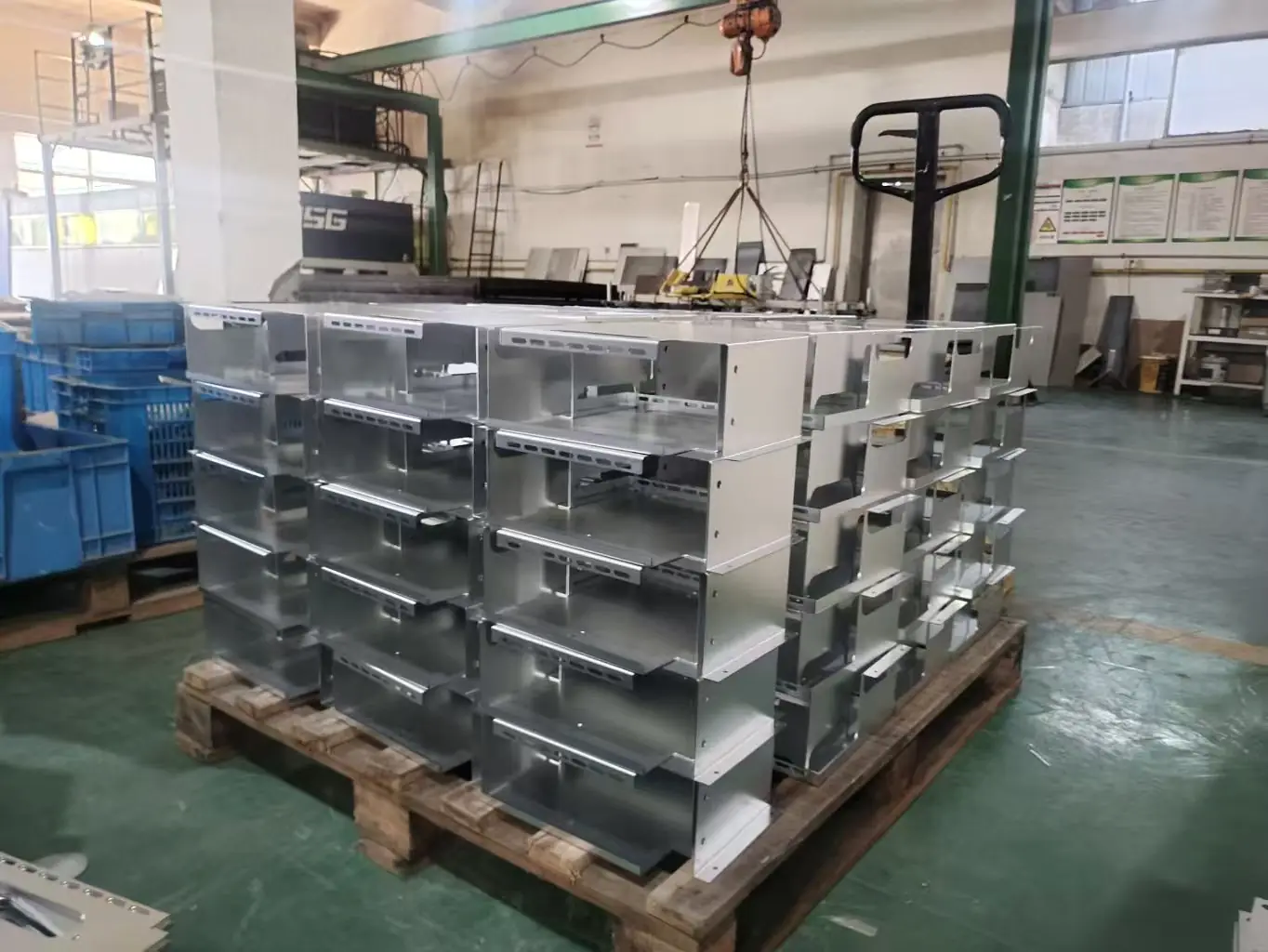
What the Distribution Box Programme Has Already Fixed
| Product type | Stainless Steel Distribution Boxes |
|---|---|
| Material and thickness | SUS304, 1.2 mm |
| Surface finish | Natural stainless steel |
| Drawing formats accepted | STEP, DWG, DXF, PDF and SolidWorks |
| Project tolerances | Confirmed against the buyer drawing and manufacturing review |
Application context
Where 1.2 mm SUS304 Distribution Boxes Are Used
The factory photograph shows fabricated box bodies arranged on a pallet during production. For electrical equipment, enclosure value comes from repeatable openings, mounting interfaces, bend geometry and assembly fit. The metal body must support the buyer’s electrical design without creating extra fitting work on the assembly line.
Stainless is usually specified where the box will be washed down, mounted outdoors near the coast, or installed in food, pharmaceutical or water-treatment areas where a painted surface would chip and rust first at the cut edges and folds. In a dry indoor switchroom, painted carbon steel is normally the cheaper route; SUS304 earns its cost when corrosion resistance and cleanability are written into the product specification rather than added as an afterthought.
The installation environment changes the drawing more than the material grade does. An outdoor box needs a door seal, a sloping top or rain shield, and drainage thought at the cable entry. An indoor box mostly needs clean edges, a consistent mounting pattern and a door that closes without forcing.
Engineering review
What to Fix on the Drawing Before Quotation
Before quotation, the buyer should identify enclosure size, mounting pattern, cable entry, ventilation, door or cover construction, hardware, grounding points and any critical component clearances. The fabrication drawing should also state which edges, faces and holes control electrical assembly.
These are the items that most often come back as clarification requests after a first RFQ:
- Envelope dimensions, door swing direction, and the side the box is serviced from
- Cable entry method — knockouts, a removable gland plate, or a cut-out list with positions
- Earthing provision — stud size, weld position, and whether the door needs a bonding strap
- Hinge, latch and lock models, or the cut-out dimensions if the buyer supplies hardware
- Mounting pattern for the back plate, DIN rail or sub-panel, and the load it must carry
- Surface acceptance — brush direction, weld finish level, and which faces are cosmetic
Certification of the completed electrical product remains with the responsible equipment or panel builder unless separately agreed. We supply the enclosure to the drawing and to the agreed material evidence; the assembly is then certified by whoever places it on the market.
Choosing Thickness and Stiffness for a Stainless Enclosure
Thickness is the first decision that moves both price and stiffness. In the 1.0–2.0 mm band that most distribution boxes are built from, moving from 1.2 mm to 1.5 mm adds about a quarter more material in the shell, but it noticeably reduces door flex and the oil-canning you can see on a wide face when a latch is pulled up. If the door carries hardware, or the box is wider than roughly 800 mm, the thicker sheet is usually the cheaper outcome once assembly complaints are counted.
| Sheet thickness | Typical box envelope | What changes in practice |
|---|---|---|
| 1.0 mm | Small boxes, longest side up to about 400 mm | Lightest option. Wide faces need a return flange or stiffener, or they flex when handled. |
| 1.2 mm | Boxes up to roughly 600–800 mm | The common choice for wall-mounted distribution boxes. Holds flat with a single return flange. |
| 1.5 mm | 800–1,000 mm enclosures | Less door flex and hinge sag. Worth it when the door carries a latch, lock or instrument cut-outs. |
| 2.0 mm | Floor-standing or heavily loaded cabinets | Used when a back plate, transformer or battery pack transfers load into the shell itself. |
These bands are practical starting points from our own production, not a substitute for the buyer’s structural calculation. Where the enclosure carries a defined load, we work from the buyer’s drawing and confirm the section at first-piece sampling rather than guessing at it.
Related: sheet metal DFM engineering review → cable entry gland plates → PEM hardware installation →
Manufacturing route
How a Distribution Box Is Built, Step by Step
- RFQ reviewDrawing, quantity, material, finish, destination and assembly scope. For stainless programs the sheet source and surface direction are agreed before cutting, because a replacement sheet from another batch can shift the brush grain.
- First-piece confirmationKey geometry and interfaces checked before batch production: door opening, hinge and latch positions, cable entry cut-outs, earthing stud location and the back-plate mounting pattern.
- Batch manufactureCutting, forming, joining, finishing and assembly as required by the project. Cut edges are deburred before bending, and stainless is formed on tooling kept separate from carbon steel so iron particles are not pressed into the surface.
- Inspection and export packingDrawing-defined checks, accessory count and transport protection, with the packing list matched to the order.
See the individual operations: laser cutting → bending → TIG welding on thin sheet →
Quality approach
Checks Before a SUS304 Electrical Distribution Boxes Batch Leaves
Inspection is based on the approved drawing and project requirements. Typical checks cover material, first-piece dimensions, bend and opening locations, edge condition, hardware fit, enclosure alignment and packing count. Natural stainless surfaces are handled to limit unnecessary scratching, but the required cosmetic acceptance level should be defined by the buyer.
- Material identification and thickness against the drawing
- First-piece dimensions on everything that controls assembly — mounting pattern, door opening, cut-out positions
- Door operation and gap consistency across the batch, not just on the sample
- Hardware fit: hinge swing, latch engagement, earthing stud position
- Surface condition on the faces the buyer has called cosmetic
- Accessory count and packing list against the order
Read our enclosure inspection checklist →
How first-article inspection is recorded →
Sheet metal quality inspection service →
Protecting Stainless Surfaces Through Assembly and Export
Stainless is rarely damaged in the bending cell. It is damaged afterwards: at hardware installation, during assembly, and above all in transit. A box that looked right on the bench can arrive with rub marks on the door face because two panels were stacked face to face for a three-week voyage. The packing method is part of the product specification, not a logistics afterthought.
- Panels separated by interleaving rather than stacked face to face
- Edge protectors on formed returns and door edges
- No carbon-steel strapping or staples in contact with the box
- Pallet orientation agreed so doors are never load-bearing in transit
- Moisture barrier for sea freight, with the container stuffing method recorded on the packing list
Export packaging for metal enclosures → Material certification and traceability →
Request a project review
Planning a Similar Stainless Enclosure Program?
Send drawings, trial quantity, estimated annual demand, material, finish, assembly scope and destination. We will review the information needed for a practical quotation.
Choosing Between 1.0, 1.2 and 1.5 mm on a Stainless Enclosure
The thickness table on this page gives a starting envelope, and the real decision is stiffness rather than strength. A 1.2 mm door on a 600 mm box will flex when it is pushed, and a door that flexes does not hold its seal evenly. The fix is rarely a thicker sheet – it is a fold, a return, or a stiffener, all of which add stiffness for far less weight and cost than going up a thickness. Thickness is the expensive way to buy stiffness and it is usually the last thing to reach for.
- A door is a flat panel with a free edge. A return along that edge does more for it than half a millimetre of material.
- The back panel carries the mounting load of everything inside. It is the face most likely to need local reinforcement rather than a thicker sheet overall.
- Weight matters on a wall-mounted enclosure. Going up a thickness on a box that hangs on a wall costs you in the fixing as well as in the material.
Keeping a Natural Stainless Finish Clean Through Fabrication and Packing
A natural stainless finish means there is no coating to hide anything: every handling mark, every roller mark and every bit of weld tint is visible on the finished part, and on a distribution box those are on the faces customers see first. Most of the work is therefore not in the finishing operation, it is in not damaging the surface before you get there. Material arrives with a protective film and it stays on through cutting and bending, and it comes off as late as possible.
Weld tint is the other one. It is an oxide with different corrosion behaviour from the surrounding surface, and on a part specified as natural stainless it is a defect rather than a cosmetic issue, so it is removed rather than polished over. For export, the parts are separated in the pack – stainless on stainless contact under vibration in transit marks the surface, and it is the most common complaint on a product that left the workshop looking perfect. Lead time is quoted after drawing review and process confirmation.
Need a Similar Part?
Most enquiries that start on a page like this are not an order for SUS304 Electrical Distribution Boxes for OEM Programs — they are a search for a factory that can make something like it. Send us your drawing, 3D model or sample and we will review the manufacturing process and the quotation requirements, then come back with a process plan, a price and a lead time.
We work from 2D drawings, STEP / DWG / DXF / PDF files, or a physical sample if that is all you have.
No complete drawings yet? Describe the part, send photos or a sketch, or send a sample — we can start from there. Discuss your project.
Trade Terms and Delivery
We quote under the standard Incoterms your logistics team already works with, and build the packing and documentation around the one you choose.
- EXW — you collect from our Ningbo facility and run export clearance through your own forwarder.
- FOB Ningbo — we deliver to the vessel at Ningbo port and handle export clearance.
- CIF — we cover carriage and insurance to your named destination port.
- DDP — we handle carriage, insurance, import clearance and duties through to your door.
Send your destination country, target delivery date and preferred trade term together with the drawing. Request a quotation.
Payment Terms
How a project is paid for is agreed before production starts, and the structure that applies to your order is stated on the quotation and on the order confirmation, so there is no ambiguity later.
- 30% advance payment with the order and the 70% balance before shipment — our standard structure.
- 70% advance payment with the order and the 30% balance before shipment — used for some projects.
- 100% payment in advance before production starts — used for some projects.
If your finance team works to a fixed structure, say so in the first enquiry and we will confirm what applies to your order before you commit. Request a quotation.
Quotation Time
We quote from your drawings. How long that takes depends on what the part asks for:
- Simple parts — quoted within 24 hours. Laser-cut blanks and bent components, supplied with complete 2D or 3D drawings. Mon–Fri, GMT+8.
- Complex assemblies — quoted after the drawing review. Payment kiosks, multi-part welded frames, enclosures with purchased hardware, or anything needing a coating or assembly trial. We confirm a quotation date once the scope is clear.
Production lead time is quoted separately, after drawing review and process confirmation. Send your drawings.
What stands behind this quotation
- Manufacturing since 20162,500 m² Ningbo plant — 3 laser cutting machines (including newer TRUMPF), 4 CNC press brakes and 10 welding stations.
- Shipped to more than 30 export marketsEnclosures, cabinets and formed parts supplied to OEM buyers across Europe, North America and Asia.
- 123 documented product casesMedical device housings, HVAC and heat pump enclosures, agricultural and livestock equipment, industrial hydraulics, material handling trolleys and EV charging cabinets.
- Factory evidence you can checkTUV Rheinland audit reference MIC-ASI243729 and Bureau Veritas reference MIC-ASR263630 available for buyer review on request.
Before you send drawings: project confidentiality is default · first-article inspection is carried out before a batch continues · pricing is staged from prototype quantity to repeat volume · pre-shipment photos and packing records are prepared when the project needs them.