
Repeat production program
Aluminum 6061 Livestock Barrier Panels for OEM Programs
These panels are produced in 1.2 mm aluminum 6061 with a natural finish, for livestock separation and animal barrier applications.
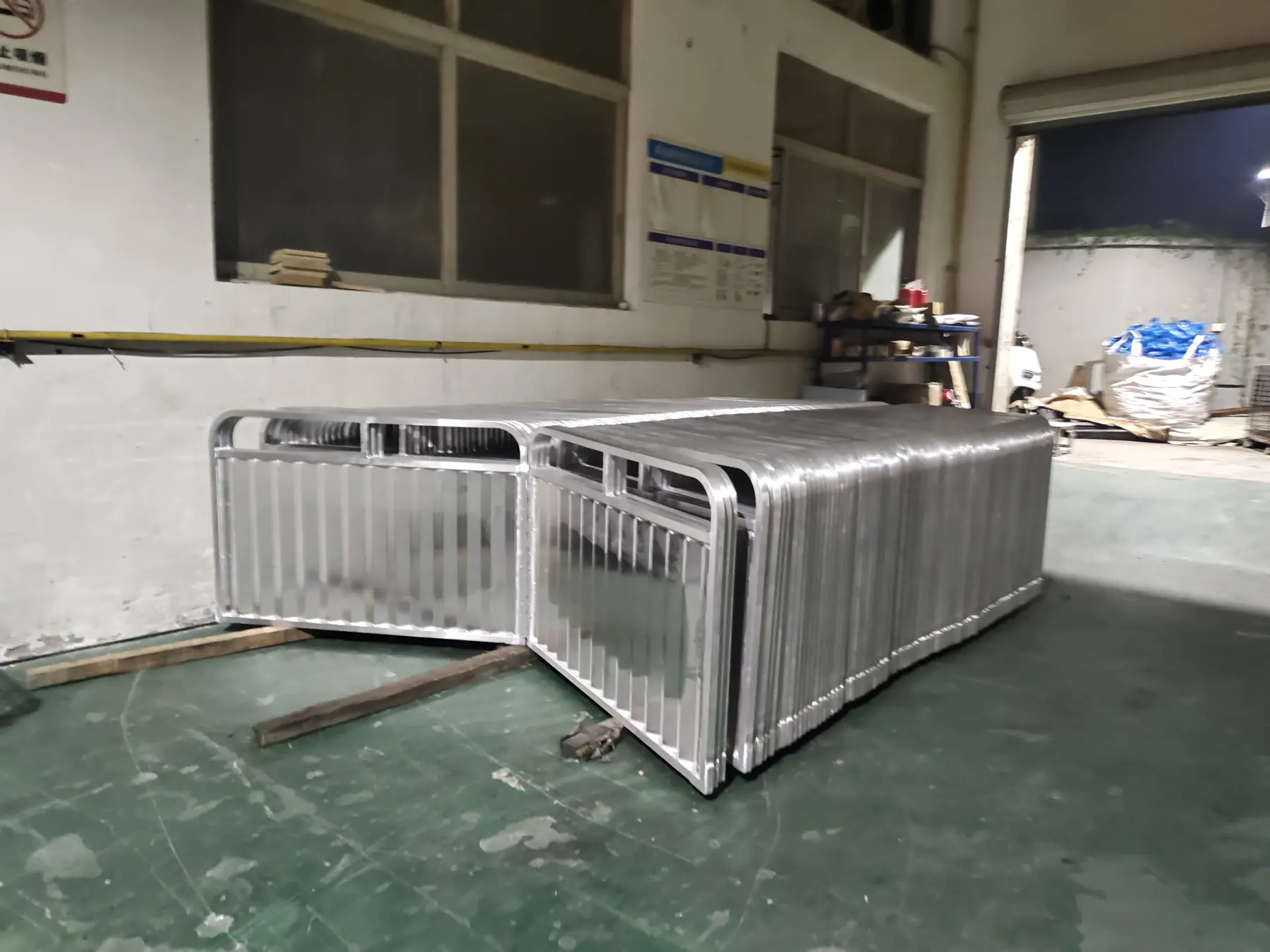
What the Barrier Panel Programme Has Already Fixed
| Product type | Aluminum Livestock Barrier Panels |
|---|---|
| Material and thickness | Aluminum 6061, 1.2 mm |
| Surface finish | Natural aluminum |
| Drawing formats accepted | STEP, DWG, DXF, PDF and SolidWorks |
| Project tolerances | Confirmed against the buyer drawing and manufacturing review |
Application context
What Livestock Barrier Panels Have to Survive
The panels are intended for repeated use in livestock systems where low weight, corrosion behaviour, safe handling and consistent interfaces matter. The factory photograph shows a batch of formed aluminum frames, providing direct evidence of repeat production rather than a catalogue rendering.
Aluminum is chosen here for two reasons that have nothing to do with appearance. First, a panel a worker carries and re-hangs several times a day is a weight problem before it is a strength problem. Second, a barrier that is washed, stands in damp bedding and sees manure does not forgive a scratched galvanised surface, and bare aluminum does not rust red at the scratch.
The trade-off is that the same alloy is far less tolerant of a tight fold than mild steel is. That is the reason the bend detail, not the panel size, is usually where the design review lands.
Engineering review
Design Points That Decide Whether a Panel Holds Up
Aluminum geometry should be reviewed before production because bend direction, inside radius, hole placement and joining access influence cracking and distortion risk. Large open frames also need a practical plan for handling and stacking so finished parts are not twisted before assembly. Final design limits depend on the selected alloy condition, thickness, tooling and drawing requirements.
- Alloy condition on the drawing — 6061 in the T6 condition tears far more readily at a tight inside radius than in the annealed condition, and the difference should be settled before cutting
- Bend direction relative to the roll direction of the sheet
- Inside radius at every fold, reviewed against the alloy condition rather than copied from a steel drawing
- Hole pattern for pins, clips and hinge hardware, and the tolerance that keeps panels interchangeable
- Welded versus mechanically joined corners, and how the joint is dressed after welding
- How the panel is lifted, stacked and stored before it reaches the installer
Related: laser cutting aluminium sheet metal → DFM engineering review →
Where the Panel Is Used Decides the Detail
A barrier panel for a holding pen and a panel for a loading race look similar on a drawing and behave very differently in service. Animal pressure, impact frequency and cleaning method each push the design in a different direction, so the drawing should say which job the panel is for.
| Where the panel works | What the design must answer | Typical consequence |
|---|---|---|
| Holding pen or alleyway | Sustained animal pressure at rail height; rail spacing | Top rail stiffness and the joint at the post matter more than panel gauge. |
| Loading ramp or race | Repeated impact from animals turning and balking | Joint strength and a slip-resistant surface take priority; corners are reviewed as impact points. |
| Portable or temporary yard | Handling weight over a long walk; how panels stack | Lift points and stack geometry become design features, not packing notes. |
| Washdown area or parlour approach | Cleaning chemicals, standing moisture, drainage | Finish and drainage are agreed with the buyer for the stated cleaning regime. |
We build the panel to the buyer’s drawing. Where the drawing does not state the alloy condition, inside radius or expected load, we raise it at review rather than choosing on the buyer’s behalf.
Manufacturing route
How an Aluminum Panel Is Built, Step by Step
- RFQ reviewDrawing, quantity, alloy condition, finish, destination and assembly scope. Bend direction and inside radius are checked against the alloy condition at this stage.
- First-piece confirmationKey geometry and interfaces checked before batch production: overall frame dimensions, squareness, hole pattern and the fit of pin or clip hardware.
- Batch manufactureCutting, forming, joining and finishing as required by the project. Cut edges are deburred before bending, and formed parts are kept on separators so finished faces do not rub.
- Inspection and export packingDrawing-defined checks, accessory count and transport protection, with the packing list matched to the order.
See the individual operations: laser cutting → bending → TIG welding on thin sheet →
Quality approach
What Is Checked Before Aluminum 6061 Livestock Barrier Panels Leaves the Shop
First-piece checks establish the reference for frame dimensions, squareness, hole location and joining points. During batch production, the same interfaces are sampled according to the agreed inspection plan. Packing separators and stack orientation are reviewed to reduce rubbing and deformation in transport.
- Material identification and thickness against the drawing
- Frame dimensions and squareness on the first piece, then on the agreed sampling plan
- Hole pattern checked with the actual pin or clip hardware, not only against a dimension
- Bend condition at the folds — the inside of the radius is looked at, because that is where a tear starts
- Weld appearance and heat-affected distortion on joined corners
- Stack orientation and separators in the packing, reviewed before the container is loaded
Read our enclosure inspection checklist →
Sheet metal quality inspection service →
Export packaging for metal enclosures →
Keeping Open Frames Flat From Our Bench to Your Yard
An open aluminum frame is the easiest shape to make and the easiest to ruin afterwards. It has no panel to hold it square, so once it is leaning against a wall or strapped tightly at one point it will stay bent. Most transport damage on this product type is a handling decision made before the truck arrives.
- Separators between nested frames, not bare metal on bare metal
- Stacked flat and level, with the stack height set so the bottom frame is not carrying the whole load
- No steel strapping in direct contact with the aluminum
- Lift points agreed for the destination, especially where there is no forklift on site
- Panel count and accessory count recorded on the packing list before loading
Other livestock equipment: aluminium and galvanized livestock panel fencing → heavy-duty cattle fence panel → goat fence panel → horse stall divider panel → livestock loading ramp → sheep gate with hinges →
Request a project review
Planning a Similar Livestock Panel Program?
Send drawings, trial quantity, estimated annual demand, material, finish, assembly scope and destination. We will review the information needed for a practical quotation.
6061 in a Yard: What Aluminium Buys and What It Costs
Aluminium barrier panels are chosen for weight, and weight on a handling panel is not a comfort feature – it is the reason one person can move a panel instead of two, and the reason a panel can be hung, carried and repositioned through a working day. What aluminium costs you is stiffness: it is roughly a third of the stiffness of steel, which means a panel of the same section will deflect about three times as much under the same load. The answer is section depth rather than material thickness.
- 1.2 mm aluminium with a formed edge and a deep return is stiffer than 2.0 mm flat, and it weighs less. That trade is the whole design.
- A natural finish is a real specification. Bare aluminium forms its own oxide layer and does not need a coating to survive outdoors, and it does not chip the way a coating does when something hits it.
- Aluminium against galvanized steel is a galvanic couple in a wet yard. If the panels meet steel posts, the joint needs isolating, and that belongs on the drawing.
Keeping an Open Panel Flat From the Bench to the Yard
An open barrier panel – a frame with infill rather than a solid sheet – has a flatness problem that a solid panel does not. The frame members are welded at the corners, and every weld pulls. On a panel that is 2 m or more across, the accumulated pull shows as a twist, and a twisted panel will not sit flat against the one next to it however good the hole pattern is. The check is the two diagonals measured as a pair, not the overall length and width.
The other half is what happens after fabrication. Aluminium does not get galvanized, so there is no bath to distort it, but it does get handled, stacked and transported, and a stack of panels that is not separated will mark. We check panels for flatness on the bench and pack them so they arrive that way. If your panels are going into an existing run with a fixed hole pattern, send the pattern – it is the dimension that decides whether a replacement fits. Lead time is quoted after drawing review and process confirmation.
What stands behind this quotation
- Manufacturing since 20162,500 m² Ningbo plant — 3 laser cutting machines (including newer TRUMPF), 4 CNC press brakes and 10 welding stations.
- Shipped to more than 30 export marketsEnclosures, cabinets and formed parts supplied to OEM buyers across Europe, North America and Asia.
- 123 documented product casesMedical device housings, HVAC and heat pump enclosures, agricultural and livestock equipment, industrial hydraulics, material handling trolleys and EV charging cabinets.
- Factory evidence you can checkTUV Rheinland audit reference MIC-ASI243729 and Bureau Veritas reference MIC-ASR263630 available for buyer review under NDA.
Before you send drawings: an NDA is signed on request · first-article inspection is carried out before a batch continues · pricing is staged from prototype quantity to repeat volume · pre-shipment photos and packing records are prepared when the project needs them.