
Description
Our livestock panel fencing system is engineered for durability and safety in cattle, horse, and sheep enclosures, and is built in two versions. The aluminium-framed panel uses extruded aluminium rails with a riveted infill and cannot rust, which makes it the usual choice for indoor housing, wash-down areas and pens where weight matters — a panel can be carried and repositioned by one person. The hot-dip galvanized steel panel uses Q235 tube with full-penetration welded joints and is the stronger option where a panel has to take direct impact from a large animal outdoors. Both versions use a pin-and-loop connection for rapid assembly without tools.
Specifications
| Parameter | Value |
|---|---|
| Material | Extruded aluminium (aluminium version) / Q235 steel tube (galvanized version) |
| Frame Section | Extruded aluminium rail 50×50mm — or Φ32 / Φ38 / Φ42 / Φ48mm round tube (galvanized) |
| Wall Thickness | Aluminium 1.5mm / 2.0mm — steel tube 1.5mm / 1.8mm / 2.0mm |
| Panel Height | 1.1m / 1.2m / 1.5m / 1.8m |
| Panel Length | 1.5m / 2.0m / 2.1m / 3.0m |
| Rail Quantity | 4 / 5 / 6 / 7 rails |
| Surface Treatment | Mill finish, anodized or powder coated (aluminium) — hot-dip galvanized 70–100µm (steel) |
| Connection | Pin & loop / drop pin |
| Weight | Aluminium version is light enough for one-person handling |
Materials
- Extruded aluminium frame (6063-T5) and aluminium infill
- Q235 Steel Tube (galvanized version)
- Q345 High-strength Steel Tube (galvanized, heavy-duty version)
Processes
- Profile Cutting & Mitering
- Punching & Drilling
- Riveting & Bolted Assembly
- MIG Welding (galvanized steel version)
- Anodizing / Powder Coating (aluminium version)
- Hot-dip Galvanizing (steel version)
Manufacturing Notes
Livestock panels take impact and they live outdoors, so the two things that decide service life are how the corners are made and how the surface behaves once it is scratched. The material choice changes both.
- Why aluminium: Aluminium cannot rust. In indoor housing, wash-down bays and slurry-heavy buildings, that is worth more than impact strength, because there is no coating film to chip and no rust bloom starting at every knock. It is also light enough for one person to move a full panel.
- Why galvanized steel: Where a panel has to take direct impact from a large animal in an outdoor run, the steel version is still the stronger one. All steel panels are hot-dip galvanized rather than painted, because the coating has to survive knocks and abrasion. The zinc is specified at 70–100µm, and drain holes are positioned so zinc does not pool and block the tube.
- Corner joints: Aluminium frames are mechanically joined — mitred rail, internal corner bracket, stainless rivets or bolts — rather than welded, because welding heat softens the extrusion. Bracket wall thickness and rivet spacing, not the rail diameter, decide whether the corner survives a knock. Steel frames are full-penetration welded at every corner and welded on both sides rather than tacked and dressed.
- Dissimilar metals: Where aluminium panels meet steel posts or gates, the fixings are stainless and the aluminium is isolated from the steel. Direct aluminium-to-steel contact in a wet pen is exactly where galvanic corrosion starts.
- Assembly interface: Pin-and-loop joints are made on a jig so panels from different batches still line up on site, which is what allows tool-free assembly in the field.
Surface Finishes
- Mill finish aluminium
- Anodized aluminium (natural / black)
- Powder Coated aluminium (any RAL)
- Hot-dip Galvanized (steel version)
Order Information
- MOQ: 10 panels per size; mixed sizes can be combined in one order
- Lead Time: 25-35 days for standard sizes; 35-45 days for custom specifications
- Sample Policy: Sample panel available (1-2 units) at material cost + shipping; sample cost deductible from bulk order
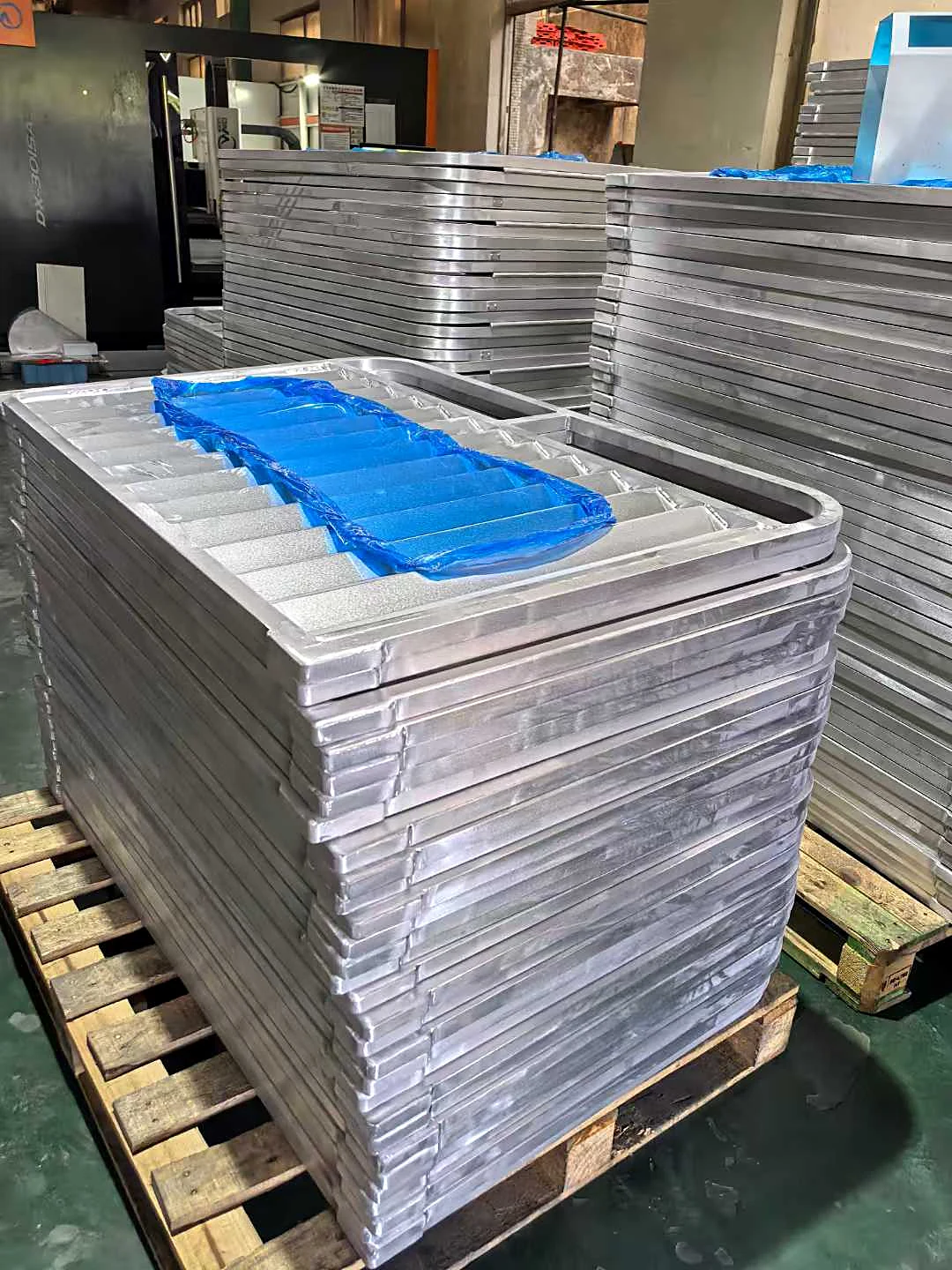
- Packaging: Steel pallet bundle, wrapped with anti-rust paper and plastic film; or wooden crate for LCL shipping
Applications
- Cattle enclosures
- Horse corrals
- Sheep pens
- Indoor dairy housing and wash-down bays
- Rodeo arenas
- Farm boundary fencing
Inspection & Quality Control
These panels cannot be repaired invisibly on site, so inspection happens before finishing as well as after.
- Incoming material: Extrusion alloy and temper verified against the mill certificate, with rail wall thickness measured per batch; steel tube wall thickness and diameter verified the same way. Certificates held on file.
- Joint inspection: Corner bracket position, rivet or bolt count and spacing checked on the first panel of the run and then on a sampling basis. Welded steel corners are checked for weld leg length and penetration against the drawing.
- Dimensional and alignment check: Panel width, height, rail spacing and diagonal measurements taken before finishing; diagonal difference over tolerance is corrected on the jig, not shimmed later.
- Finish inspection: Anodized and powder-coated aluminium checked for colour and film thickness; galvanized steel measured with a magnetic gauge at several points per panel and inspected for bare patches, excess zinc build-up and blocked drain holes.
- Assembly trial: Sample panels from each batch are assembled pin-to-loop with the previous batch to confirm they still fit on site.
Key Features
- Aluminium version: rust-free, no coating film to chip, one-person handling
- Galvanized steel version: 15+ year outdoor service life
- Full-penetration welded corners on galvanized steel panels
- Bracketed and riveted corners on aluminium panels
- Tool-free pin-and-loop assembly
- Stainless fixings and isolated joints where aluminium meets steel
Fulei Metal builds components like this in-house. The surface finishing service page explains how the process is set up and checked, while custom metal enclosure manufacturing covers the materials and finishes we normally run. Related reading: Cattle Fence Panel Fabrication.
Frequently Asked Questions
Aluminium or galvanized steel — which should I use?
It comes down to where the panel stands. Aluminium for indoor housing, wash-down bays and anywhere the panel is moved by hand, because it cannot rust and there is no coating to chip. Galvanized steel for outdoor turnout and any run where a large animal makes direct contact with the panel, because the steel section takes more impact before it deforms.
Can you match the panel size we already use?
Yes, and it is the usual way to start. Send one panel or its dimensions and we will match the rail centres and the pin-and-loop positions so the new panels join your existing runs.
How long does the aluminium last outdoors?
Aluminium does not rust, so it will not develop red rust the way a scratched steel panel does. Outdoors, what limits the panel is the finish rather than the metal: anodizing or powder coating is what protects the appearance. Tell us the site conditions — coastal, high-ammonia or inland — and we will specify the alloy and the finish to suit.
What is the MOQ?
10 panels per size for a large assembly. Mixed sizes can be combined in one order as long as the total quantity is economic to run.