
Repeat production program
SUS304 Livestock Feeder Components for OEM Programs
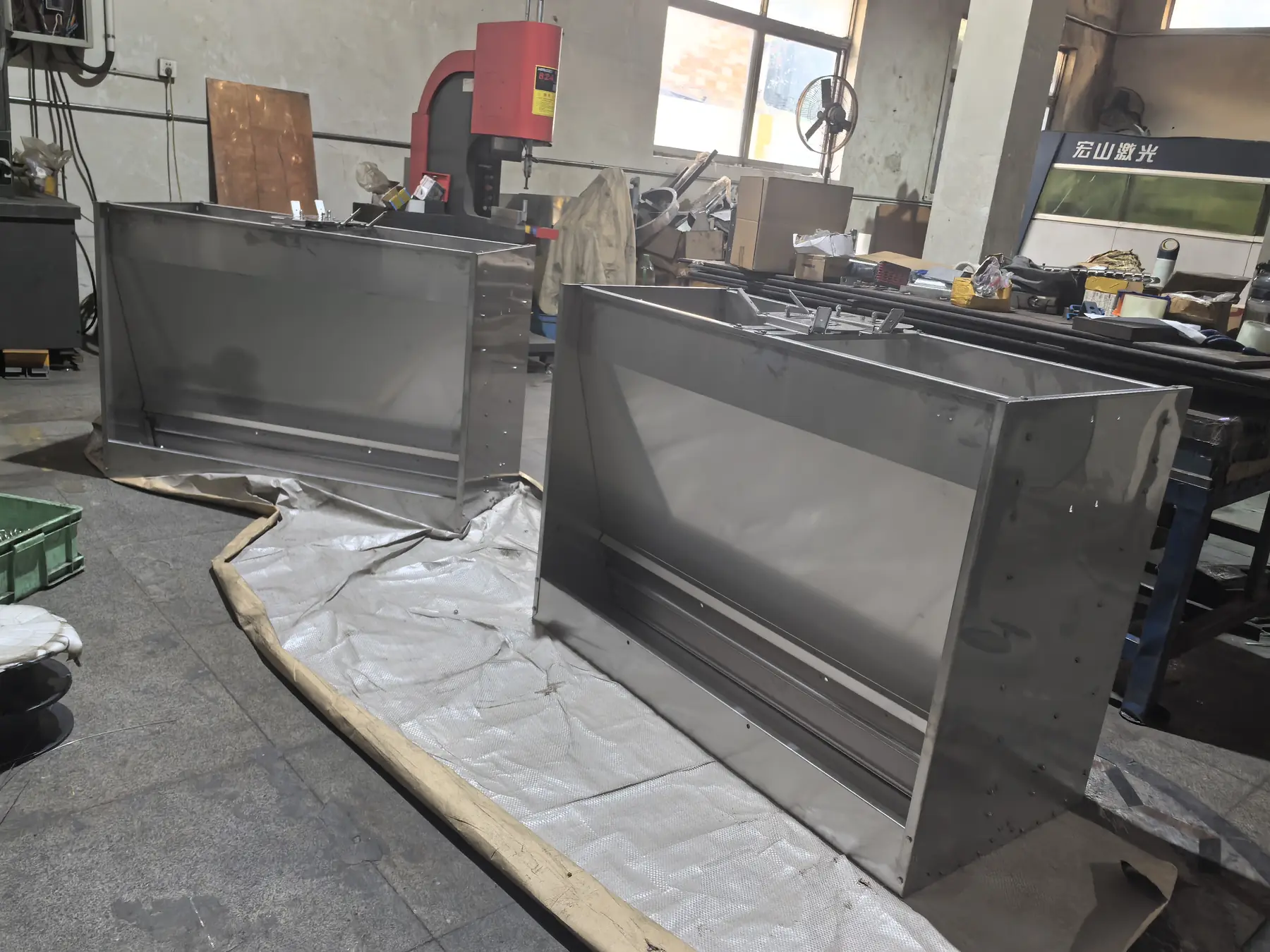
These components are produced in 1.2 mm SUS304 with no additional surface treatment. They are used in nursery, adult-pig and dry-wet feeding applications.
Confirmed Program Data
| Product type | Stainless Steel Livestock Feeders |
|---|---|
| Material and thickness | SUS304, 1.2 mm |
| Surface finish | Natural stainless steel |
| Drawing formats accepted | STEP, DWG, DXF, PDF and SolidWorks |
| Project tolerances | Confirmed against the buyer drawing and manufacturing review |
Application context
What the Product Must Do
Livestock equipment is repeatedly exposed to feed, water, cleaning and physical contact. The metal structure therefore needs cleanable surfaces, controlled seams, stable mounting locations and edges that are appropriate for the operating environment. The real workshop image shows formed stainless steel feeder bodies before final project completion.
Engineering review
DFM Points Before Production
A useful RFQ identifies animal type, feeding method, capacity, installation points, access for cleaning and whether the buyer supplies internal mechanisms. The enclosure geometry should be reviewed for drainage, trapped residue, weld access and assembly sequence. Where several models share a platform, common panels and hardware can simplify repeat purchasing.
Manufacturing route
A Controlled Path from Drawing to Repeat Order
- RFQ reviewDrawing, quantity, material, finish, destination and assembly scope.
- First-piece confirmationKey geometry and interfaces checked before batch production.
- Batch manufactureCutting, forming, joining, finishing and assembly as required by the project.
- Inspection and export packingDrawing-defined checks, accessory count and transport protection.
Quality approach
Inspection Follows the Approved Drawing
Inspection follows the buyer drawing and approved sample. We focus on overall fit, panel alignment, welded-joint condition, hardware position, accessible edges and the interfaces used for installation or adjustment. Packaging is planned around the finished assembly size and the buyer’s destination.
Request a project review
Planning a Similar OEM Program?
Send drawings, trial quantity, estimated annual demand, material, finish, assembly scope and destination. We will review the information needed for a practical quotation.
Working in Stainless: The Decisions That Change the Outcome
This page already sets out the production route from drawing to repeat order. What is worth adding is the part that is specific to stainless: the same operations that are forgiving on coated steel leave marks on a natural finish, and there is no coating to cover a miss afterwards.
| Decision | Why it matters in stainless | How it is settled before production |
|---|---|---|
| Grade and condition of the material | 304 in a soft condition forms and bends cleanly. The same grade work-hardened by an earlier operation will crack at a radius it took without complaint on a fresh sheet | The mill certificate is checked against the operations the part needs, not only against the grade written on the drawing |
| Visible faces and tooling marks | A formed stainless part holds tool marks, roller marks and weld tint. A coated part would hide all three | Which faces are visible is agreed before forming, so the tooling and the weld sequence are planned around them rather than corrected later |
| Weld appearance and heat tint | TIG welding leaves a heat tint that is a cosmetic problem, and on a hygienic part also a place where corrosion starts | Whether each joint is left as-welded, brushed or passivated is decided per joint rather than left to the welder |
| Bend radius against the material limit | A radius tighter than the batch will take either tears the outside of the bend or work-hardens it | The tightest radius on the part is checked against the actual material batch before the drawing is frozen, not after the first part cracks |
| Edge condition | A stainless edge cannot be touched up the way a painted edge can. A burr or a grinding mark stays on the finished part | Edges are dressed as part of the operation, not as a rework step at the end |
| Tolerance and springback | Springback varies with the batch, and there is no coating thickness to absorb a dimensional miss | Bend angles are set by measured trial on the batch in hand, and the critical dimensions are recorded against the run |
| Packing and protective film | Stainless marks in transit, and a protective film left on too long leaves adhesive on the surface | The film and the removal window are agreed, because a film that stays on for months leaves a residue that has to be removed before the part is used |
What Can Be Changed Without New Tooling
On a stainless part the variables are the grade, the finish and the treatment of the welds. Change those and most else follows.
| What can be changed | What it affects | What it does not affect |
|---|---|---|
| Grade: 304, 316, or a ferritic grade | Corrosion behaviour, weldability and cost | The forming operations, provided the grade still takes the same radii |
| Thickness | Stiffness, weight and how the part forms | The welding parameters and the fixture |
| Finish: as-welded, brushed, passivated or electropolished | Hygiene level and how the surface ages in service | The geometry |
| Weld treatment, joint by joint | Appearance, and corrosion resistance at the weld | The joint positions |
| Protective film and packing method | Whether the part arrives unmarked, and how the film comes off | Nothing structural |
| Which faces are allowed to carry tool marks | Where the tooling may touch, and the appearance of the finished part | The function, provided the structural faces stay as they are |
Frequently Asked Questions
How do we know the material is what the certificate says?
The mill certificate travels with the batch and is checked against the grade and the heat number when material is issued, so the sheet that was formed is traceable to the certificate. Where a substituted grade or a suspect batch is involved, the check moves to a test rather than the paperwork – which is the point of keeping the certificate tied to the batch in the first place.
Why is a tight bend radius a problem in stainless?
Because stainless work-hardens as it is formed. A radius the material takes without complaint on the first bend can crack on a part that was already formed or punched nearby, and the tighter the radius the less margin there is. That is why the tightest radius is checked against the actual batch before the drawing is fixed, rather than discovered on the press.
Can the parts be supplied with no additional surface treatment?
Yes, and for a natural stainless part that is often the correct answer, because the material is already doing the work. What still has to be decided is the weld treatment: leaving a joint as-welded is a legitimate finish on a structural part, and it is the wrong one on a part that has to be cleaned or that will sit in a corrosive environment.
Stainless is chosen for the surface, so the surface is the specification. Send the drawing with the visible faces and the environment marked through the RFQ form and the finish and the weld treatment are set to them. Related: material certification, surface finishing and DFM engineering review.