
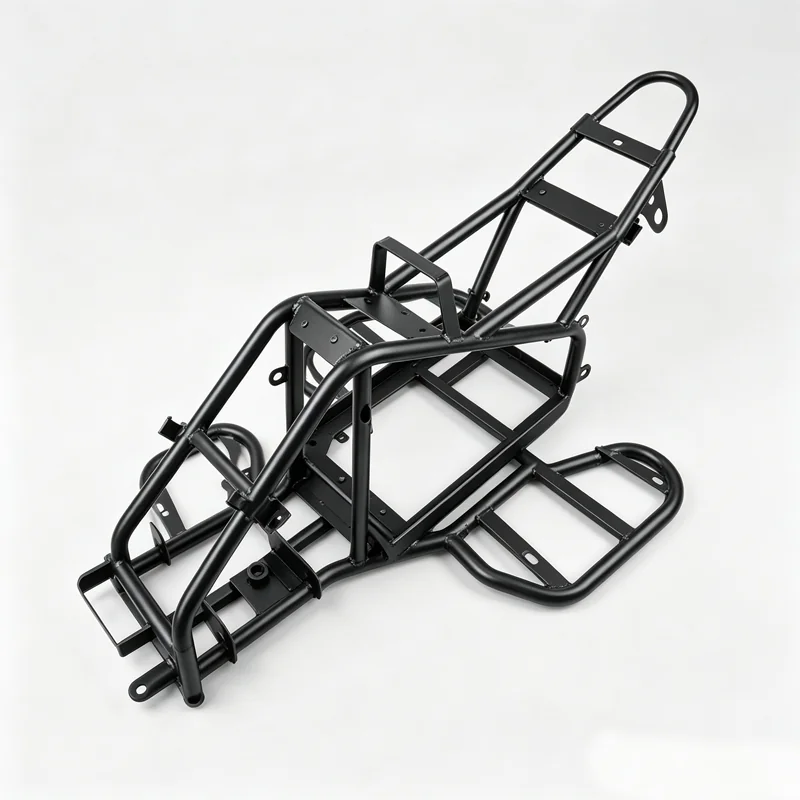

ATV Component
SKU: FL-AK-007
Custom ATV components. Sheet metal fabrication, lightweight.
| Material | Aluminum 5052 / SPCC steel |
|---|---|
| Manufacturing Process | Laser cutting + bending + welding + powder coating |
| Surface Finish | Powder coating (custom colors) |
| Tolerance | ±0.5mm |
| Dimensions | Custom per design |
| Weight | Lightweight optimized |
| Finish | Powder coating |
| MOQ | 30 units |
| Lead Time | Quoted after drawing review and process confirmation |
| Sample Time | Quoted after drawing review and process confirmation |
| Sample Fee | USD 150 |
| Price Range | USD 45-180/unit |
| Applications | ATVs, quad bikes |
| Compliance | ISO 9001 |
| Export Markets | USA, Canada, Australia |
All-errain vehicles (ATVs) operate in challenging off-road environments, requiring components that withstand impacts, mud, rocks, and weather. Sheet metal components provide protection, structure, and functionality for ATV applications.
ATV Component Types
Skid plate components protect ATV undercarriages from rocks and obstacles. Fender components protect riders from mud and debris. Rack components provide cargo carrying capacity. Brush guard components protect front ends from brush and impacts. Footwell components provide rider footing. Frame gusset components reinforce frame structures. Heat shield components protect riders from engine and exhaust heat.
Material Selection for ATV and Quad Bike Parts
Aluminum provides skid plates with lightweight, impact-resistant construction that slides over obstacles. We use 3.0 to 5.0 mm aluminum sheet (5052 alloy). Powder-coated steel provides cost-effective components for guards, racks, and brackets. Stainless steel provides corrosion resistance for components exposed to mud and water. High-strength steel provides frame reinforcement components. All materials must withstand off-road impacts, mud, and weather exposure.
Design Considerations for Off-Road Loads
Skid plates must withstand rock impacts without deformation while being lightweight. All components must resist corrosion from mud, water, and cleaning. Components must withstand vibration from off-road operation. Edges must be smooth or reinforced for rider safety. Designs must provide access for maintenance and cleaning. Components must accommodate various ATV models and configurations. Mounting systems must be secure against vibration and impact loosening.
How ATV Components Are Fabricated
Our TRUMPF fiber laser cuts component blanks, brackets, and mounting plates from flat sheet stock with precise dimensions. CNC press brake machines form skid plate profiles, fender shapes, and rack components with impact-resistant contours. Component assembly uses TIG welding for aluminum and stainless steel and MIG welding for steel. Surface treatments include anodizing for aluminum, powder coating for steel, and electropolishing for stainless steel.
Field Notes: ATV and Quad Bike Components
ATV components take a load pattern that is hard to design for on paper: the vehicle is used on terrain with no suspension travel to spare, and the parts see repeated impact rather than smooth loads. Skid plates and guards are the parts that come through a sheet metal route, and the requirements on them are simple to state and awkward to meet. A skid plate has to protect what is above it while not becoming a place where mud and debris collect, which means it has to drain and its fixings have to be recessed or protected rather than standing proud where they will be caught. It also has to be removable in the field for servicing, so the fastenings are designed for the conditions the vehicle is used in, not for a workshop.
ATV and quad bike components sit in a narrow band: light enough not to hurt handling, stiff enough to survive a season of rough ground, and cheap enough that a mid-volume model line can carry them. That balance is set on the drawing, not on the shop floor.
Where Weight Saving Actually Pays on an ATV
Aluminium 5052 and SPCC steel reach the same shape by different routes, and the choice is rarely about which material is “better”. On a component that sits high on the machine — a rack, a guard, a bracket carrying accessories — mass matters because it moves the centre of gravity. On a component that sits low and takes impact — a skid plate, a footrest support, a tow point — the section and the joint design decide whether the part survives, and a thinner aluminium panel usually loses that fight to formed steel.
The practical route most models take is mixed: aluminium where the part is carried and steel where the part is hit. Where that split is unclear, a prototype in each material is the cheapest way to settle it, because the difference shows up in a day of riding rather than in a calculation.
Decisions That Fix the Cost of an ATV Part
- Bend radius against material temper — 5052 in a half-hard temper will crack on a tight radius. The radius on the drawing has to match the temper being bought.
- Weld access on a folded part — a bracket that is folded closed before welding may leave a joint that cannot be made properly. Fold sequence and weld sequence are one decision.
- Mounting interface — ATV frames vary by model year. The hole pattern and the bushing detail have to be confirmed against the actual frame, not against a catalogue drawing.
- Coating against fuel and mud — powder coating is the standard, but the preparation matters more than the colour: a part that sees fuel spillage and pressure washing needs a clean, profiled surface before anything is applied.
These are settled at DFM engineering review, which runs alongside the quotation rather than after it.
How These Parts Are Checked Before They Ship
Inspection follows the buyer drawing and the approved sample. On this part type the checks that matter are the mounting hole pattern, the formed profile against a gauge or the mating frame, and the coating coverage on edges and inside corners. General tolerances are to ISO 2768 unless the drawing states otherwise; the ±0.5 mm on the specification table applies to the formed features called out on the drawing.
Material certificates are issued with the batch so the heat and coating can be traced — see material certification and traceability. Packing is planned around how dealers receive parts: nested where the shape allows, separated where coated faces would rub. For export consignments see export packaging standards.
Aluminium or steel for this part?
Send the mounting points and what the part has to survive. Where it is carried and seen, aluminium usually wins; where it is hit, formed steel at a sensible thickness usually does.
Can you match an existing component?
Yes — send the sample or its dimensions and we will produce a drawing for confirmation before cutting. The mounting interface is the part that has to be exactly right.
What to Send for ATV Component Pricing
The STEP or DWG geometry, material and finish, the quantity split between samples and batch, and the destination market. Timing is quoted after drawing review and process confirmation.
Payment Terms
How a project is paid for is agreed before production starts, and the structure that applies to your order is stated on the quotation and on the order confirmation, so there is no ambiguity later.
- 30% advance payment with the order and the 70% balance before shipment — our standard structure.
- 70% advance payment with the order and the 30% balance before shipment — used for some projects.
- 100% payment in advance before production starts — used for some projects.
If your finance team works to a fixed structure, say so in the first enquiry and we will confirm what applies to your order before you commit. Request a quotation.
Questions buyers ask before sending drawings
The questions that come up most often before a project starts, answered the way we answer them by email.
What do you need from me to quote ATV Component?
2D drawings as PDF, DWG or DXF, or 3D files as STEP, IGES or SolidWorks, together with material grade, sheet thickness, surface finish, quantity and destination country. If the drawing is not finished yet, send a photo, a sketch or the existing part instead — we review what can be measured from it and reply with the questions that still need answering.
How long does a quotation take?
Enquiries are answered within one business day. Simple laser-cut and bent parts are quoted within 24 hours. Welded frames, assembled units and multi-part structures are quoted after the drawing review and process confirmation, and the date is confirmed in our reply.
Is there a minimum order quantity?
Prototypes are made from a single piece and small batches of 10–50 pieces are routine. Prototype, first batch and repeat volume are quoted together so the numbers stay consistent as the project scales.
Can you work from a sample or a photo if I have no drawing?
Yes. Send the part itself, clear photographs with a rule or caliper in frame, or a dimensioned sketch. We measure what can be measured, list what is still undefined, and confirm it with you before production.
Need a Similar Part?
Most enquiries that start on a page like this are not an order for ATV Component — they are a search for a factory that can make something like it. Send us your drawing, 3D model or sample and we will review the manufacturing process and the quotation requirements, then come back with a process plan, a price and a lead time.
We work from 2D drawings, STEP / DWG / DXF / PDF files, or a physical sample if that is all you have.
No complete drawings yet? Describe the part, send photos or a sketch, or send a sample — we can start from there. Discuss your project.
Trade Terms and Delivery
We quote under the standard Incoterms your logistics team already works with, and build the packing and documentation around the one you choose.
- EXW — you collect from our Ningbo facility and run export clearance through your own forwarder.
- FOB Ningbo — we deliver to the vessel at Ningbo port and handle export clearance.
- CIF — we cover carriage and insurance to your named destination port.
- DDP — we handle carriage, insurance, import clearance and duties through to your door.
Send your destination country, target delivery date and preferred trade term together with the drawing. Request a quotation.
Quotation Time
We quote from your drawings. How long that takes depends on what the part asks for:
- Simple parts — quoted within 24 hours. Laser-cut blanks and bent components, supplied with complete 2D or 3D drawings. Mon–Fri, GMT+8.
- Complex assemblies — quoted after the drawing review. Payment kiosks, multi-part welded frames, enclosures with purchased hardware, or anything needing a coating or assembly trial. We confirm a quotation date once the scope is clear.
Production lead time is quoted separately, after drawing review and process confirmation. Send your drawings.
What stands behind this quotation
- Manufacturing since 20162,500 m² Ningbo plant — 3 laser cutting machines (including newer TRUMPF), 4 CNC press brakes and 10 welding stations.
- Shipped to more than 30 export marketsEnclosures, cabinets and formed parts supplied to OEM buyers across Europe, North America and Asia.
- 123 documented product casesMedical device housings, HVAC and heat pump enclosures, agricultural and livestock equipment, industrial hydraulics, material handling trolleys and EV charging cabinets.
- Factory evidence you can checkTUV Rheinland audit reference MIC-ASI243729 and Bureau Veritas reference MIC-ASR263630 available for buyer review under NDA.
Before you send drawings: an NDA is signed on request · first-article inspection is carried out before a batch continues · pricing is staged from prototype quantity to repeat volume · pre-shipment photos and packing records are prepared when the project needs them.