
A tool trolley carries the daily weight of a working workshop — literally. Mechanics, technicians and hobbyists push, pull and load them hundreds of times a week. A well-designed trolley is quiet, stable and effortless to move; a poorly designed one sags, squeaks and topples. Here is what to specify when commissioning a custom trolley.
Define the Real Load
Start with the payload per shelf and total capacity. A typical workshop trolley is rated 100–300 kg total. Overload a trolley and you bend shelves, stress welds and destroy casters. State your worst-case load in the RFQ and we will size the steel accordingly:
- Frame: 40×40 mm or 40×20 mm rectangular tube, 1.5–2.0 mm wall, welded at joints.
- Shelves: 1.0–1.5 mm SPCC sheet with formed edges and stiffening embosses; optionally with a non-slip rubber mat.
Wheel Selection Is Half the Design
The right casters make a 200 kg trolley feel light; the wrong ones make a 50 kg trolley feel like a truck. Specify:
- Diameter: 100–150 mm wheels roll over floor joints and debris far more easily than small 50 mm wheels.
- Material: PU or rubber tread for quiet, floor-friendly rolling; nylon for oily environments.
- Brakes: at least two locking casters for stability when parked.
- Mounting: top-plate or stem mounts with a rated load per caster 1.5× the corner load.
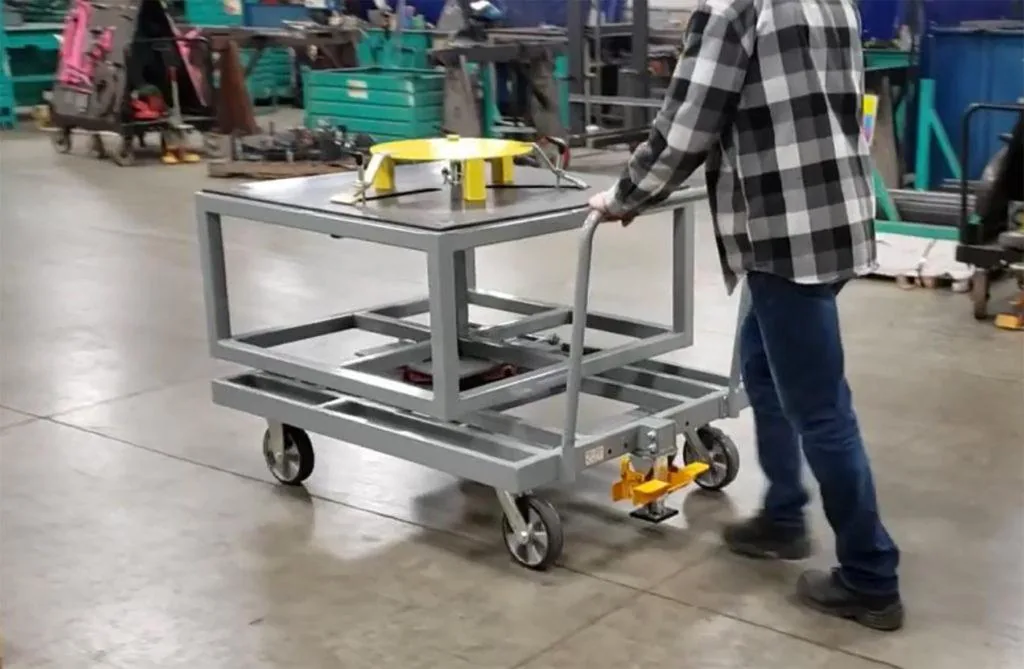
Ergonomic Layout
Think about how the user actually works: are tools picked from the side or the front? Should the top be a work surface or a tool tray? A well-designed trolley has:
- A comfortable push handle at hip height (900–1000 mm).
- Drawers or trays with dividers sized to the actual tools.
- A low center of gravity — heavy items stored on lower shelves to prevent tipping.
- Edge protection (rolled edges or plastic trims) so sharp metal does not damage hands, tools or vehicles.
Finishing
Powder coating (RAL color) with a matte or textured finish resists scratches and fingerprints. Drawer slides should be ball-bearing type rated for repeated daily use. If the trolley ships flat-packed, plan for bolted rather than welded joints and provide clear assembly instructions.
Fulei Metal has built custom trolleys for workshops, libraries, livestock facilities and industrial clients. Send us your layout sketch or CAD and we will return a manufacturable design with a firm quotation.
For OEM buyers the practical next step is a drawing review — see our DFM engineering review for what we need and how fast we turn it around. This work sits inside our custom sheet metal fabrication capability, and Tool Management for Sheet Metal Assembly explains the technical background in more detail.
Casters Against the Floor You Actually Have
Wheel selection is usually done against the load, and it should be done against the floor. A small, hard wheel is adequate on a smooth, clean, level floor and miserable on anything else: it stops at expansion joints, cable covers, threshold strips and the lip of a doorway, and every stop is a push the operator has to make. That is the difference between a trolley that gets used and one that gets bypassed.
Read three things: wheel diameter, tread material, and bearing type. Larger diameter crosses obstacles; softer tread rolls quietly and protects the floor but wears faster and rolls harder; the bearing is what determines whether a loaded trolley starts moving without a shove. Then check the brake arrangement against how the trolley is actually used — a brake on one wheel of a four-wheel trolley stops it spinning, not rolling.
Keeping Unit Fifty the Same as Unit One
A prototype that works is not the same achievement as a batch that matches it. On a welded trolley the things that drift across a run are frame squareness, drawer fit, and the alignment of the slides to the body — all three of which are controlled by fixturing rather than by care. Fixtures hold the frame through welding; the drawers are run in the finished body before the batch settings are fixed; and a first-off is kept as the reference the rest of the run is checked against.
The buyer’s equivalent control is simple and worth stating in the order: keep one approved sample, and check the delivery against it rather than against the drawing. Drawings describe intent; samples describe agreement.
What to Specify on the Drawing
- Load per shelf and per drawer, not a single total figure — the failure is local before it is total.
- Wheel specification — diameter, tread, bearing and brake, chosen against the floor.
- Finish and colour, including whether the coating has to meet a chemical restriction for the destination market.
- Whether the drawers lock, and whether keys are common across the order.
Send those with the drawing and the quotation comes back without a round of questions. DFM review covers them at quotation stage, and custom sheet metal fabrication sets out the wider capability behind this part type.
What stands behind this quotation
- Manufacturing since 20162,500 m² Ningbo plant — 3 laser cutting machines (including newer TRUMPF), 4 CNC press brakes and 10 welding stations.
- Shipped to more than 30 export marketsEnclosures, cabinets and formed parts supplied to OEM buyers across Europe, North America and Asia.
- 123 documented product casesMedical device housings, HVAC and heat pump enclosures, agricultural and livestock equipment, industrial hydraulics, material handling trolleys and EV charging cabinets.
- Factory evidence you can checkTUV Rheinland audit reference MIC-ASI243729 and Bureau Veritas reference MIC-ASR263630 available for buyer review under NDA.
Before you send drawings: an NDA is signed on request · first-article inspection is carried out before a batch continues · pricing is staged from prototype quantity to repeat volume · pre-shipment photos and packing records are prepared when the project needs them.