
An enclosure that looks simple is actually the product of five tightly controlled processes. Understanding the journey from flat sheet to finished box helps OEMs specify better, negotiate more effectively and spot quality problems early. Here is how we build heat pump enclosures at Fulei Metal.
Step 1: Laser Cutting
Every panel starts as flat sheet — typically SGCC/SECC galvanized steel at 1.2–1.5 mm. Our TRUMPF and domestic fiber lasers cut profiles, louvers, fan openings and mounting holes in one pass, holding ±0.1 mm. Cutting strategy matters: correct piercing order and gas settings prevent edge burr and heat-affected discoloration on galvanized coating.
Step 2: CNC Press Braking
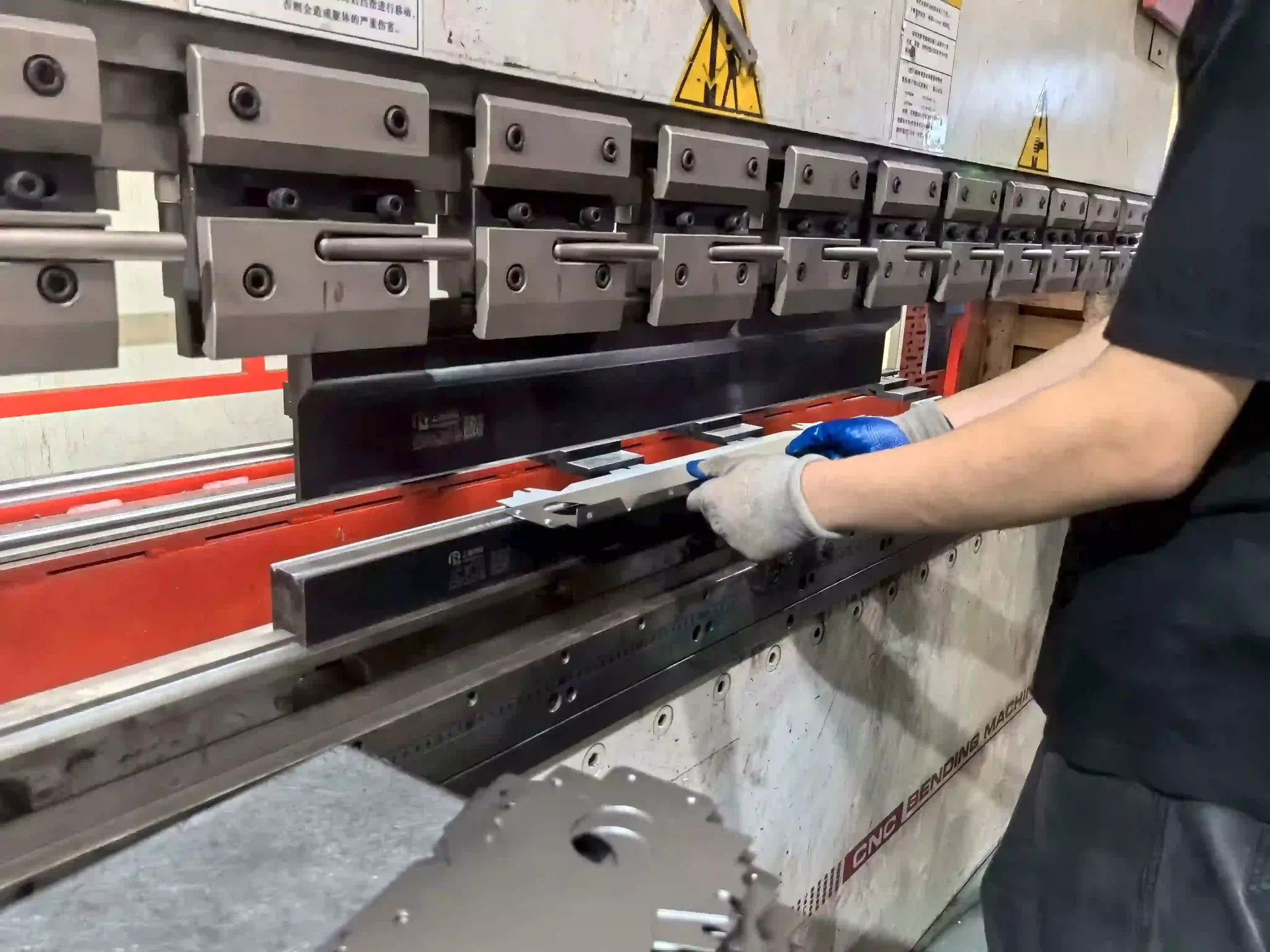
Panels are folded on CNC press brakes with precision-ground tooling. Bend allowance and springback are calculated per material grade and thickness so that after folding, the box fits together within ±0.5° on angles and ±0.2 mm on critical dimensions. Consistent bending is what makes the four corners of an enclosure close cleanly.
Step 3: Welding
Corner seams are joined with spot welding (fast, strong, minimal distortion) or TIG welding where a continuous sealed seam is required for IP protection. Fixtures hold the assembly square while welding, and welders are qualified to the project’s standard.
Step 4: Surface Treatment
Depending on specification, panels go through degreasing, zinc plating, and powder coating at 60–100 µm. For galvanized base material, a duplex system (galvanize + powder) gives the longest outdoor life. We verify film thickness and adhesion on every production batch.
Step 5: Assembly and Inspection
Final assembly fits doors, hinges, gaskets, fasteners and drainage parts. Every unit is checked against the drawing: dimensions, squareness, weld quality, coating condition and IP sealing details. A dimensional report accompanies each batch.
Lead Times
Prototype and production timing is quoted after drawing review and process confirmation; enclosure complexity, order quantity and surface treatment load all affect it. RFQ files: STEP + 2D PDF. We reply with a DFM review within 48 hours.
Fulei Metal builds components like this in-house. The DFM engineering review page explains how the process is set up and checked, while custom metal enclosure manufacturing covers the materials and finishes we normally run. Related reading: Network Cabinet Enclosure Manufacturing Guide.
How Tolerance Accumulates Across the Five Steps
Each of the five processes contributes its own variation, and the enclosure that arrives is the sum of them. A laser-cut blank holds a tight figure on its own; a bend adds springback variation that depends on the material batch and the tool; a weld adds distortion, and the amount depends on the joint design and the sequence. By the time the part is assembled, the variation that matters is not the one on the drawing — it is the accumulated result.
That is why the interfaces are dimensioned as relationships rather than as individual numbers. A door that has to meet a gasket along its full height is dimensioned to the opening it closes against, not to the cabinet’s overall height. A mounting plate is dimensioned to the holes that have to line up, not to the nearest edge. Stated this way, the tolerance that matters survives the accumulation; stated the other way, it does not.
The Rework Points That Show Up Most Often
- Bend springback on a new material batch — the same program produces a different angle on a different coil, and the correction belongs in the setup rather than in a hammer.
- Weld distortion on long flat panels — sequencing and fixturing control it; straightening afterwards does not restore the material.
- Coating over an under-prepared edge — the edge and the weld zone are where coating fails first, and preparation is verified before coating, not after.
- Gasket compression after a door has been re-hung — a door removed and refitted during assembly can lose the compression it was designed for.
None of these are exotic. They are the four that account for most of the rework on this part type, and all four are cheaper to control in process than to detect at final inspection — which is the argument for DFM engineering review happening before the first blank is cut.
What to Give Us So the Process Runs Once
The STEP or DXF geometry, the 2D drawing with the tolerances and interfaces marked, the material and finish, and the quantity split between samples and batch. Where an enclosure has to meet an ingress rating, say which rating and against which standard, because the joint and gland design follows from it rather than from the panel thickness.
Related reading: custom metal enclosure manufacturing covers the materials and finishes, and our enclosure inspection checklist sets out what is checked at the end of the sequence described above.
What stands behind this quotation
- Manufacturing since 20162,500 m² Ningbo plant — 3 laser cutting machines (including newer TRUMPF), 4 CNC press brakes and 10 welding stations.
- Shipped to more than 30 export marketsEnclosures, cabinets and formed parts supplied to OEM buyers across Europe, North America and Asia.
- 123 documented product casesMedical device housings, HVAC and heat pump enclosures, agricultural and livestock equipment, industrial hydraulics, material handling trolleys and EV charging cabinets.
- Factory evidence you can checkTUV Rheinland audit reference MIC-ASI243729 and Bureau Veritas reference MIC-ASR263630 available for buyer review under NDA.
Before you send drawings: an NDA is signed on request · first-article inspection is carried out before a batch continues · pricing is staged from prototype quantity to repeat volume · pre-shipment photos and packing records are prepared when the project needs them.