
Corrosion is the number one field-failure mode for outdoor heat pump enclosures. The choice between galvanized steel and powder-coated steel — and the quality of each — determines whether your units still look and function properly after five winters in the rain.
Three Common Approaches
| Option | Typical Use | Cost | Corrosion Life (Outdoor) |
|---|---|---|---|
| Electro-galvanized (SECC) + clear coat | Indoor / sheltered units | Low | 3–5 years |
| Hot-dip galvanized (SGCC) | Utility / agricultural outdoor gear | Medium | 8–15+ years |
| Galvanized + powder coating (duplex) | Premium heat pumps, coastal markets | Medium-high | 15–25 years |
Why Duplex Systems Win for Heat Pumps
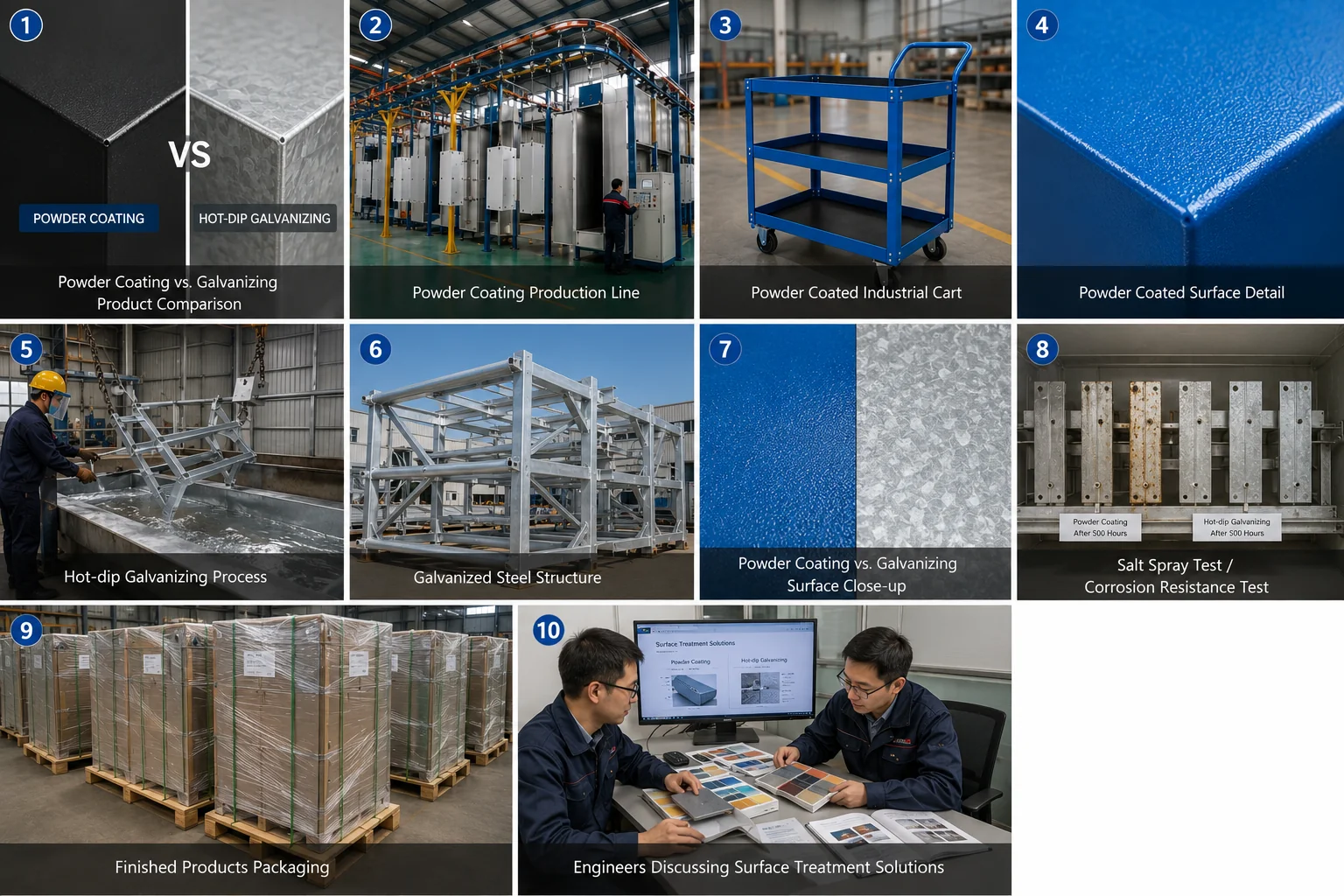
The best of both worlds: zinc provides cathodic protection at scratches and cut edges, while the powder coat adds color, UV stability and a barrier against salt and moisture. The combination lasts significantly longer than either system alone — the so-called duplex effect.
Quality Traps to Avoid
- Cut edges uncoated: laser-cut edges expose bare steel. Specify edge sealing or ensure the zinc layer is thick enough to protect edges sacrificially.
- Powder too thin: less than 60 µm film thickness gives poor coverage over sharp corners. We target 60–100 µm with pre-treatment (degrease + zinc phosphate).
- White rust: freshly galvanized surfaces stored in humid conditions develop white corrosion. Proper passivation and dry storage prevent this.
What Fulei Metal Does
We offer electro-galvanized (SECC), hot-dip galvanized (SGCC) and full duplex systems: zinc-plated base steel, pre-treatment, and polyester powder coating in any RAL color, verified with coating thickness meters and salt-spray testing per ISO 9227. Tell us your market and expected service life, and we will specify the right system for your budget.
If you are sourcing this type of part, our surface finishing service page covers the tolerances, batch sizes and inspection we work to, and custom metal enclosure manufacturing shows the wider range we produce in Ningbo, China. For background reading before you request a quote, see Quality Inspection Checklist for Sheet Metal Enclosures.
How to Read a Salt-Spray Result Before You Specify
A salt-spray figure is only meaningful with its standard and its acceptance criterion attached. ASTM B117 and ISO 9227 both describe a continuous salt-fog exposure, and both are comparative tests rather than service-life predictions — a result reported as “1,000 hours” means the panels met the agreed acceptance criterion at that duration, not that the enclosure will last a thousand hours outdoors. What matters just as much is what was counted as failure: white rust, red rust, creep from a scribe, or blistering at a defined distance from an edge.
Ask for three things together — the standard, the duration, and the acceptance criterion. Then ask where the test panels came from. A panel cut from flat sheet behaves differently from a formed corner or a welded joint, and the corner and the joint are where an enclosure actually fails.
Choosing by Climate Rather Than by Habit
- Inland, temperate, sheltered — a quality powder coating over a properly prepared substrate is usually sufficient and gives the colour range a brand needs.
- Coastal or poolside — chloride aerosol attacks from the edge inward, so a coating that relies on a film is the wrong first line. Galvanized substrate, or a duplex system of galvanizing plus coating, is the usual answer.
- Industrial or agricultural — the contaminant is chemical rather than chloride, and the coating chemistry has to be checked against it rather than assumed.
- Desert, high UV — the failure mode is chalking and colour fade rather than corrosion, which points to a coating system selected for UV stability.
The pattern is that location decides the substrate, and only then does colour decide the topcoat. Specifying the other way round is how an enclosure ends up with the right colour on the wrong metal.
What to Ask Your Supplier Before Ordering
Send the installation location, the expected service life and whether the enclosure will be washed, and ask what substrate and pre-treatment are proposed for that duty. Ask what happens at the cut edges and at the welds, because those are the two places a specification is either thought through or not. Ask how the coating thickness is verified and on which part of the part — a reading taken on a flat face says nothing about a corner.
For the inspection side of this, see our enclosure inspection checklist, and for the corrosion mechanism during shipment rather than service, see rust-proof packaging for export shipping.
What stands behind this quotation
- Manufacturing since 20162,500 m² Ningbo plant — 3 laser cutting machines (including newer TRUMPF), 4 CNC press brakes and 10 welding stations.
- Shipped to more than 30 export marketsEnclosures, cabinets and formed parts supplied to OEM buyers across Europe, North America and Asia.
- 123 documented product casesMedical device housings, HVAC and heat pump enclosures, agricultural and livestock equipment, industrial hydraulics, material handling trolleys and EV charging cabinets.
- Factory evidence you can checkTUV Rheinland audit reference MIC-ASI243729; ISO 9001 certificate available for buyer review before you commit.
Before you send drawings: an NDA is signed on request · first-article inspection is carried out before a batch continues · pricing is staged from prototype quantity to repeat volume · pre-shipment photos and packing records are prepared when the project needs them.
Get a quote for this part
Send a drawing, or just the size and quantity. A sales engineer replies within 24 hours, Monday to Friday (China time).