
Welded Tubular Steel Go Description
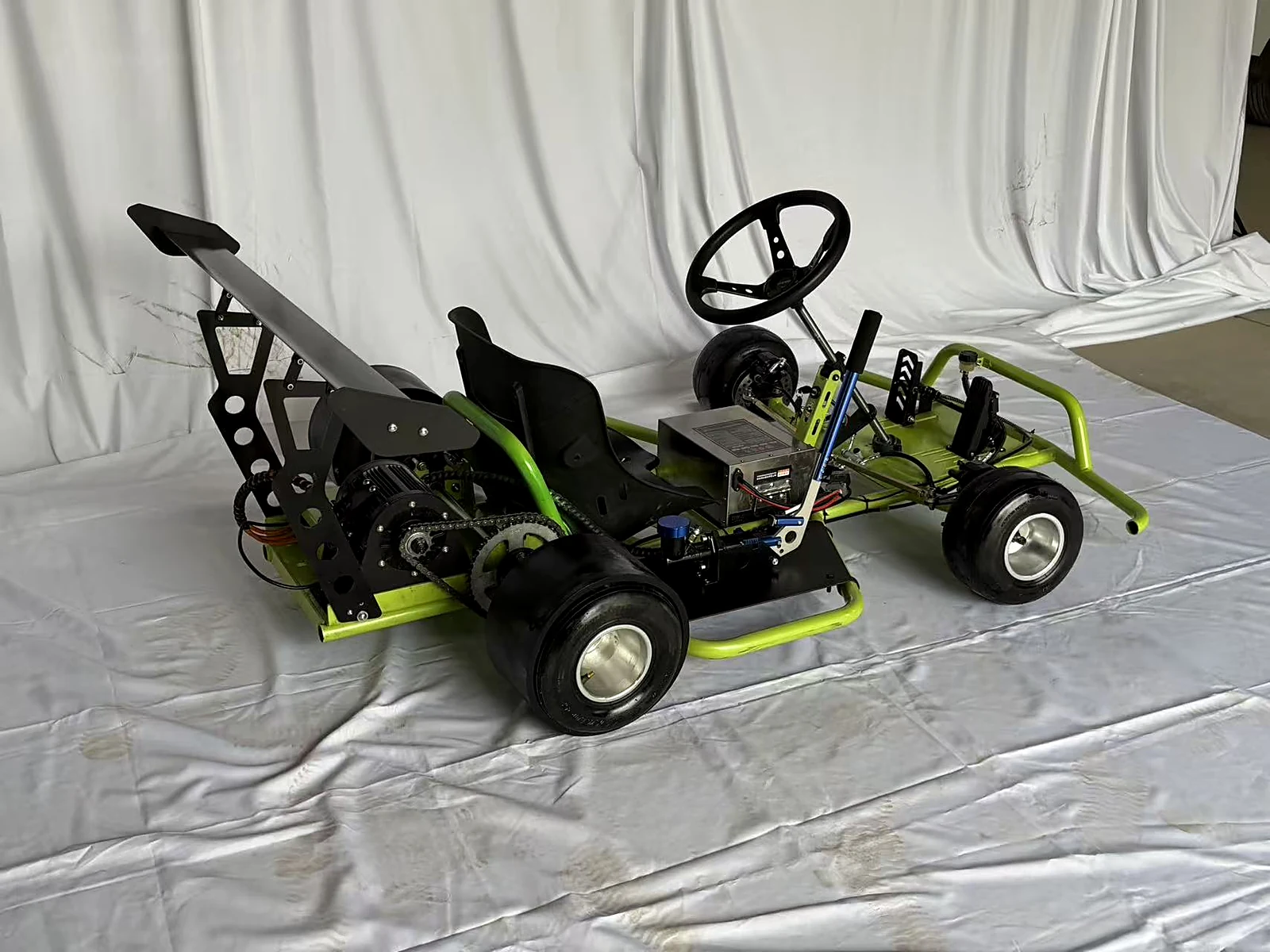
Our go-kart frame chassis is manufactured from ERW cold-drawn steel tubing (Φ25mm-Φ32mm, wall 1.5-2.0mm), CNC bent to exact racing specifications. The frame is fully TIG welded at all critical junctions for maximum structural integrity, then stress-relief annealed to eliminate welding distortion. Each chassis is jig-welded on a precision fixture ensuring dimensional accuracy within ±1mm. Final finish is epoxy primer + powder coating for corrosion protection and professional appearance.
Specs for Welded Tubular Steel Go
| Parameter | Value |
|---|---|
| Material | ERW Cold-drawn Steel Tube (Q345) |
| Tube Diameter | Φ25mm / Φ28mm / Φ32mm |
| Wall Thickness | 1.5mm / 1.8mm / 2.0mm |
| Wheelbase | 1040mm (standard) / custom |
| Overall Length | 1720mm (standard) / custom |
| Track Width | 1100mm front / 1150mm rear |
| Weight | 18-22kg (depending on configuration) |
| Welding | TIG at critical joints / MIG at secondary |
Material Options for Welded Tubular Steel Go
- Q345 ERW Steel Tube
- 4130 Chromoly (optional upgrade)
Process Steps for Welded Tubular Steel Go
- CNC Tube Bending
- Jig Welding (TIG+MIG)
- Stress Relief Annealing
- Powder Coating
Manufacturing Notes for Welded Tubular Steel Go
A go-kart chassis is a welded structure that has to be straight, and it has to stay straight through the heat of welding and the heat of coating. Most of the process planning goes into controlling distortion.
- Tube specification and wall thickness: Chassis tube wall thickness is selected from the intended use and the class rules — a recreational frame and a race frame do not use the same wall. Send the class or the target weight and we will specify from there rather than defaulting to a heavy wall.
- Cutting and notching: Tubes are laser cut and fish-mouthed to fit the mating tube, so joints close up without gaps. Gap-filling with weld wire is what pulls a frame out of alignment as it cools.
- Welding sequence and fixturing: The frame is built in a jig and welded in a sequence designed to balance heat input on opposite sides of the structure. Weld-on tabs and brackets are positioned in the jig, not measured afterwards.
- Post-weld correction and finish: After welding the frame is checked for twist and corrected while it is still on the fixture. Coating is powder coat or wet paint depending on the finish specified, with the frame supported so it does not sag while curing.
Surface Finishes for Welded Tubular Steel Go
- Epoxy Primer + Powder Coat
- Powder Coat Only (economy)
How to Order Welded Tubular Steel Go
- MOQ: 30 frames per design
- Lead Time: Quoted after drawing review and process confirmation (new design requires tooling/fixture setup)
- Sample Policy: 1 prototype frame available; prototype cost $450-800 depending on complexity, deductible from orders ≥100 units
- Packaging: Individual bubble wrap + carton; or steel rack loading for container shipment
Applications for Welded Tubular Steel Go
- Recreational go-karts
- Racing karts (cadet/junior/senior)
- Amusement park karts
- Off-road buggy frames
- Custom motorsport projects
Checking Welded Tubular Steel Go Before It Ships
A chassis is a single assembly, so every frame is checked individually rather than by sampling.
- Incoming material: Tube outer diameter and wall thickness checked on the batch; material certificate held for the tube grade used.
- Jig and fixture check: The welding jig is verified before each production run so the reference dimensions in the jig are still correct.
- Dimensional check on the frame: Key mounting points, wheelbase, track width and engine or motor mount positions are measured on every frame after welding and recorded.
- Twist and straightness: The frame is set on a flat reference and checked for twist across the diagonals; out-of-tolerance frames are corrected before they leave the jig.
- Weld inspection: Visual inspection of all welds on every frame, with penetration checked on sample joints from each run.
Key Features of Welded Tubular Steel Go
- Jig-welded on precision fixtures (±1mm dimensional accuracy)
- Stress-relief annealed for dimensional stability
- TIG welded at all critical stress points
- Engine mount, seat mount, and pedal mounts pre-fabricated
- Compatible with standard Honda GX200 / GX160 engine mounts
Send drawings and we will check them against our DFM engineering review capability before quoting. You can also see how this fits into our custom metal enclosure manufacturing work, or read Network Cabinet Enclosure Manufacturing Guide first if you are still comparing options.
Welded Tubular Steel Go Questions, Answered
Do you build from our drawings or do you design the chassis?
Both are possible. Most customers send a drawing or a CAD model. If you have a design concept but no drawings, we can fabricate from a reference frame or a dimensional specification, but the structural design remains the customer’s responsibility.
Can you add brackets for our components?
Yes. Engine or motor mounts, seat mounts, bearing hangers, pedal brackets and brake mounts are all positioned in the welding jig, so they are located off the same datum as the rest of the frame.
How do you keep the frame from distorting during welding?
The frame is welded in a jig in a balanced sequence, with the heat spread on opposite sides of the structure. Fit-up is controlled by laser-cut, fish-mouthed tube ends so no gap has to be filled with extra weld.
Minimum Order Quantity for Welded Tubular Steel Go
10 frames for a fabricated welded assembly of this size. Prototype frames can be quoted separately if you need to validate the design before committing to a production run.
Why a Welded Frame Gets Stress-Relieved Before It Gets Checked
A go-kart chassis is a welded tube structure that has to hold its geometry while being loaded in several directions at once – cornering, braking, and the torsional twist of one wheel hitting a bump the others have not. Welding puts residual stress into that structure, and if it is not relieved, the frame will move after it leaves the jig. A frame that measures correctly on the day it is welded and is out of alignment a week later has not failed, it has relaxed.
- Stress-relief annealing is what stops that. It is a process step, it costs time, and it is the difference between a frame that stays where it was built and one that does not.
- TIG at the critical junctions gives a controlled, penetrative weld on thin-wall tube. On tubing this light, heat input matters more than deposition rate.
- Cold-drawn ERW tube is specified because its wall thickness and roundness are consistent, which is what makes a bent tube predictable rather than approximate.
CNC Tube Bending: The Dimension That Decides Whether It Fits
A chassis is a set of tubes that have to meet at points in three dimensions, and the dimension that decides whether they meet is not the length of each tube – it is the angle between bends and the rotation of one bend plane relative to the next. A tube that is the right length with a bend rotated a few degrees off will pull the whole assembly out of line, and the error only appears when the frame is assembled, which is the worst possible time to find it.
That is why tube bending for a frame is programmed and checked rather than set up by eye, and why the first article is assembled and measured rather than measured tube by tube. Send us the geometry – a model, or a dimensioned drawing, or a sample frame to copy – and the bend program, the jig and the checks follow from it. Lead time is quoted after drawing review and process confirmation.
Need a Similar Part?
Most enquiries that start on a page like this are not an order for Welded Tubular Steel Go-Kart Frame Chassis — they are a search for a factory that can make something like it. Send us your drawing, 3D model or sample and we will review the manufacturing process and the quotation requirements, then come back with a process plan, a price and a lead time.
We work from 2D drawings, STEP / DWG / DXF / PDF files, or a physical sample if that is all you have.
No complete drawings yet? Describe the part, send photos or a sketch, or send a sample — we can start from there. Discuss your project.
Trade Terms and Delivery
We quote under the standard Incoterms your logistics team already works with, and build the packing and documentation around the one you choose.
- EXW — you collect from our Ningbo facility and run export clearance through your own forwarder.
- FOB Ningbo — we deliver to the vessel at Ningbo port and handle export clearance.
- CIF — we cover carriage and insurance to your named destination port.
- DDP — we handle carriage, insurance, import clearance and duties through to your door.
Send your destination country, target delivery date and preferred trade term together with the drawing. Request a quotation.
Payment Terms
How a project is paid for is agreed before production starts, and the structure that applies to your order is stated on the quotation and on the order confirmation, so there is no ambiguity later.
- 30% advance payment with the order and the 70% balance before shipment — our standard structure.
- 70% advance payment with the order and the 30% balance before shipment — used for some projects.
- 100% payment in advance before production starts — used for some projects.
If your finance team works to a fixed structure, say so in the first enquiry and we will confirm what applies to your order before you commit. Request a quotation.
Quotation Time
We quote from your drawings. How long that takes depends on what the part asks for:
- Simple parts — quoted within 24 hours. Laser-cut blanks and bent components, supplied with complete 2D or 3D drawings. Mon–Fri, GMT+8.
- Complex assemblies — quoted after the drawing review. Payment kiosks, multi-part welded frames, enclosures with purchased hardware, or anything needing a coating or assembly trial. We confirm a quotation date once the scope is clear.
Production lead time is quoted separately, after drawing review and process confirmation. Send your drawings.
What stands behind this quotation
- Manufacturing since 20162,500 m² Ningbo plant — 3 laser cutting machines (including newer TRUMPF), 4 CNC press brakes and 10 welding stations.
- Shipped to more than 30 export marketsEnclosures, cabinets and formed parts supplied to OEM buyers across Europe, North America and Asia.
- 123 documented product casesMedical device housings, HVAC and heat pump enclosures, agricultural and livestock equipment, industrial hydraulics, material handling trolleys and EV charging cabinets.
- Factory evidence you can checkTUV Rheinland audit reference MIC-ASI243729 and Bureau Veritas reference MIC-ASR263630 available for buyer review on request.
Before you send drawings: project confidentiality is default · first-article inspection is carried out before a batch continues · pricing is staged from prototype quantity to repeat volume · pre-shipment photos and packing records are prepared when the project needs them.