
Aluminium | fibre laser cutting
Laser Cutting Aluminium Sheet Metal
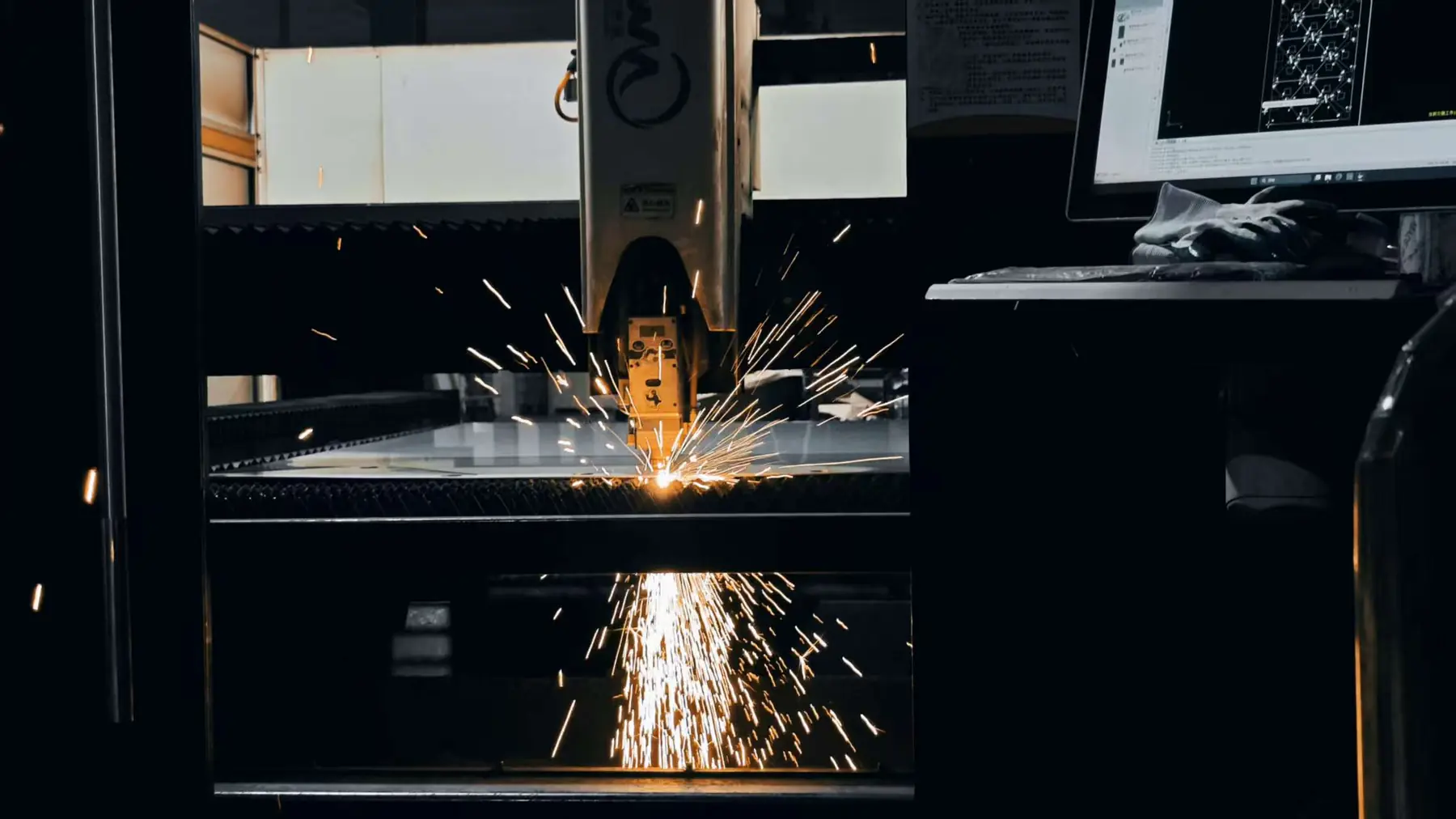
Aluminium can be laser cut cleanly, but it does not behave like steel at the machine. Reflectivity, heat conduction and a refractory oxide layer decide what the edge looks like, how much burr you get, and what still has to happen before the part can be bent, welded or anodised.
The short answer
What Changes When the Material Is Aluminium
Aluminium is not simply a softer steel as far as a fibre laser is concerned. Three physical properties drive almost every practical difference, and the rest of this page follows from them.
| 1. High reflectivity | An untreated aluminium surface reflects a large share of a 1 µm fibre laser beam. The process needs higher peak power and a machine with back-reflection protection. |
|---|---|
| 2. High thermal conductivity | Aluminium conducts heat roughly three to five times faster than carbon steel. Heat drains away from the kerf instead of staying where it is needed, which changes how the cut behaves on thick sections. |
| 3. Refractory oxide layer | Aluminium melts near 660 °C, but the aluminium oxide on its surface melts above 2,000 °C. The oxide is why a cut edge cannot go straight into a weld without preparation. |
None of these make aluminium un-cuttable. They make it a material where the parameter set has to match the alloy and the temper, not just the thickness.
Material selection
Which Aluminium Alloys Cut Cleanly
Alloy and temper change the result more than most buyers expect. The table below is the practical starting point we use when a drawing names a grade, or when it only says “aluminium”.
| Alloy | Family | Cuts cleanly | Burr tendency | Bendability | Typical use |
|---|---|---|---|---|---|
| 1050 / 1100 | Pure aluminium | Very good | Low | Very good | Decorative panels, shims, busbars |
| 5052 | Al-Mg | Very good | Low | Very good | Enclosures, cabinets, covers |
| 5754 | Al-Mg | Very good | Low | Very good | Marine and process environments |
| 5083 | Al-Mg | Good | Medium | Moderate | Tanks, structural plate, shipbuilding |
| 6061 T4 | Al-Mg-Si | Very good | Medium | Good | Brackets and frames that will be formed |
| 6061 T6 | Al-Mg-Si | Very good | Medium | Poor if bent tight | High-strength structural parts |
| 2024 / 7075 | Aerospace alloys | Poor | High | Poor | Generally not recommended for cut-and-form work |
The two rows that cause the most rework are 6061 T6 and the aerospace alloys. 6061 T6 cuts perfectly well and then cracks at the bend if the inside radius is tight. 2024 and 7075 cut with more burr and are crack-sensitive at bends. If a part has to be both cut and formed, it is much cheaper to confirm the alloy while the drawing is still open than to discover it at the press brake.
Side by side
Aluminium Against Carbon Steel and Stainless
Buyers who already source steel parts tend to assume the same rules apply. This is where the process actually differs.
| At the machine | Carbon steel | Stainless steel | Aluminium |
|---|---|---|---|
| Reflectivity at 1 µm | Low to medium | Medium | High on untreated surface |
| Heat conduction | Moderate | Low (stays in the kerf) | High (drains away fast) |
| Assist gas | Oxygen on heavy sections, nitrogen on thin | Nitrogen | Nitrogen |
| Dross and burr | Low | Medium | Higher, molten aluminium adheres easily |
| Edge after cutting | Usually weld-ready | Needs cleaning | Oxide layer must be removed before welding |
| Thermal expansion | Roughly half that of aluminium | Similar to steel | Highest of the three |
Two consequences follow. First, an aluminium cut edge is not the same starting point as a steel cut edge: welding, anodising and coating all need the edge prepared. Second, because aluminium expands more per degree than steel and conducts heat away faster, thin panels are sensitive to heat input and long parts are more sensitive to dimensional drift during cutting.
Edge Quality: Burr, Dross and What to Specify
Two different defects get called the same thing in conversation, and they need different answers. A burr is a rough ridge of material on the cut face. Dross is molten material that has re-solidified on the underside. Aluminium produces both more readily than steel because its molten state is less viscous and adheres well to cold metal.
What actually controls them: assist gas pressure and purity, focus position, the condition of the slats under the sheet, and the surface state of the blank. An anodised, oxidised or heavily scratched surface does not cut the same as clean mill finish.
For the drawing, the useful specification is not “clean cut”. It is whether the edge will be seen, whether it will be handled, whether it will be welded, and whether a defined deburring operation is included. An edge that is hidden inside a cabinet does not need the same treatment as a visible fascia panel.
Tolerance, Flatness and Small Features in Aluminium
Aluminium expands more per degree of temperature change than steel, so a long part cut with a lot of heat input can drift out of tolerance during the cycle. On thin sheet this shows up as distortion rather than size error: edges lift, panels bow, and the part is no longer flat enough to assemble cleanly.
Small features have their own rules. As a working guide, hole diameters below the sheet thickness, narrow webs, and dense vent patterns all deserve a second look before release. Feature-to-bend distance matters as well, because a hole placed too close to a bend line will deform when the part is formed, no matter how accurately it was cut.
None of this means the feature has to change. It means the feature should be identified at RFQ stage so it can be reviewed against the specific alloy and thickness rather than discovered on the first piece.
Downstream
From Cutting to Bending, Welding and Anodising
A laser-cut aluminium blank is a starting point, not a finished part. What happens next depends on the alloy and on how the edge has been prepared.
Bending
Bendability is governed by alloy and temper, not by the cut. 5052 and 5754 form easily. 6061 behaves very differently in T4 and T6, and tight inside radii are where cracking shows up. The cut edge itself carries no work hardening, so the bend limit is essentially the parent material limit.
Welding
The oxide layer has to come off first, mechanically or chemically. Welding straight over an unprepared laser-cut aluminium edge is one of the most common causes of porosity and lack of fusion in thin-section work. Deburring before welding is process preparation, not cosmetic finishing.
Anodising and coating
Anodising is an electrochemical process, so it responds to surface condition. A cut edge and a rolled face do not always take the same colour depth, and handling marks left before anodising cannot be removed afterwards. If the part will be anodised, the cosmetic face and handling requirements belong on the drawing from the start.
Troubleshooting
What Goes Wrong, and Why
Almost every problem on aluminium cut-and-form work traces back to one of a small number of causes. Naming the cause is what makes the fix repeatable instead of a one-off adjustment.
| What you see | Usual cause | What fixes it |
|---|---|---|
| Dross re-solidified on the underside | Aluminium melt is thin and adheres readily; assist gas pressure or focus position is off; the bed slats underneath are dirty | Tune the parameter set for that alloy and thickness; clean the bed; verify nitrogen pressure |
| Heavy burr on the top edge | Power density too low for the cutting speed, or one shared parameter set used across different alloys | Run a separate set per alloy; confirm on the first piece rather than the tenth |
| Thin panels bowed or lifted | Too much heat concentrated in one region because the contour order is inefficient | Split contours, change the cut sequence, reduce heat input into the part |
| Long parts drifting out of tolerance | Thermal expansion during the cut, plus residual stress released from the sheet | Control heat input; let the part stabilise before it is measured |
| Cracking at the bend | 6061 in T6, an inside radius that is too tight, or a bend running the wrong way relative to the grain | Move to T4 or 5052, open the radius, review bend direction on the drawing |
| Porosity in the weld | Oxide layer left on the laser-cut edge | Deburr and clean before welding; treat it as process preparation, not cosmetics |
Terminology
Aluminium or Aluminum? Both Names, One Material
Search results for this topic split almost evenly, so it is worth being direct about it: aluminium and aluminum are the same metal.
| Spelling | Where it is used | Notes |
|---|---|---|
| Aluminium | Europe, the UK, Australia, India, and most international standards | The spelling confirmed by IUPAC as the international standard |
| Aluminum | The United States and Canada | The same element, same alloys, same designations |
What matters for procurement is not which spelling is correct but whether the material callout is unambiguous. Alloy designations such as 5052, 5754 and 6061 are written the same way in both conventions, so a drawing that states the alloy number and temper removes the question entirely. A drawing that only says “aluminium sheet” or “aluminum sheet” leaves the most important variable open, whichever spelling it uses.
RFQ preparation
What to Send With an Aluminium Cutting RFQ
The replies that come back fastest and most usefully are the ones where the material and the downstream route are already defined.
| Drawing files | DXF or DWG profile, plus a controlled PDF and a 3D model where one exists |
|---|---|
| Alloy and temper | Exact designation, for example 5052 H32 or 6061 T6. Not just “aluminium”. |
| Thickness and quantity | Nominal thickness, prototype quantity and expected annual volume |
| Cosmetic requirements | Which face is visible, whether protective film is required, and the surface finish called for |
| Critical features | Small holes, narrow webs, tight tolerances, and anything that must mate with another part |
| Downstream route | Deburring, bending, hardware insertion, welding, anodising, coating or assembly |
| Acceptance points | Which dimensions and which edge conditions actually decide whether the part is accepted |
That last row is the one buyers most often leave out, and it is the one that changes how a job is planned. A part where the visible edge is critical is inspected differently from a part where only two mounting holes matter.
Common questions
Questions Buyers Ask About Laser Cutting Aluminium Sheet Metal
Which aluminium grades cut best?
5052 and 5754 give the most forgiving combination of cut quality and formability, which is why they dominate enclosure work. 6061 cuts cleanly too, but needs confirming before quoting if the part will be bent, especially in T6.
Can small holes and narrow slots be laser cut in aluminium?
Usually yes. Practical results depend on thickness, alloy, feature size, web width and spacing. Anything smaller than the sheet thickness, or a web narrower than about the thickness, should be identified on the drawing so it can be reviewed rather than assumed.
Can aluminium parts be welded straight after cutting?
Not without cleaning. The laser-cut edge carries an oxide layer with a melting point far above that of the metal underneath. Deburring and cleaning before welding is process preparation, and skipping it is a common cause of porosity in thin aluminium.
Does laser cutting complete the part?
Rarely. Deburring, bending, hardware insertion, welding, finishing and assembly are what decide whether the part meets the equipment interface. Cutting produces the profile, not the finished component.
Will the cut edge corrode?
Aluminium forms its own protective oxide very quickly, so an exposed cut edge is generally not the weak point in service. The practical concern is preparation for welding or coating, not corrosion at the edge itself.
Does laser cutting change the material properties?
The heat-affected zone on a fibre-laser cut in sheet aluminium is narrow, and the cut face itself is not work hardened. For most enclosure and bracket work the parent alloy and temper remain the deciding factor, not the cutting process.
From reading to quoting
Send the Drawing, Get the Real Answers
Send the alloy, thickness, quantity and the downstream route. We will come back with the questions that actually affect manufacture for your specific part, rather than a generic capability list.
Continue the topic
Related Reading
- CNC laser cutting service for sheet metal — the production capability behind this guide
- Laser cutting different materials — how steel, aluminium and copper compare
- Bending aluminium sheet — alloy, radius and springback
- Welding aluminium — oxide removal, filler and distortion
- Anodising aluminium — what the finish needs from the blank
- Laser cutting tolerance standards — what is achievable and what to specify
What stands behind this quotation
- Manufacturing since 20162,500 m² Ningbo plant — 3 laser cutting machines (including newer TRUMPF), 4 CNC press brakes and 10 welding stations.
- Shipped to more than 30 export marketsEnclosures, cabinets and formed parts supplied to OEM buyers across Europe, North America and Asia.
- 123 documented product casesMedical device housings, HVAC and heat pump enclosures, agricultural and livestock equipment, industrial hydraulics, material handling trolleys and EV charging cabinets.
- Factory evidence you can checkTUV Rheinland audit reference MIC-ASI243729 and Bureau Veritas reference MIC-ASR263630 available for buyer review on request.
Before you send drawings: project confidentiality is default · first-article inspection is carried out before a batch continues · pricing is staged from prototype quantity to repeat volume · pre-shipment photos and packing records are prepared when the project needs them.