
Description
Our custom equipment enclosures are engineered to protect your machinery and electronics in any environment. Each enclosure is designed from your specifications — dimensions, internal layout, ventilation requirements, cable routing, and access panels. Fabricated from 1.5-2.0mm steel, stainless steel, or aluminum, with laser-cut ventilation patterns, EMC shielding options, and internal mounting rails. Surface treatment includes powder coating, anodizing, or special chemical-resistant coatings. We provide full DFM support and prototyping.
Specifications
| Parameter | Value |
|---|---|
| Material | SPCC / SUS304 / Aluminum 5052 |
| Thickness | 1.0mm / 1.5mm / 2.0mm / 3.0mm |
| Dimensions | Fully custom (max 2000×1000×800mm) |
| Ventilation | Laser-cut patterns / fan mounts / louvers |
| Cable Management | Cable glands / strain relief / routing clips |
| Internal Mounting | DIN rails / mounting plate / brackets |
| EMC Shielding | Optional (conductive gaskets + coating) |
| Protection | IP54 / IP65 (with gaskets) |
Materials
- SPCC Cold-rolled Steel
- SUS304 Stainless Steel
- Aluminum 5052/6061
- Galvanized Steel
Processes
- CAD/DFM Design
- Laser Cutting
- CNC Bending
- Welding (TIG/MIG)
- Surface Treatment
Manufacturing Notes
An equipment enclosure has to do three jobs at once: protect the contents, allow heat and cables in and out, and close properly every time. The first two are design decisions, the third is a manufacturing one.
- Thickness and stiffness: 1.0mm to 3.0mm. Panels up to about 600mm square are usually fine at 1.5mm; larger panels or doors need 2.0mm or a folded return, otherwise the panel drums when the door is closed.
- Folded returns and gaskets: All door and side panel edges carry a folded return. That is what gives the enclosure its stiffness and gives the gasket a flat face to seal against, so ingress protection does not depend on how hard the door is pushed.
- Ventilation and cable entry: Laser-cut louvre patterns, fan cut-outs and cable gland holes are cut in the flat sheet before forming, and mesh or filter panels are fitted on removable frames so they can be cleaned or replaced.
- Finish: Powder coating at 60–80μm over a phosphate pre-treatment for standard industrial use; chemical-resistant coatings or anodising for aluminium where the enclosure sits in a process environment.
Surface Finishes
- Powder Coating (textured/smooth)
- Anodizing (aluminum)
- Brushed (stainless)
- Chemical-resistant coating
Order Information
- MOQ: 50 units (prototype: 1-5 units)
- Lead Time: Prototype: 7-10 days; Production: 25-35 days
- Sample Policy: Prototype enclosure available; cost $300-1500 depending on complexity, deductible from orders ≥200 units
- Packaging: Individual carton with foam inserts; or wooden crate for heavy units
Applications
- Industrial machinery
- Medical device housings
- Electronics enclosures
- Telecom equipment
- ATM/kiosk housings
- Control panels
Inspection & Quality Control
Enclosures are checked as assemblies, not just as panels, because fit between door and body is what the customer experiences.
- Incoming material: Sheet thickness and grade verified against the mill certificate; stainless grades checked to confirm no substitution.
- First article inspection (FAI): A complete enclosure is assembled and checked for overall dimensions, door-to-body gap, panel flatness and the position of all cut-outs and mounting rails.
- Door and fit check: Every enclosure is closed and opened through its full travel; latch alignment and gap consistency are checked, and the gasket is checked for compression along its full length.
- Flatness and squareness: Panels measured against a straight edge and diagonals checked — a twisted body shows up immediately as an uneven door gap.
- Coating and ingress: Film thickness measured on flat areas and edges; where an IP rating is specified, sample units are water-spray tested before the batch is released.
Key Features
- Full custom design from your specifications
- DFM optimization at no additional cost
- EMC shielding available for sensitive electronics
- Integrated ventilation and thermal management
- Modular internal mounting for flexibility
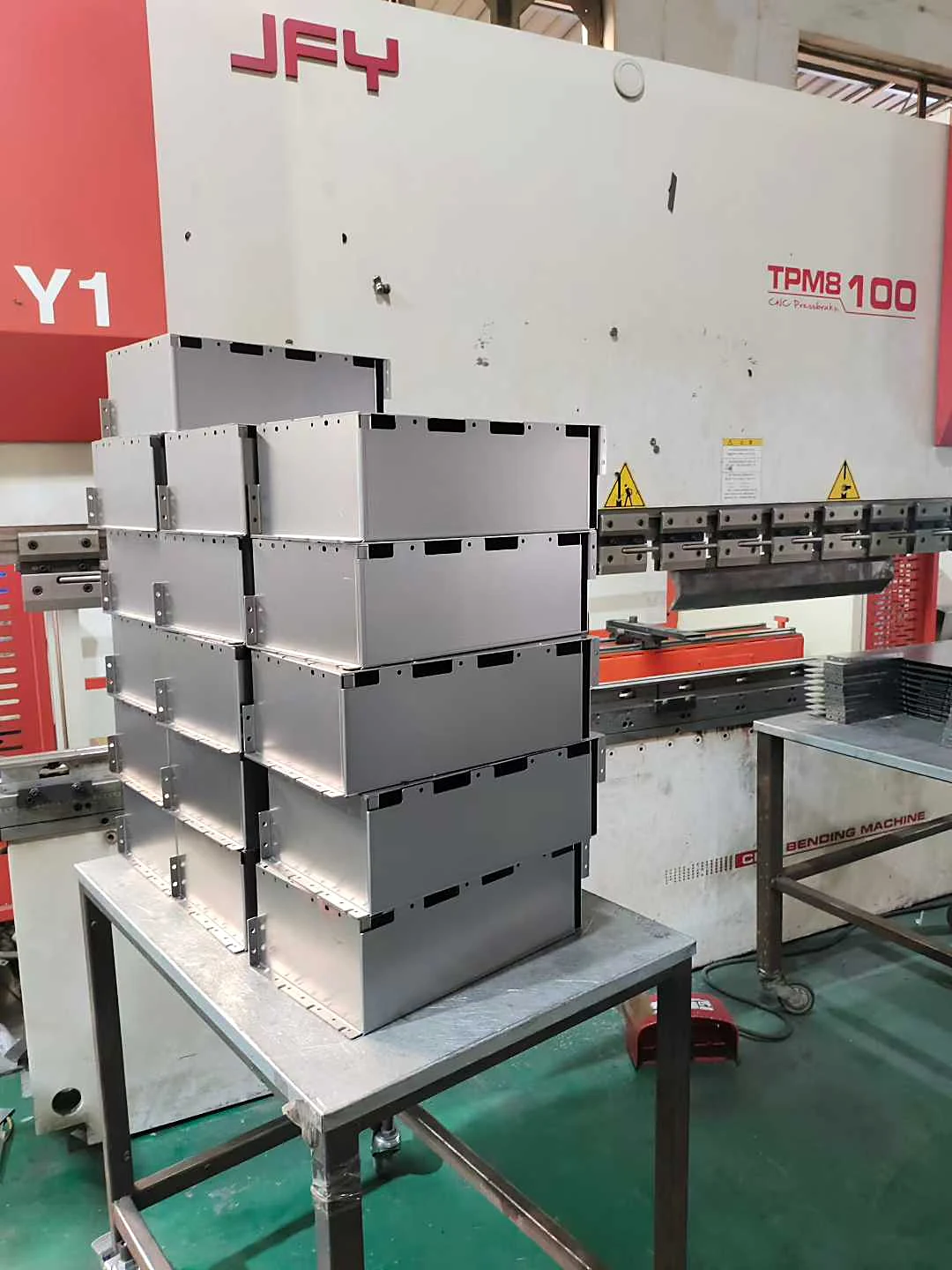
For OEM buyers the practical next step is a drawing review — see our DFM engineering review for what we need and how fast we turn it around. This work sits inside our custom metal enclosure manufacturing capability, and Network Cabinet Enclosure Manufacturing Guide explains the technical background in more detail.
Frequently Asked Questions
Can you design the enclosure from our internal layout?
Yes. Send the equipment dimensions, mounting positions, heat load and cable entry requirements and we will return a proposed layout with a DFM note before anything is cut.
Can you hold an IP rating?
Where a rating is required, the sealing method is specified at design stage and confirmed by spray testing on sample units. Ratings are achieved with the gasket, latch and gland arrangement taken together, not by the sheet metal alone.
Do you supply DIN rails and mounting plates?
Yes, internal mounting rails, plates and brackets are fabricated and fitted in-house so the internal layout is checked before the enclosure ships.
What is the MOQ?
10 units for a large fabricated enclosure. If you need a single prototype first, we quote that separately and the tooling and programme carry over to the production order.