

Library Locker Cabinet
SKU: FL-LB-010
Multi-door library locker, 12 compartments, master lock.
| Material | SPCC cold-rolled steel (0.8-1.0mm) |
|---|---|
| Manufacturing Process | Laser cutting + bending + welding + powder coating |
| Surface Finish | Powder coating (grey RAL 7035) |
| Tolerance | ±0.5mm |
| Dimensions | 900×450×1800mm |
| Compartments | 12 (3 columns × 4 rows) |
| Lock | Hasp + padlock |
| Ventilation | Punched |
| MOQ | 30 units |
| Lead Time | Quoted after drawing review and process confirmation |
| Sample Time | Quoted after drawing review and process confirmation |
| Sample Fee | USD 180 |
| Price Range | USD 180-260/unit |
| Applications | Libraries, gyms, schools, offices |
| Compliance | ANSI/BIFMA |
| Export Markets | USA, Germany, UK |
How This Library Locker Cabinet Is Fabricated and Checked
A locker cabinet is a door product before it is a cabinet. Twelve doors each have to align, close, lock, and stay aligned when the doors either side of them are shut hard.
| Stage | What happens | What is verified before the job moves on |
|---|---|---|
| Panel and door forming | Carcass panels, shelves, dividers and doors laser cut and formed from 0.8-1.0 mm sheet | Panel square and door flatness. Door flatness is what decides whether the gap stays even once the lock is fitted |
| Door forming and stiffening | Door edges folded and stiffened to the design, with the lock aperture made | Fold depth against the door size, and the lock aperture. A door that flexes loses its alignment |
| Compartment assembly | Shelves and dividers positioned and fixed to the design grid | Compartment positions and square, because a grid out by a millimetre across twelve doors does not have even gaps |
| Carcass welding and squaring | Carcass welded or mechanically joined, with reinforcement along the hinge line | Diagonals, and the front face checked for twist before the doors are hung |
| Door hanging and alignment | Doors hung and adjusted to an even gap across the grid | Gap consistency between every pair of doors, and that each lock and latch engages without force |
| Surface preparation and coating | Degrease, phosphate, then powder coat | Film thickness and colour, and that coating has not built up on hinge seats or in the lock apertures |
| Lock and function check | Locks, keys and numbering fitted and tested, with every compartment worked | That each door opens and locks independently, and that the numbering matches the delivered order |
| Packing | Wrapped with the doors secured and edges protected | The packed unit. A locker cabinet is often handled on its back, and the doors take the load if it is packed badly |
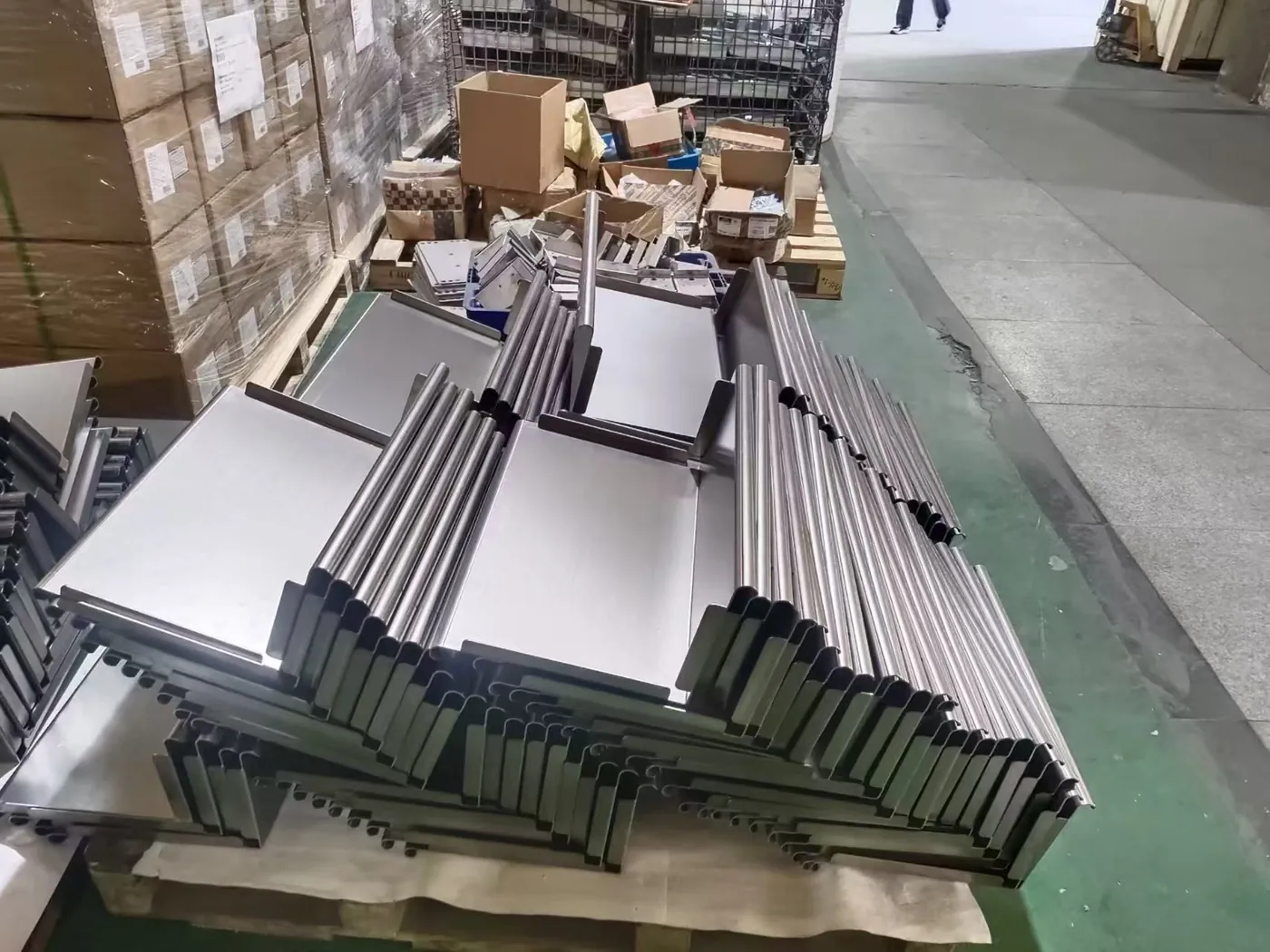
What Can Change on Library Locker Cabinet Without New Tooling
Compartment grid and lock type are the two decisions that fix almost everything else on a locker cabinet.
| What can be changed | What it affects | What it does not affect |
|---|---|---|
| Cabinet size and compartment grid | Panel sizes, divider positions and the door layout | The lock specification, provided the aperture does not move |
| Compartment size | What fits: A4, bags, coats or equipment | The carcass grid |
| Sheet thickness | Door stiffness and how the doors behave when shut hard | The coating process |
| Lock type: key, cam lock, padlock hasp or code | Access control and the maintenance regime | The door geometry apart from the lock aperture |
| Doors: solid, perforated or with a window | Ventilation, visibility and hygiene | The carcass |
| Numbering and identification | How compartments are assigned and managed | Nothing structural |
What Buyers Usually Ask About Library Locker Cabinet
Why do locker doors go out of alignment?
Because the door is the flexible part of the assembly. If the panels are not flat or the carcass front is not square, the locks pull the doors into an alignment that only looks right while they are closed. Door flatness and front-face square are checked before the doors are hung rather than adjusted after.
What sheet thickness do we need?
It follows how the doors are used. Where they are opened gently, 0.8 mm with a folded edge is usually adequate; where they are shut hard, as in a gym or a school corridor, the door needs a deeper fold or a thicker sheet. Say where it is going and the thickness follows.
Can the cabinet take a code lock?
Yes, but the lock determines the door aperture, the door stiffness and sometimes where the bracing goes. It is worth settling the lock type before the doors are cut, because changing it afterwards means new doors rather than a new fitting.
Door flatness and grid square are what the cabinet is judged on, so both are checked before the doors are hung. Send the compartment sizes and the lock type through the RFQ form and the grid is set to them. Related: metal enclosure manufacturing, CNC bending and quality inspection.
Door Stiffness in 0.8 mm Steel
Twelve compartments in three columns and four rows means twelve doors, and at 0.8 to 1.0 mm each door is a large flat panel that wants to oil-can. Three things fix it: a formed return on all four edges, a stiffening fold or a bonded panel in the middle, and a latch side that is held flat by the frame rather than left free. A door that flexes will not latch reliably, and in a locker the latch is the part the user touches every day – it is also the part that gets complained about first.
- Punched ventilation is standard, and it does two jobs: it lets a wet coat dry, and it stops the compartment smelling. The punch pattern is also the cheapest way to stiffen a flat door.
- A hasp and padlock arrangement keeps the locking mechanism out of the door, which is why it survives in a public building better than an integrated cam lock.
- At 1800 mm high the unit needs fixing to a wall or to adjacent units. Twelve loaded compartments is a real overturning load.
Public Use: What a Locker Has to Endure
A locker in a library is used by strangers, hundreds of times a week, by people who are not careful with it. That environment decides the detailing: no sharp edge at the door aperture, no hinge that can be levered off, a finish that hides scuffs and a hasp that cannot be sprung with a coin. We deburr every edge a hand can reach and we grind the welds at the door aperture, which is the edge most likely to be grabbed.
Keying and numbering are worth settling early. Numbered compartments need either a screen-printed panel or a riveted plate, and choosing between them after fabrication means a second operation on a finished part. Send the compartment count, the lock type, the vent pattern and the numbering method; lead time is quoted after drawing review and process confirmation.
Payment Terms
How a project is paid for is agreed before production starts, and the structure that applies to your order is stated on the quotation and on the order confirmation, so there is no ambiguity later.
- 30% advance payment with the order and the 70% balance before shipment — our standard structure.
- 70% advance payment with the order and the 30% balance before shipment — used for some projects.
- 100% payment in advance before production starts — used for some projects.
If your finance team works to a fixed structure, say so in the first enquiry and we will confirm what applies to your order before you commit. Request a quotation.
Questions buyers ask before sending drawings
The questions that come up most often before a project starts, answered the way we answer them by email.
What do you need from me to quote Library Locker Cabinet?
2D drawings as PDF, DWG or DXF, or 3D files as STEP, IGES or SolidWorks, together with material grade, sheet thickness, surface finish, quantity and destination country. If the drawing is not finished yet, send a photo, a sketch or the existing part instead — we review what can be measured from it and reply with the questions that still need answering.
How long does a quotation take?
Enquiries are answered within one business day. Simple laser-cut and bent parts are quoted within 24 hours. Welded frames, assembled units and multi-part structures are quoted after the drawing review and process confirmation, and the date is confirmed in our reply.
Is there a minimum order quantity?
Prototypes are made from a single piece and small batches of 10–50 pieces are routine. Prototype, first batch and repeat volume are quoted together so the numbers stay consistent as the project scales.
Can you work from a sample or a photo if I have no drawing?
Yes. Send the part itself, clear photographs with a rule or caliper in frame, or a dimensioned sketch. We measure what can be measured, list what is still undefined, and confirm it with you before production.
Need a Similar Part?
Most enquiries that start on a page like this are not an order for Library Locker Cabinet — they are a search for a factory that can make something like it. Send us your drawing, 3D model or sample and we will review the manufacturing process and the quotation requirements, then come back with a process plan, a price and a lead time.
We work from 2D drawings, STEP / DWG / DXF / PDF files, or a physical sample if that is all you have.
No complete drawings yet? Describe the part, send photos or a sketch, or send a sample — we can start from there. Discuss your project.
Trade Terms and Delivery
We quote under the standard Incoterms your logistics team already works with, and build the packing and documentation around the one you choose.
- EXW — you collect from our Ningbo facility and run export clearance through your own forwarder.
- FOB Ningbo — we deliver to the vessel at Ningbo port and handle export clearance.
- CIF — we cover carriage and insurance to your named destination port.
- DDP — we handle carriage, insurance, import clearance and duties through to your door.
Send your destination country, target delivery date and preferred trade term together with the drawing. Request a quotation.
Quotation Time
We quote from your drawings. How long that takes depends on what the part asks for:
- Simple parts — quoted within 24 hours. Laser-cut blanks and bent components, supplied with complete 2D or 3D drawings. Mon–Fri, GMT+8.
- Complex assemblies — quoted after the drawing review. Payment kiosks, multi-part welded frames, enclosures with purchased hardware, or anything needing a coating or assembly trial. We confirm a quotation date once the scope is clear.
Production lead time is quoted separately, after drawing review and process confirmation. Send your drawings.
What stands behind this quotation
- Manufacturing since 20162,500 m² Ningbo plant — 3 laser cutting machines (including newer TRUMPF), 4 CNC press brakes and 10 welding stations.
- Shipped to more than 30 export marketsEnclosures, cabinets and formed parts supplied to OEM buyers across Europe, North America and Asia.
- 123 documented product casesMedical device housings, HVAC and heat pump enclosures, agricultural and livestock equipment, industrial hydraulics, material handling trolleys and EV charging cabinets.
- Factory evidence you can checkTUV Rheinland audit reference MIC-ASI243729 and Bureau Veritas reference MIC-ASR263630 available for buyer review under NDA.
Before you send drawings: an NDA is signed on request · first-article inspection is carried out before a batch continues · pricing is staged from prototype quantity to repeat volume · pre-shipment photos and packing records are prepared when the project needs them.