
Kitchen Hanging Rack
SKU: FL-HO-008
SUS 304 stainless steel kitchen hanging rack. Wall or ceiling mount.
| Material | SUS 304 stainless steel (1.2mm) |
|---|---|
| Manufacturing Process | Laser cutting + bending + TIG welding |
| Surface Finish | Brushed stainless |
| Tolerance | ±0.3mm |
| Dimensions | 800×300×500mm |
| Hooks | 8 |
| Load | 25kg |
| Mounting | Wall/ceiling |
| MOQ | 100 units |
| Lead Time | Quoted after drawing review and process confirmation |
| Sample Time | Quoted after drawing review and process confirmation |
| Sample Fee | USD 100 |
| Price Range | USD 45-80/unit |
| Applications | Home kitchens, restaurants |
| Compliance | FDA food contact |
| Export Markets | USA, Germany, Japan |
How This Kitchen Hanging Rack Is Fabricated and Checked
A wall-mounted kitchen rack carries two loads, and only one of them is the rack. The rack itself is straightforward stainless fabrication. The load path that decides whether it is still on the wall in five years runs from the hooks, through the back panel, into the fixing and finally into the wall – and the wall is usually the weakest link.
This page covers how the rack is made and checked at Fulei Metal, and which questions are worth settling before production rather than after installation.
The joints are TIG welded, which is used here wherever a weld has to be fully fused rather than spotted.| Stage | What happens | What is verified before the job moves on |
|---|---|---|
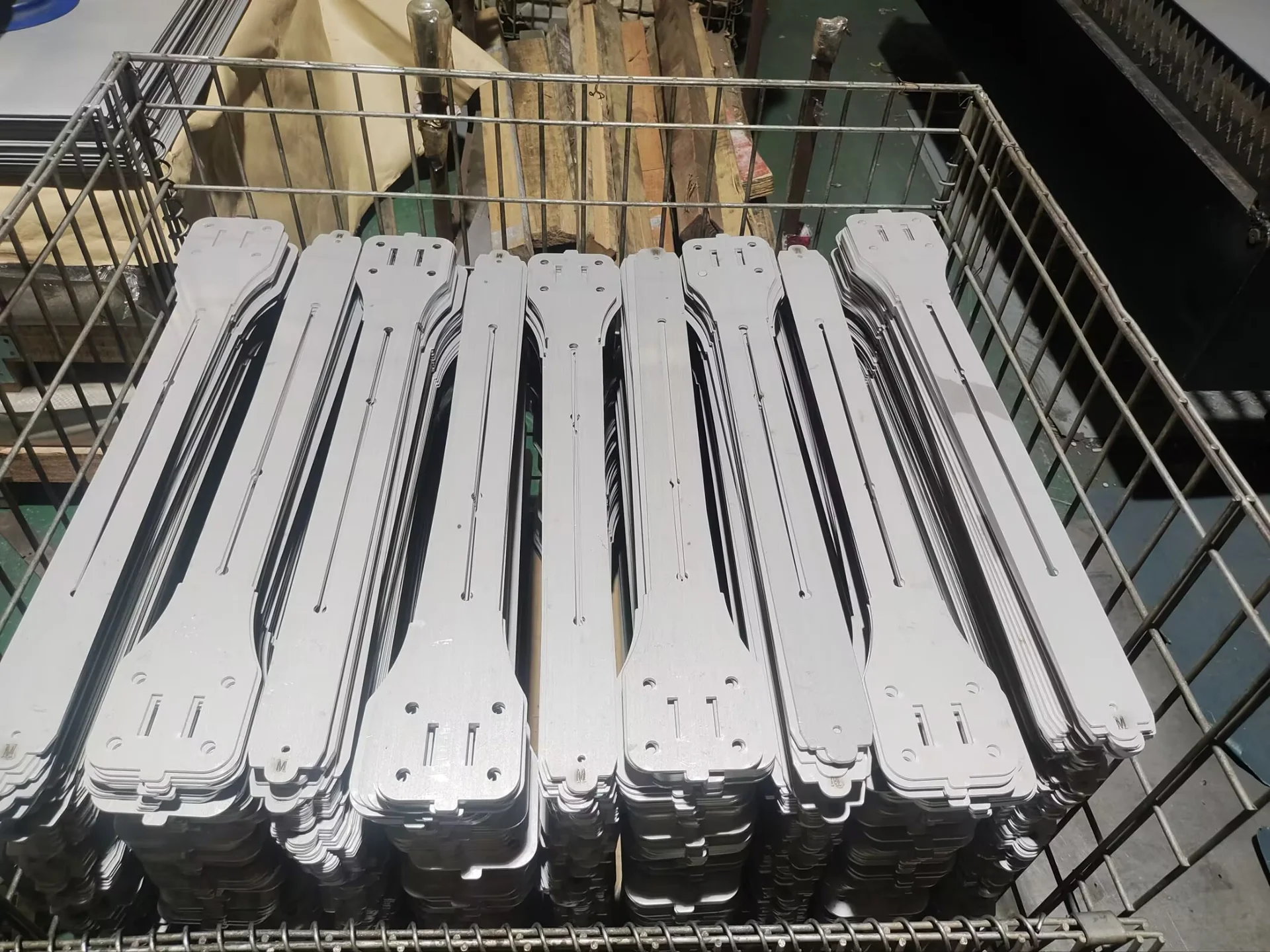
| Cutting | 304 stainless is laser cut at 1.2 mm. Back panel, side arms and mounting holes come off one nest. | Mounting hole centres are checked against the drawing before bending. Hole pitch decides whether the unit can be landed on studs or battens on site, and it is fixed by the cut. |
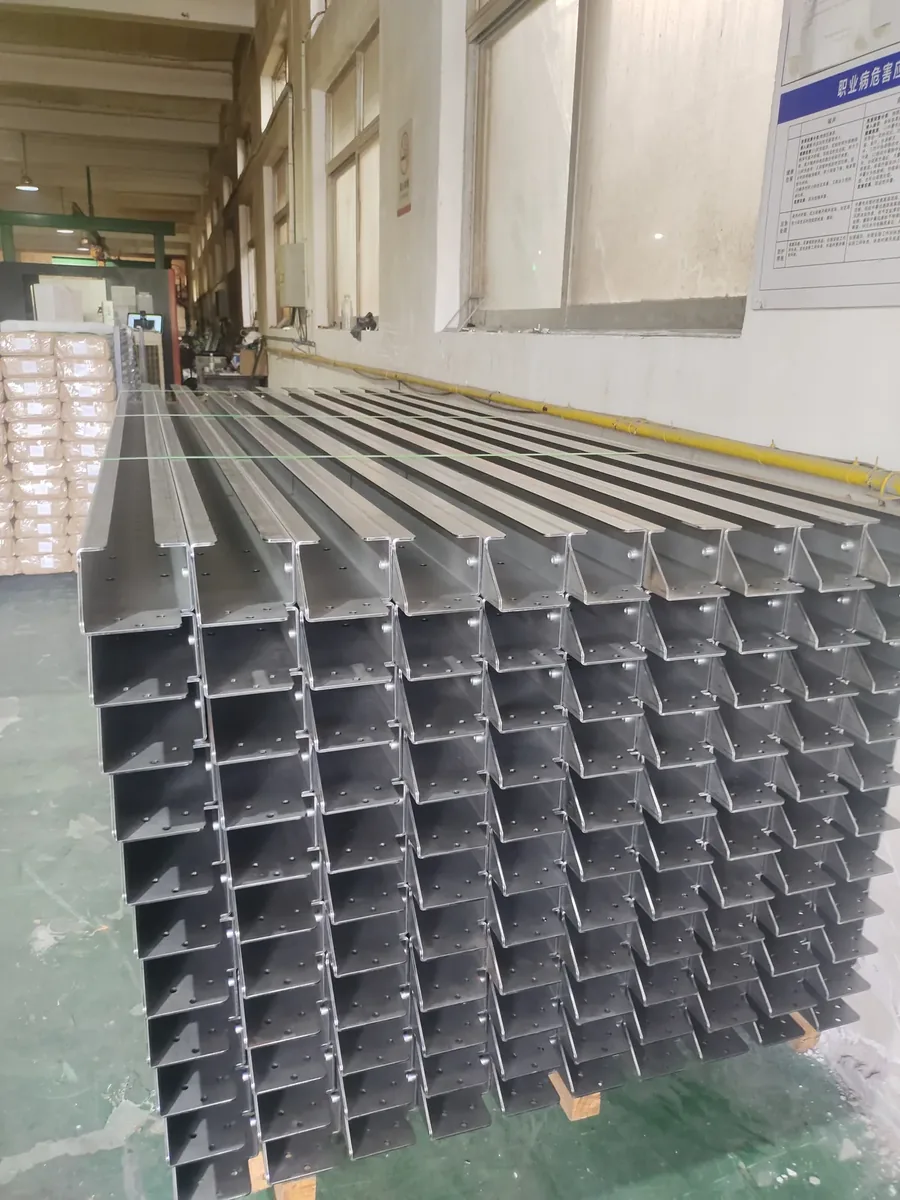
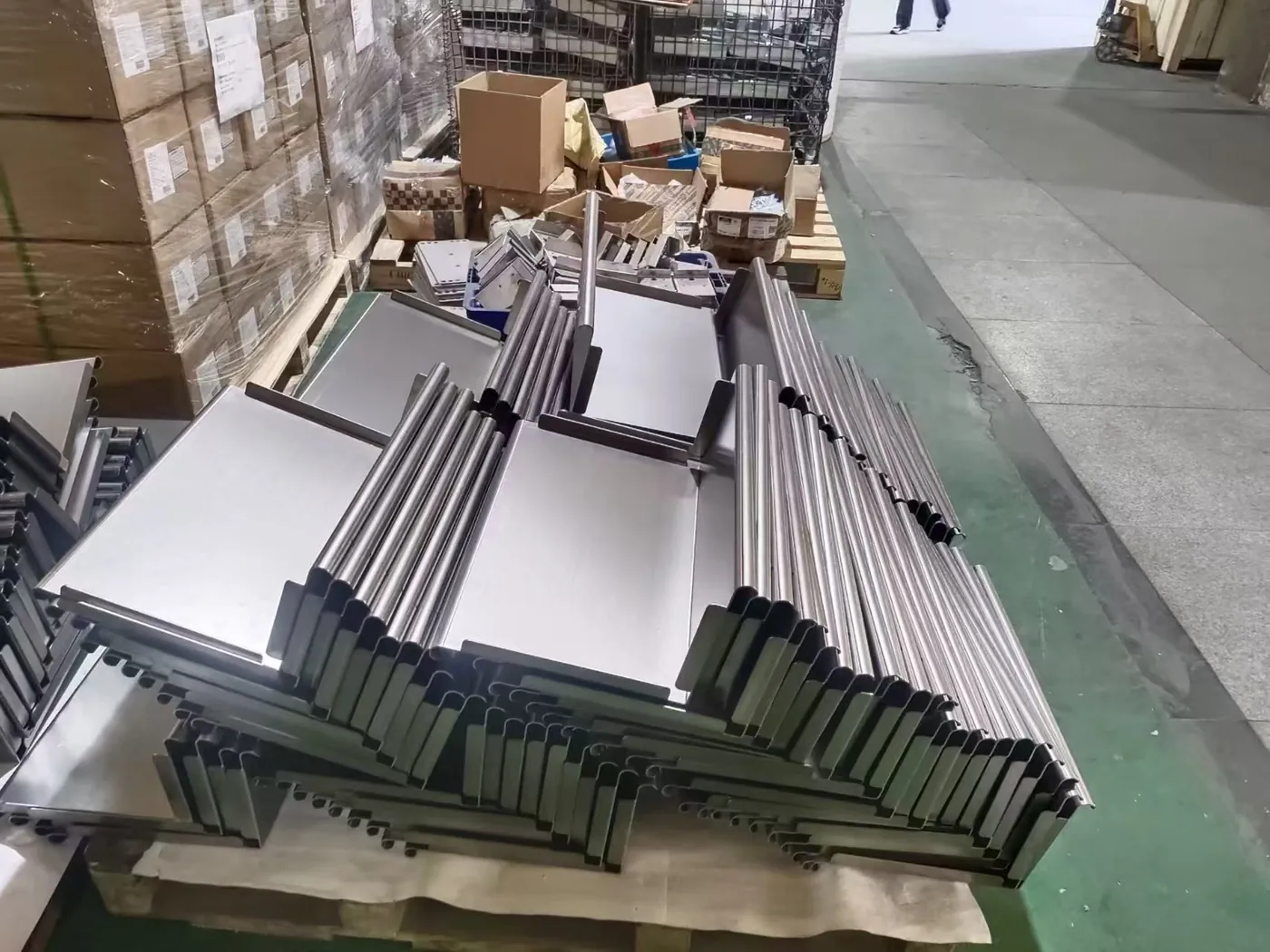
| Bending | Side arms are formed on a press brake. Back panel edges are folded to stiffen the panel rather than relying on flat 1.2 mm sheet. | Angle and the fold line position are checked on the first part. The stiffening fold is what stops the back panel from bowing under an off-centre load. |
| Hook forming and welding | Hooks are formed from stainless wire or rod and TIG welded to the frame. TIG is used so each joint is a full fusion weld rather than a spot. | Hook pitch, hook opening and weld penetration are checked. The opening of the hook is what decides whether a pan handle actually hangs, and it is the dimension buyers most often leave to us. |
| Weld cleaning and passivation | Heat tint is removed and the welded area is treated so the chromium oxide layer is restored. | Welds are inspected for tint left behind. A tinted weld on stainless is not only cosmetic – it is where corrosion starts, particularly in a kitchen. |
| Brushing | The part is brushed in one direction across the visible faces. | Brush direction and grain consistency are checked against a reference sample. Grain running two ways on one product is the defect that shows up in every photograph a customer takes. |
| Final check and packing | Hardware is bagged, the rack is wrapped and packed with the hooks protected. | Hooks are checked for alignment in three dimensions, and the finished part is compared against the approved sample before the batch is packed. |
Changes Kitchen Hanging Rack Can Absorb Without New Tooling
Racks are cut and folded, not cast or pressed, so most of the design is open to change. The items below are the ones buyers ask about most.
| What can be changed | What it affects | What it does not affect |
|---|---|---|
| Overall length and number of hooks | Cut file and mounting hole positions | The hook form itself, once it is agreed |
| Hook style and opening | The forming tool for the hook | The back panel and the stiffening fold |
| Mounting hole pattern | Site fixing method and the load each fixing carries | The rack body |
| Finish – brushed or a coated stainless look | Surface treatment route | The welded structure |
| Depth from the wall | Side arm length and the load moment on the fixings | Hook spacing along the rail |
FAQ on Kitchen Hanging Rack
How much weight will the rack hold?
The figure in the specification is 25 kg for the rack itself, and it is worth reading it as a limit on the steel rather than a promise about the wall. The real capacity is set by the fixing and by what it is fixed into. On a stud wall or a plasterboard partition, the load has to reach the framing; fixings alone into the board will not carry 25 kg at 300 mm from the wall. Tell us the wall build-up and we will confirm the fixing pattern.
What does the FDA food contact note actually cover?
It covers the material and the surface condition of the parts that food or utensils touch: 304 stainless, welded joints that are fully fused rather than spot welded, and a brushed finish that can be cleaned. It is not a claim about antimicrobial performance, and we do not make that claim for any surface finish. If a customer needs a specific food contact declaration for their market, say so at quotation and it will be handled as a document request.
Can the hooks be respaced to suit our own range?
Yes, the hook pitch is a cut and weld detail rather than a tooling constraint. Two things follow from a change. The hooks are welded on a fixture, so the fixture is remade for a new pitch – that is a one-off cost, not a per-unit cost. And the mounting holes are cut into the same blank, so a change to the hook spacing usually means the back panel is re-nested as well. Changing both together is cheap; changing one later is not.
Tell us the longest item that has to hang, the weight it carries and the wall you are fixing to. Hook opening and mounting hole pitch are both set before cutting, and both are harder to change after the first batch than before it. Send the details for a quotation.
If you need the rack supplied with a fixing kit matched to your wall construction, say so at quotation and it will be included in the packing specification.
Ceiling Mount and Wall Mount Are Not the Same Bracket
A rack that can go on a wall or a ceiling is usually sold as one product with two fixing options, and the two cases load it completely differently. On a wall the load is mostly shear with some pull-out at the top fixings. On a ceiling the load is pure tension, and every fixing is hanging the whole weight of the rack plus whatever is on it. A fixing pattern that is generous for a wall mount can be marginal for a ceiling mount on the same part, which is why the mounting method belongs on the drawing rather than in the instruction leaflet.
- Dynamic loading matters here. Hanging pans onto a rack is an impact load, and dropping one is worse. A static weight rating does not describe it.
- The ceiling structure is the unknown. A bracket is specified for the rack; the fixing has to be specified for what is above the plasterboard, and that is the installer’s information to give.
- 1.2 mm is chosen because the rack spans between two fixings and has to stay flat under load. Thinner material dishes visibly between the fixings.
Kitchen Metalwork Lives in the Wettest Room in the House
A kitchen hanging rack sits in steam, grease and cleaning product, and gets wiped down constantly. That combination is harder on stainless than a bathroom is, because the cleaning agents are more aggressive and the grease holds whatever is in the air against the surface. The failure mode is not rust in the usual sense – it is tea-staining, a light surface discolouration that appears where the surface has been contaminated or where a weld was not cleaned properly.
Two things prevent most of it. Fully fused welds rather than tacked ones, so there is no crevice to hold residue. And a finish applied after the weld has been dressed, not over the top of it – polishing over a disc-finished weld pushes contamination into the surface rather than removing it. If the rack goes directly over a hob, tell us; that is a chloride and heat question, and the grade decision follows from it. Lead time is quoted after drawing review and process confirmation.
Payment Terms
How a project is paid for is agreed before production starts, and the structure that applies to your order is stated on the quotation and on the order confirmation, so there is no ambiguity later.
- 30% advance payment with the order and the 70% balance before shipment — our standard structure.
- 70% advance payment with the order and the 30% balance before shipment — used for some projects.
- 100% payment in advance before production starts — used for some projects.
If your finance team works to a fixed structure, say so in the first enquiry and we will confirm what applies to your order before you commit. Request a quotation.
Questions buyers ask before sending drawings
The questions that come up most often before a project starts, answered the way we answer them by email.
What do you need from me to quote Kitchen Hanging Rack?
2D drawings as PDF, DWG or DXF, or 3D files as STEP, IGES or SolidWorks, together with material grade, sheet thickness, surface finish, quantity and destination country. If the drawing is not finished yet, send a photo, a sketch or the existing part instead — we review what can be measured from it and reply with the questions that still need answering.
How long does a quotation take?
Enquiries are answered within one business day. Simple laser-cut and bent parts are quoted within 24 hours. Welded frames, assembled units and multi-part structures are quoted after the drawing review and process confirmation, and the date is confirmed in our reply.
Is there a minimum order quantity?
Prototypes are made from a single piece and small batches of 10–50 pieces are routine. Prototype, first batch and repeat volume are quoted together so the numbers stay consistent as the project scales.
Can you work from a sample or a photo if I have no drawing?
Yes. Send the part itself, clear photographs with a rule or caliper in frame, or a dimensioned sketch. We measure what can be measured, list what is still undefined, and confirm it with you before production.
Need a Similar Part?
Most enquiries that start on a page like this are not an order for Kitchen Hanging Rack — they are a search for a factory that can make something like it. Send us your drawing, 3D model or sample and we will review the manufacturing process and the quotation requirements, then come back with a process plan, a price and a lead time.
We work from 2D drawings, STEP / DWG / DXF / PDF files, or a physical sample if that is all you have.
No complete drawings yet? Describe the part, send photos or a sketch, or send a sample — we can start from there. Discuss your project.
Trade Terms and Delivery
We quote under the standard Incoterms your logistics team already works with, and build the packing and documentation around the one you choose.
- EXW — you collect from our Ningbo facility and run export clearance through your own forwarder.
- FOB Ningbo — we deliver to the vessel at Ningbo port and handle export clearance.
- CIF — we cover carriage and insurance to your named destination port.
- DDP — we handle carriage, insurance, import clearance and duties through to your door.
Send your destination country, target delivery date and preferred trade term together with the drawing. Request a quotation.
Quotation Time
We quote from your drawings. How long that takes depends on what the part asks for:
- Simple parts — quoted within 24 hours. Laser-cut blanks and bent components, supplied with complete 2D or 3D drawings. Mon–Fri, GMT+8.
- Complex assemblies — quoted after the drawing review. Payment kiosks, multi-part welded frames, enclosures with purchased hardware, or anything needing a coating or assembly trial. We confirm a quotation date once the scope is clear.
Production lead time is quoted separately, after drawing review and process confirmation. Send your drawings.
What stands behind this quotation
- Manufacturing since 20162,500 m² Ningbo plant — 3 laser cutting machines (including newer TRUMPF), 4 CNC press brakes and 10 welding stations.
- Shipped to more than 30 export marketsEnclosures, cabinets and formed parts supplied to OEM buyers across Europe, North America and Asia.
- 123 documented product casesMedical device housings, HVAC and heat pump enclosures, agricultural and livestock equipment, industrial hydraulics, material handling trolleys and EV charging cabinets.
- Factory evidence you can checkTUV Rheinland audit reference MIC-ASI243729 and Bureau Veritas reference MIC-ASR263630 available for buyer review under NDA.
Before you send drawings: an NDA is signed on request · first-article inspection is carried out before a batch continues · pricing is staged from prototype quantity to repeat volume · pre-shipment photos and packing records are prepared when the project needs them.