
Drawing-based construction component manufacturing
Custom Perforated Steel Lintels for African Construction Projects
A practical manufacturing page for formed, perforated steel lintels produced from approved project drawings. The current RFQ covers nine length, section and thickness combinations from 1,200 to 2,400 mm, with 200 pieces per specification.
For a firm review, include the cross-section, perforation pattern, steel grade, finish, structural approval basis and destination.
Scope note: This page records a buyer requirement and explains the manufacturing information needed to move it toward quotation. It is not presented as a completed Fulei Metal export case. Material grade, coating, structural load, exact country, price and lead time remain to be confirmed.
Size schedule
Nine Requested Lintel Specifications
Dimensions are recorded as length x height x width x thickness. All values are in millimetres and each line currently carries a quantity of 200 pieces.
| Item | Length | Height | Width | Thickness | Quantity |
|---|---|---|---|---|---|
| 01 | 1,200 mm | 50 mm | 100 mm | 1.6 mm | 200 pcs |
| 02 | 1,200 mm | 50 mm | 100 mm | 2.0 mm | 200 pcs |
| 03 | 1,500 mm | 75 mm | 150 mm | 1.6 mm | 200 pcs |
| 04 | 1,500 mm | 75 mm | 150 mm | 2.0 mm | 200 pcs |
| 05 | 1,800 mm | 100 mm | 200 mm | 2.0 mm | 200 pcs |
| 06 | 1,800 mm | 100 mm | 200 mm | 1.6 mm | 200 pcs |
| 07 | 2,100 mm | 100 mm | 200 mm | 2.0 mm | 200 pcs |
| 08 | 2,100 mm | 100 mm | 200 mm | 2.6 mm | 200 pcs |
| 09 | 2,400 mm | 100 mm | 200 mm | 2.6 mm | 200 pcs |
| Total proposed quantity | 1,800 pcs | ||||
Engineering review before quotation
Dimensions Alone Do Not Define a Structural Lintel
The following decisions control manufacturability, inspection and commercial risk. Closing them before pricing protects both the buyer and the factory from avoidable assumptions.
Cross-section and end details
The length, height, width and thickness schedule does not fully define the part. A dimensioned section, return flanges, hems, end cuts, hole pattern and allowable joins are needed before tooling and forming can be reviewed.
Perforation geometry
Hole shape, pitch, edge distance and perforated area influence forming behavior, coating coverage and local stiffness. The approved drawing should define which pattern is functional and which dimensions are inspection points.
Material and corrosion system
The exact steel grade, coating mass or finish system, cut-edge protection and target environment are still to be confirmed. A reference claim from another supplier cannot be used as a Fulei Metal warranty.
Structural responsibility
Opening span, masonry condition, imposed load, support length and local building requirements belong in the project engineering basis. Fulei Metal manufactures to approved drawings; load capacity must be approved by the buyer or a qualified structural engineer.
Long-part consistency
Parts from 1,200 to 2,400 mm require a defined approach to straightness, twist, section dimensions and stack protection. Inspection datums and practical gauges should be agreed before the first batch.
Packing and site handling
Nine specifications should be separated, labelled and counted clearly. Bundle weight, lifting method, pallet length, container loading and moisture protection depend on the final material, finish and destination.
Application references
Understanding the Intended Site Context
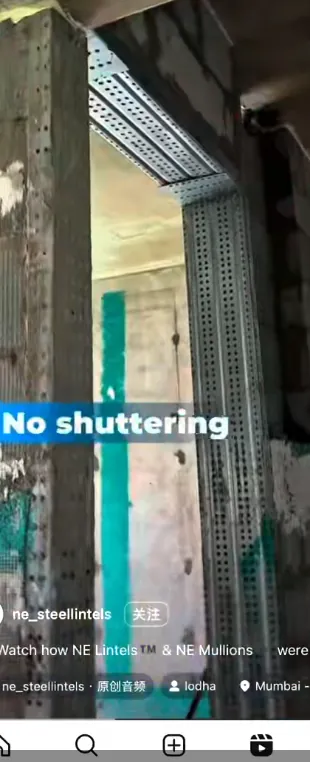
The supplied images show a perforated formed member installed over a building opening. They are useful for discussing overall configuration, perforation, support and site handling, but they cannot replace a controlled fabrication drawing or structural calculation.
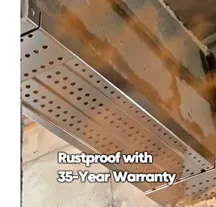
The wording visible in the close-up image, including any rustproof warranty, is reference content from another source. Fulei Metal does not adopt that claim for this requirement.
Proposed manufacturing route
From Approved Drawing to Labelled Export Bundles
The route is finalized only after material, section geometry, perforation and finish are confirmed.
- 01
Drawing and schedule review
Compare the cross-section drawing, nine-line size schedule, quantity, installation reference and required delivery sequence.
- 02
Material confirmation
Lock the steel grade, thickness tolerance, corrosion-protection system, certificates and any project-specific compliance documents.
- 03
Blank and perforation planning
Review coil or sheet route, perforation pattern, edge margins, cut length, burr direction and part identification.
- 04
Forming trial
Form a first article using the proposed sequence and check section size, angle, straightness, twist and surface condition.
- 05
First-article approval
Record the critical measurements and resolve open drawing questions before releasing all nine specifications.
- 06
Batch manufacture
Run each specification against a controlled revision, with clear separation between thicknesses and lengths.
- 07
Final inspection and labelling
Verify dimensions, perforations, edges, finish, quantity and identification according to the agreed inspection plan.
- 08
Export packing
Bundle and palletize long components to limit movement, edge damage, bending and specification mixing in transport.
Inspection plan
Controls for Long, Formed Components
- Material identity and thickness against the approved specification
- Overall length, section height and width using agreed datums
- Angles, return flanges, straightness and twist
- Perforation size, pitch, edge distance and burr condition
- Cut ends, sharp edges, surface condition and coating coverage
- Part code, quantity, bundle label and packing-list match
Inspection frequency and measuring methods should be agreed during drawing review, especially for structural or site-critical characteristics.
Export packing
Keep Nine Sizes Identifiable in Transit
Long thin-gauge components can be damaged by unsupported lifting, excessive strap pressure, movement inside a bundle or mixed identification. A practical packing plan separates specifications, protects formed edges and gives the receiving team a clear count.
- Specification codes on parts, bundles and packing lists
- Separators and edge protection selected for the finish
- Support points planned for the longest 2,400 mm parts
- Pallet and bundle limits matched to handling equipment
- Moisture and corrosion protection matched to the final material system and shipping route
RFQ completion checklist
Information Needed for a Reliable Quotation
Sending these items together makes it easier to compare process options and avoid a quotation built on hidden assumptions.
Buyer questions
Questions Raised About the Lintel Enquiry
Can Fulei Metal quote from this size list alone?
The list is enough for an initial discussion, but not a firm manufacturing quotation. We also need the section drawing, steel grade, perforation pattern, finish, structural approval basis, delivery location and packing requirement.
Can you confirm a load capacity for the lintels?
Not from dimensions alone. Load capacity depends on section geometry, material properties, opening span, support conditions and the building design. The buyer or qualified structural engineer should approve the structural specification.
Do you offer a 35-year rustproof warranty?
No such warranty is stated for this RFQ. The wording visible in a buyer reference image belongs to another source. Any corrosion performance or warranty must be based on the selected material, finish, validation method and a separate written agreement.
How will nine specifications be controlled?
Each approved part can be assigned a specification code linked to the controlled drawing revision. Production, inspection records, bundle labels and packing lists should use the same code to reduce mixing risk.
What drawing formats can be reviewed?
STEP, DWG, DXF, PDF and SolidWorks files can be reviewed. A PDF drawing is especially useful for dimensions, tolerances, notes, coating requirements and inspection characteristics.
Is 200 pieces per size suitable for batch planning?
It is a workable RFQ quantity for review. Final process route, tooling, packaging, lead time and price depend on the completed technical specification and whether the nine sizes share the same cross-section and perforation tooling.
Start the technical review
Send the Lintel Section and Project Requirements
Attach STEP, DWG, DXF, PDF or SolidWorks files together with the material, coating, structural approval basis, destination and required delivery sequence. We will identify the missing decisions before preparing a manufacturing quotation.
Perforation Geometry Changes the Section Before It Changes the Appearance
Holes in a lintel are usually specified for weight, for drainage or for keying into masonry, and the structural consequence is easy to underestimate. A perforated section is a weaker section, and weakening is concentrated where the holes are. What matters is not only how much material is removed, but the pattern: holes in a line across the section remove it at one station, and staggered holes distribute the loss. On a lintel, the critical positions are the ends, where the shear is highest, and the bottom flange, which is in tension.
- Keep the end zones clear of perforations where the bearing and shear demand it. This is the detail that most often needs a revision.
- Hole spacing relative to hole diameter matters more than hole count. Closely spaced holes leave thin ligaments that deform during forming.
- Perforating before forming and after forming are different processes with different results on hole roundness and on edge quality.
Structural Responsibility Sits With the Designer, and That Is Worth Stating Early
A lintel carries a building. We manufacture the section to the drawing and to the material and corrosion specification; the load-carrying adequacy of that section for a given opening is a structural calculation made by the project’s designer or engineer, and it is not something a fabricator can take on by implication. Stating that at enquiry stage avoids the situation where a part is manufactured exactly to the drawing and then found to be inadequate for the span.
What we can contribute is the manufacturing side of the same question: whether the section as drawn can be formed consistently at 1.2 to 2.4 m lengths, whether the perforation pattern survives forming without deforming, and whether the coating system specified is achievable on the section geometry. Those are manufacturing answers to a structural question, and they are worth having before the drawing is frozen rather than after. Send the cross-section, the perforation pattern, the steel grade, the finish and the destination, and the review covers all of it. Lead time is quoted after drawing review and process confirmation.
Get a quote for this part
Send a drawing, or just the size and quantity. A sales engineer replies within 24 hours, Monday to Friday (China time).