


Public Guardrail
SKU: FL-PF-004
Highway guardrail. Galvanized steel, W-beam profile, post included.
| Material | Hot-dip galvanized steel (Q235, 3.0mm W-beam) |
|---|---|
| Manufacturing Process | Roll forming + hot-dip galvanizing |
| Surface Finish | Hot-dip galvanized (≥85μm) |
| Tolerance | ±2mm |
| Beam length | 4m |
| Post spacing | 2-4m |
| Beam thickness | 3.0mm |
| Height | Effective 700mm |
| MOQ | 500 meters |
| Lead Time | Quoted after drawing review and process confirmation |
| Sample Time | Quoted after drawing review and process confirmation |
| Sample Fee | USD 200 |
| Price Range | USD 25-50/meter |
| Applications | Highways, roads, parking lots |
| Compliance | AASHTO M180, EN 1317 |
| Export Markets | USA, Germany, Africa, Middle East |
How This Public Guardrail Is Fabricated and Checked
This product is a rolled steel beam section with a galvanized finish, made to a published profile and coating requirement. It is worth being precise about what that covers, because the word guardrail is used for two different things: a barrier beam, which is a component, and a tested crash barrier system, which is a completely different proposition involving posts, foundations, end treatments and physical testing.
The beam is roll formed and then hot-dip galvanized, a combination of forming and surface treatment that has to be planned as one sequence.| Stage | What happens | What is verified before the job moves on |
|---|---|---|
| Coil preparation | Steel coil at 3.0 mm is prepared and fed to the roll forming line. | The coil is checked against the material certificate. For a guardrail beam the yield strength of the coil is what the section performance is based on, so the certificate is part of the record rather than paperwork filed away. |
| Roll forming | The W profile is formed by progressive rolls, in one continuous pass along the coil. | Profile dimensions are checked against the drawing at the start of the run and at intervals afterwards. Roll forming holds a constant section along the whole length; this is the reason a continuous profile is rolled rather than press braked in segments. |
| Cutting to length | The formed beam is cut to the specified length, 4 m as standard. | Finished length and the squareness of the cut ends are checked. The cut end is where the beam is joined to the next one, so an out-of-square end shows as a misaligned run on site. |
| Hole punching | Post fixing holes are punched on the line. Hole positions are set from the drawing. | Hole positions and pitch are checked against the drawing. Slotted or oversized holes are sometimes requested to allow for site tolerance; if they are not requested, the tolerance has to be held at the post spacing instead. |
| Pre-galvanizing preparation | The beams are checked for sharp edges, burrs and any oil residue from forming. | Surface condition is confirmed before the dip. Roll forming leaves oil on the section, and if it is not removed the coating will not bond evenly over the whole surface. |
| Hot-dip galvanizing | Beams are galvanized to the specified coating thickness. | Coating thickness is measured after the dip on a sample basis, on flat faces and on the inside of the profile. The inside of a W section is where the coating thins out and where corrosion starts if it does. |
| Checking and packing | Beams are checked for straightness and packed in bundles for shipping. | Straightness after galvanizing is confirmed, and bundles are banded so the beams cannot slide against each other. Galvanized surfaces are never stacked wet. |
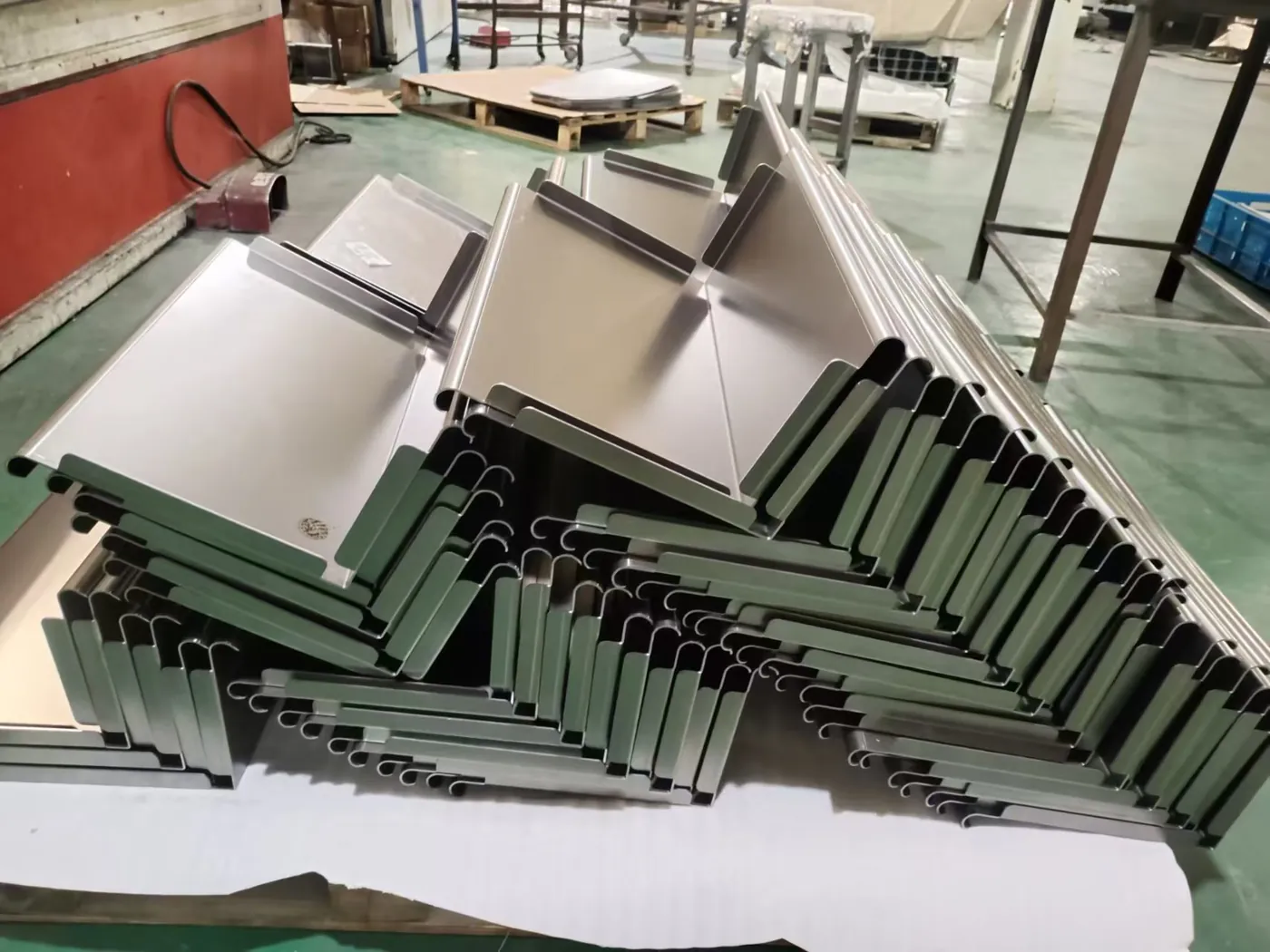
Adjusting Public Guardrail Without New Tooling
Beam length, hole pattern and coating are all open within the limits of the roll forming tooling that produces the profile.
| What can be changed | What it affects | What it does not affect |
|---|---|---|
| Beam length | Cutting setup and packing | The profile itself |
| Hole pattern and spacing | Punching setup, and the post spacing it suits | The section |
| Galvanized coating thickness | The galvanizing specification and the price | The profile |
| Coating colour | An additional coating step over the galvanizing | The beam section |
| Posts and fixings | Whether they are in scope at all – they are usually supplied separately | Nothing on the beam |
What Buyers Usually Ask About Public Guardrail
Is this a crash-tested barrier?
No, and this is the point worth being absolutely clear about. What is manufactured here is the beam component, made to a published profile with a specified galvanized coating. Crash performance is a property of a complete system – the beam, the posts, the post foundations, the end treatment and the transition to whatever is adjacent – and it is established by physical impact testing of that whole assembly under a standard such as EN 1317, with the result certified by a testing body. Supplying a beam that meets a profile and coating requirement is not the same thing, and any supplier who blurs the two is doing their customer a disservice. If your project needs a certified system, we can make the components to the drawings of a system that has been certified, but the certification is not ours to give.
Why is the beam rolled rather than press braked?
Because the profile is continuous. Roll forming passes the steel through a series of rolls that each move it a little closer to the finished section, so the profile is constant from the first metre to the last. Press braking the same shape would mean forming it in segments along the length, and every segment boundary leaves a mark and a small deviation. For a profile that has to interlock with posts at consistent centres along four metres, that difference matters. It is also why the beam length is cut from a continuous run rather than made in fixed increments.
How is the coating thickness controlled?
It is specified before galvanizing and measured after. Coating thickness on hot-dip galvanizing is a function of steel thickness and the time in the bath, so the specification is set from the section and then verified by measurement on a sample basis using a magnetic gauge. Measurements are taken on flat faces and inside the profile, because the inside of the section is consistently the thinnest part and that is where corrosion would begin. If your project specifies a minimum coating figure, give it at quotation – it may require the dip time to be adjusted rather than simply checked afterwards.
Send the beam length, the hole pattern and the coating thickness you require. If your project needs a certified barrier system rather than components, say so at the outset so the scope is clear from the beginning. Send your requirement for a quotation.
Coating thickness is measured on a sample basis, inside the profile as well as on the flats, following the same inspection approach used across production.
Post Spacing Decides Whether the Beam Bends or Tears
A W-beam barrier works by deflecting: the beam takes the impact, the posts give, and the whole system absorbs energy by moving. That is why post spacing is a system decision rather than a procurement one. Put the posts further apart and the beam has a longer unsupported span, which means it deflects more – and while deflection is the mechanism you want, beyond a certain span the failure moves from bending to tearing at the post, which is not. The 2 to 4 m range on this product is the working window, and where you sit inside it depends on the site.
- Shorter spacing holds the beam higher on impact and loads the posts more. Longer spacing lets the beam pocket, which is the intended behaviour on a shallow impact.
- The splice between two 4 m beams is a deliberate weak point in the system. It has to be detailed the way the system designer specified it, not the way it is easiest to make.
- Crash performance is a property of the complete barrier system and is demonstrated by type testing carried out by the system supplier or a test house. What we supply is the beam and post steelwork to the drawing and coating specification.
A 4 m Beam Goes Into the Bath Lengthwise and Comes Out Bent
Roll forming leaves residual stress in a W-beam, and a hot-dip bath at roughly 450 degrees is enough to let some of it relax. A long, slender part is the worst geometry for this: it has very little stiffness across its width, so a small relaxation shows up as a visible bow along 4 m. It is not a coating defect and it is not a material defect, and it is managed by how the part is handled into and out of the bath rather than by changing the steel.
Coating thickness on these beams is specified at a minimum of 85 microns and it is measured, not assumed. What measurement does not cover is the ends. Cut ends and punched holes expose bare steel at the moment they are made, and on a hot-dip part there is no way to re-coat them in the field that gives the same protection. Where holes are needed, the sequence – form, then galvanize, then avoid cutting – is worth deciding before the beam is made. Lead time is quoted after drawing review and process confirmation.
Payment Terms
How a project is paid for is agreed before production starts, and the structure that applies to your order is stated on the quotation and on the order confirmation, so there is no ambiguity later.
- 30% advance payment with the order and the 70% balance before shipment — our standard structure.
- 70% advance payment with the order and the 30% balance before shipment — used for some projects.
- 100% payment in advance before production starts — used for some projects.
If your finance team works to a fixed structure, say so in the first enquiry and we will confirm what applies to your order before you commit. Request a quotation.
Questions buyers ask before sending drawings
The questions that come up most often before a project starts, answered the way we answer them by email.
What do you need from me to quote Public Guardrail?
2D drawings as PDF, DWG or DXF, or 3D files as STEP, IGES or SolidWorks, together with material grade, sheet thickness, surface finish, quantity and destination country. If the drawing is not finished yet, send a photo, a sketch or the existing part instead — we review what can be measured from it and reply with the questions that still need answering.
How long does a quotation take?
Enquiries are answered within one business day. Simple laser-cut and bent parts are quoted within 24 hours. Welded frames, assembled units and multi-part structures are quoted after the drawing review and process confirmation, and the date is confirmed in our reply.
Is there a minimum order quantity?
Prototypes are made from a single piece and small batches of 10–50 pieces are routine. Prototype, first batch and repeat volume are quoted together so the numbers stay consistent as the project scales.
Can you work from a sample or a photo if I have no drawing?
Yes. Send the part itself, clear photographs with a rule or caliper in frame, or a dimensioned sketch. We measure what can be measured, list what is still undefined, and confirm it with you before production.
Need a Similar Part?
Most enquiries that start on a page like this are not an order for Public Guardrail — they are a search for a factory that can make something like it. Send us your drawing, 3D model or sample and we will review the manufacturing process and the quotation requirements, then come back with a process plan, a price and a lead time.
We work from 2D drawings, STEP / DWG / DXF / PDF files, or a physical sample if that is all you have.
No complete drawings yet? Describe the part, send photos or a sketch, or send a sample — we can start from there. Discuss your project.
Trade Terms and Delivery
We quote under the standard Incoterms your logistics team already works with, and build the packing and documentation around the one you choose.
- EXW — you collect from our Ningbo facility and run export clearance through your own forwarder.
- FOB Ningbo — we deliver to the vessel at Ningbo port and handle export clearance.
- CIF — we cover carriage and insurance to your named destination port.
- DDP — we handle carriage, insurance, import clearance and duties through to your door.
Send your destination country, target delivery date and preferred trade term together with the drawing. Request a quotation.
Quotation Time
We quote from your drawings. How long that takes depends on what the part asks for:
- Simple parts — quoted within 24 hours. Laser-cut blanks and bent components, supplied with complete 2D or 3D drawings. Mon–Fri, GMT+8.
- Complex assemblies — quoted after the drawing review. Payment kiosks, multi-part welded frames, enclosures with purchased hardware, or anything needing a coating or assembly trial. We confirm a quotation date once the scope is clear.
Production lead time is quoted separately, after drawing review and process confirmation. Send your drawings.
What stands behind this quotation
- Manufacturing since 20162,500 m² Ningbo plant — 3 laser cutting machines (including newer TRUMPF), 4 CNC press brakes and 10 welding stations.
- Shipped to more than 30 export marketsEnclosures, cabinets and formed parts supplied to OEM buyers across Europe, North America and Asia.
- 123 documented product casesMedical device housings, HVAC and heat pump enclosures, agricultural and livestock equipment, industrial hydraulics, material handling trolleys and EV charging cabinets.
- Factory evidence you can checkTUV Rheinland audit reference MIC-ASI243729 and Bureau Veritas reference MIC-ASR263630 available for buyer review under NDA.
Before you send drawings: an NDA is signed on request · first-article inspection is carried out before a batch continues · pricing is staged from prototype quantity to repeat volume · pre-shipment photos and packing records are prepared when the project needs them.