


Pig Slatted Floor Support
SKU: FL-LF-013
Tri-beam slatted floor support for pig pens. Hot-dip galvanized for long service life.
| Material | Galvanized steel beam (Q235) |
|---|---|
| Manufacturing Process | Laser cutting + forming + welding + galvanizing |
| Surface Finish | Hot-dip galvanized |
| Tolerance | ±1mm |
| Length | 2400mm |
| Beam height | 60mm |
| Load capacity | 500kg/m² |
| Slats width | Compatible standard |
| MOQ | 200 units |
| Lead Time | Quoted after drawing review and process confirmation |
| Sample Time | Quoted after drawing review and process confirmation |
| Sample Fee | USD 100 |
| Price Range | USD 18-25/unit |
| Applications | Pig farms, farrowing crates |
| Compliance | ISO 1461 |
| Export Markets | Germany, Spain, USA |
How This Pig Slatted Floor Support Is Fabricated and Checked
A slatted floor support is a beam carrying a distributed load in a wet, corrosive environment. The load rating is set by the section and the support spacing, and the corrosion question is settled by how the beam drains.
| Stage | What happens | What is verified before the job moves on |
|---|---|---|
| Beam forming | The support beam laser cut and formed to its section from Q235 | Section dimensions and straightness. The section is what carries the load, so a formed profile that is out of shape is a strength problem rather than a fit problem |
| Slat interface provision | Pockets, notches or fixing positions made where the slats land | Pocket positions and depth, because the slats have to sit level across a whole pen and the supports are what set that level |
| End plate and fixing provision | End plates formed and welded where the beam meets its support or the concrete | End plate flatness and position, since the beam load goes into the structure through these |
| Welding | End plates and any reinforcement welded | Weld condition at the ends, which take the shear, and that no weld closes a section that has to drain |
| Drain and vent provision | Holes formed so the galvanising bath enters and drains from the closed section | Hole positions on every closed length. A beam that holds the bath inside corrodes from within, and that is invisible until it fails |
| Hot-dip galvanising | Beams dipped, drained and cooled | Zinc thickness against the specified figure, and the drain condition |
| Dimensional check and packing | Beams checked against the tighter tolerance this part is specified at, then bundled | Length and pocket positions, and that bundling does not load the section |
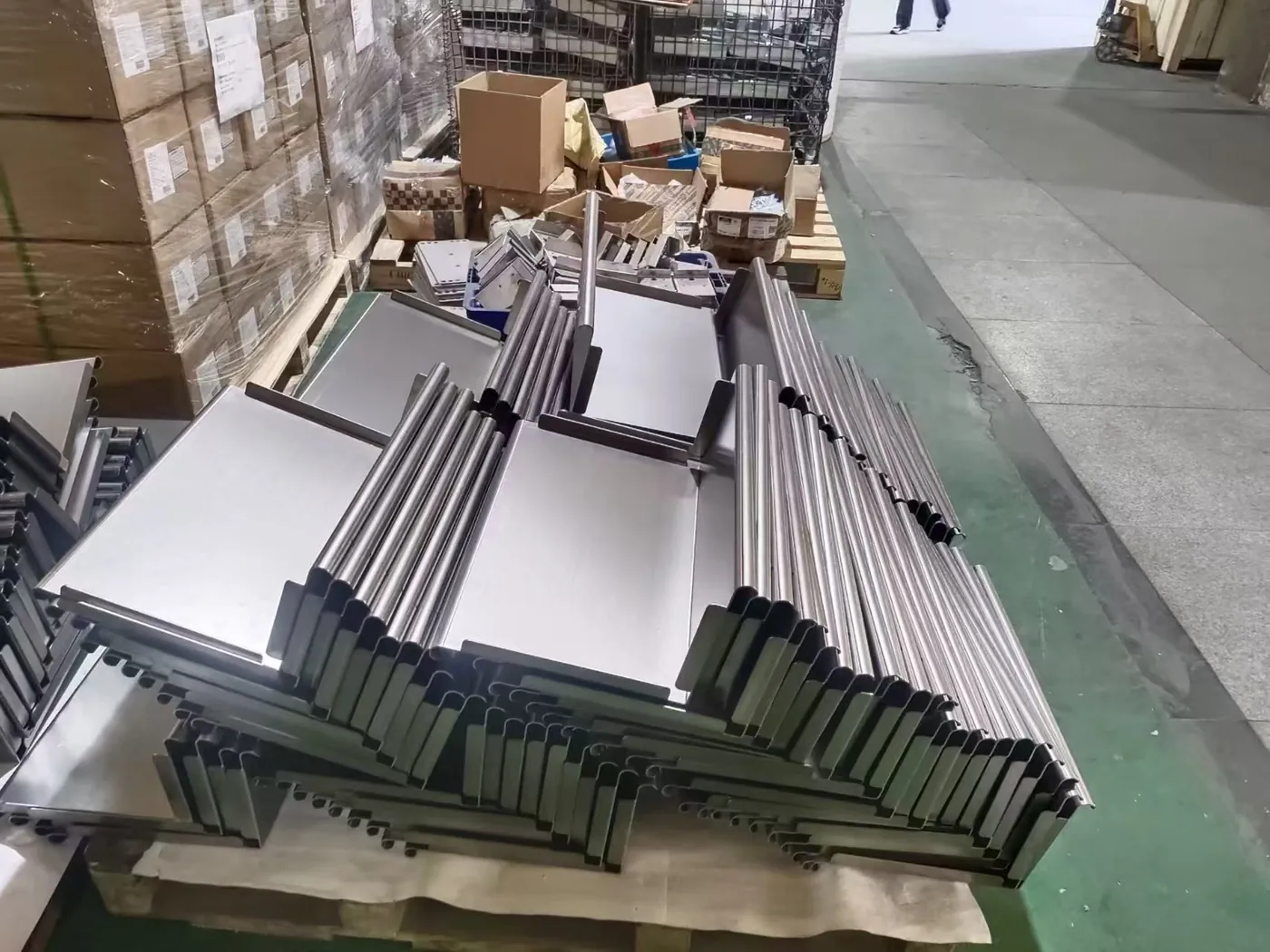
Adjusting Pig Slatted Floor Support Without New Tooling
Load, span and slat type are the three inputs; the section and the pockets follow.
| What can be changed | What it affects | What it does not affect |
|---|---|---|
| Length, section and pocket spacing | The formed beam and the slats it carries | The material and the galvanising process |
| Load rating and support spacing | Beam section and the number of supports per run | The pocket layout |
| Slat type and orientation | The pocket shape and whether the slats are locked or loose | The beam section |
| Interface with concrete or a steel frame | The end plate and the fixings, and how the wet interface is treated | The beam |
| Finish: galvanised as standard | Life under a slatted floor, where it is never dry | Nothing structural |
| Bundling and packing | How the beams are handled and stored before installation | The beam itself |
FAQ on Pig Slatted Floor Support
How is the load rating arrived at?
From the beam section, the support spacing and how the load is distributed across the slats. Those three are considered together, because a beam rated for the load on supports that are too far apart is not rated at all. The rating is quoted per square metre of floor so it can be checked against the actual stocking density.
What happens where the beam meets concrete?
That is the wet interface, and it is where a slatted floor support corrodes first, because the joint holds moisture and the beam is never dry. Keeping the end detail drained, and giving the fixing positions on the drawing so the concrete insert can be set correctly, are the two things that decide how long the joint lasts.
Why is the tolerance tighter than on a fence panel?
Because the pockets set the level of the slats across the whole pen. A support that is a couple of millimetres out is a slat that rocks, and a floor that rocks is a welfare and hygiene problem. The beam tolerances and the pocket positions are held to the tighter figure for that reason.
The section, the pockets and the drainage decide how a floor support behaves. Send the span, the stocking load and the slat type through the RFQ form and the beam is sized to them. Related: CNC bending, welding and surface finishing.
Slat Gap and Load Rating Are Set by the Animal, Not the Drawing
A slatted floor support beam looks like a structural part and is really an interface part: it has to carry the load above it while presenting the right gap to the animal standing on it. The gap is an animal-welfare input that belongs to the buyer’s husbandry system – the size and category of pig the pen is built for – and it is not something a fabricator should guess. What we control is the part in front of us: the beam section, the height, the span, and holding the stated tolerance so the slats seat on the support the way the layout expects.
- The stated 500 kg per square metre is a distributed figure. Animals load a pen unevenly, and a group gathered along one wall puts a line load into a small number of beams.
- A tri-beam section resists the twisting that a single flat would suffer when the load lands off-centre, which is what happens constantly in a pen.
- Where the beam meets concrete is the corrosion start. The end bearing detail – how the beam sits on or in the concrete – is the decision that decides service life, and it belongs on the drawing.
Why Galvanizing Happens After Welding, and What That Means for the Design
Hot-dip galvanizing protects a welded assembly because the steel goes into the zinc bath as a finished fabrication: welds, ends and any brackets are all coated. That is the reason this sequence is used on livestock equipment rather than painting over a pre-coated material. It also puts two constraints on the design. The assembly has to fit the bath – a 2400 mm beam is fine, a larger welded frame is not – and it has to let zinc in and out. Sealed hollow sections need vent and drain holes positioned so no air pocket is trapped and no zinc is left inside.
The bath is also hot, and a long welded member can come out of it with a bow that was not there when it went in. We jig long members for galvanizing and we discuss the straightness tolerance with you before quoting, because a beam that is straight before dipping and bowed afterwards is a process reality rather than a defect. Lead time is quoted after drawing review and process confirmation.
Payment Terms
How a project is paid for is agreed before production starts, and the structure that applies to your order is stated on the quotation and on the order confirmation, so there is no ambiguity later.
- 30% advance payment with the order and the 70% balance before shipment — our standard structure.
- 70% advance payment with the order and the 30% balance before shipment — used for some projects.
- 100% payment in advance before production starts — used for some projects.
If your finance team works to a fixed structure, say so in the first enquiry and we will confirm what applies to your order before you commit. Request a quotation.
Questions buyers ask before sending drawings
The questions that come up most often before a project starts, answered the way we answer them by email.
What do you need from me to quote Pig Slatted Floor Support?
2D drawings as PDF, DWG or DXF, or 3D files as STEP, IGES or SolidWorks, together with material grade, sheet thickness, surface finish, quantity and destination country. If the drawing is not finished yet, send a photo, a sketch or the existing part instead — we review what can be measured from it and reply with the questions that still need answering.
How long does a quotation take?
Enquiries are answered within one business day. Simple laser-cut and bent parts are quoted within 24 hours. Welded frames, assembled units and multi-part structures are quoted after the drawing review and process confirmation, and the date is confirmed in our reply.
Is there a minimum order quantity?
Prototypes are made from a single piece and small batches of 10–50 pieces are routine. Prototype, first batch and repeat volume are quoted together so the numbers stay consistent as the project scales.
Can you work from a sample or a photo if I have no drawing?
Yes. Send the part itself, clear photographs with a rule or caliper in frame, or a dimensioned sketch. We measure what can be measured, list what is still undefined, and confirm it with you before production.
Need a Similar Part?
Most enquiries that start on a page like this are not an order for Pig Slatted Floor Support — they are a search for a factory that can make something like it. Send us your drawing, 3D model or sample and we will review the manufacturing process and the quotation requirements, then come back with a process plan, a price and a lead time.
We work from 2D drawings, STEP / DWG / DXF / PDF files, or a physical sample if that is all you have.
No complete drawings yet? Describe the part, send photos or a sketch, or send a sample — we can start from there. Discuss your project.
Trade Terms and Delivery
We quote under the standard Incoterms your logistics team already works with, and build the packing and documentation around the one you choose.
- EXW — you collect from our Ningbo facility and run export clearance through your own forwarder.
- FOB Ningbo — we deliver to the vessel at Ningbo port and handle export clearance.
- CIF — we cover carriage and insurance to your named destination port.
- DDP — we handle carriage, insurance, import clearance and duties through to your door.
Send your destination country, target delivery date and preferred trade term together with the drawing. Request a quotation.
Quotation Time
We quote from your drawings. How long that takes depends on what the part asks for:
- Simple parts — quoted within 24 hours. Laser-cut blanks and bent components, supplied with complete 2D or 3D drawings. Mon–Fri, GMT+8.
- Complex assemblies — quoted after the drawing review. Payment kiosks, multi-part welded frames, enclosures with purchased hardware, or anything needing a coating or assembly trial. We confirm a quotation date once the scope is clear.
Production lead time is quoted separately, after drawing review and process confirmation. Send your drawings.
What stands behind this quotation
- Manufacturing since 20162,500 m² Ningbo plant — 3 laser cutting machines (including newer TRUMPF), 4 CNC press brakes and 10 welding stations.
- Shipped to more than 30 export marketsEnclosures, cabinets and formed parts supplied to OEM buyers across Europe, North America and Asia.
- 123 documented product casesMedical device housings, HVAC and heat pump enclosures, agricultural and livestock equipment, industrial hydraulics, material handling trolleys and EV charging cabinets.
- Factory evidence you can checkTUV Rheinland audit reference MIC-ASI243729 and Bureau Veritas reference MIC-ASR263630 available for buyer review under NDA.
Before you send drawings: an NDA is signed on request · first-article inspection is carried out before a batch continues · pricing is staged from prototype quantity to repeat volume · pre-shipment photos and packing records are prepared when the project needs them.