


Hay Rack for Horses
SKU: FL-LF-006
Wall-mounted hay rack for horses. Reduces hay waste and improves feeding hygiene.
| Material | Powder-coated steel (Q235, 25mm round tube) |
|---|---|
| Manufacturing Process | Tube bending + MIG welding + powder coating |
| Surface Finish | Powder coating (black/green/custom) |
| Tolerance | ±2mm |
| Dimensions | 1200×600×800mm |
| Tube OD | 25mm |
| Capacity | 20kg hay |
| Mounting | Wall bracket |
| MOQ | 50 units |
| Lead Time | Quoted after drawing review and process confirmation |
| Sample Time | Quoted after drawing review and process confirmation |
| Sample Fee | USD 130 |
| Price Range | USD 55-75/unit |
| Applications | Horse stables, equestrian centers |
| Compliance | ASTM A500 |
| Export Markets | USA, UK, Germany |
How This Hay Rack for Horses Is Fabricated and Checked
A hay rack is bought for two reasons: to keep hay off the floor, and to keep a horse out of trouble. The second one is a design question, and it is decided by the bar spacing and the treatment of every tube end.
| Stage | What happens | What is verified before the job moves on |
|---|---|---|
| Tube cutting and bending | 25 mm round tube cut and bent to the rack profile | Bend radii and the bar positions, since the bar spacing is a safety dimension rather than a structural one |
| Frame welding | Frame and bars MIG welded with the spacing held | That the spacing is consistent from the top of the rack to the bottom. One wide gap is where a hoof gets trapped |
| Bar spacing control | Spacing set against the animal the rack is for, and checked through the whole frame | The clear opening between bars, measured rather than assumed from the bar centres, because the opening is the dimension that matters |
| Tube end treatment | Every tube end closed, capped or formed over | That no open tube end is left anywhere a horse can reach. An open tube at head height is a cutting edge and a place for feed to collect |
| Wall bracket provision | Brackets formed and positioned for the wall fixing | Bracket position and the projected load, because the rack is loaded by a horse leaning on it as well as by the hay |
| Surface preparation and coating | Degrease, phosphate, then powder coat to the agreed colour | Film thickness and coverage at the joints, and that no coating has built up inside the bar spacing |
| Load check | The rack loaded with representative hay and the brackets checked | That the frame does not deflect into the wall and the bracket fixings are not loaded in a way the drawing did not intend |
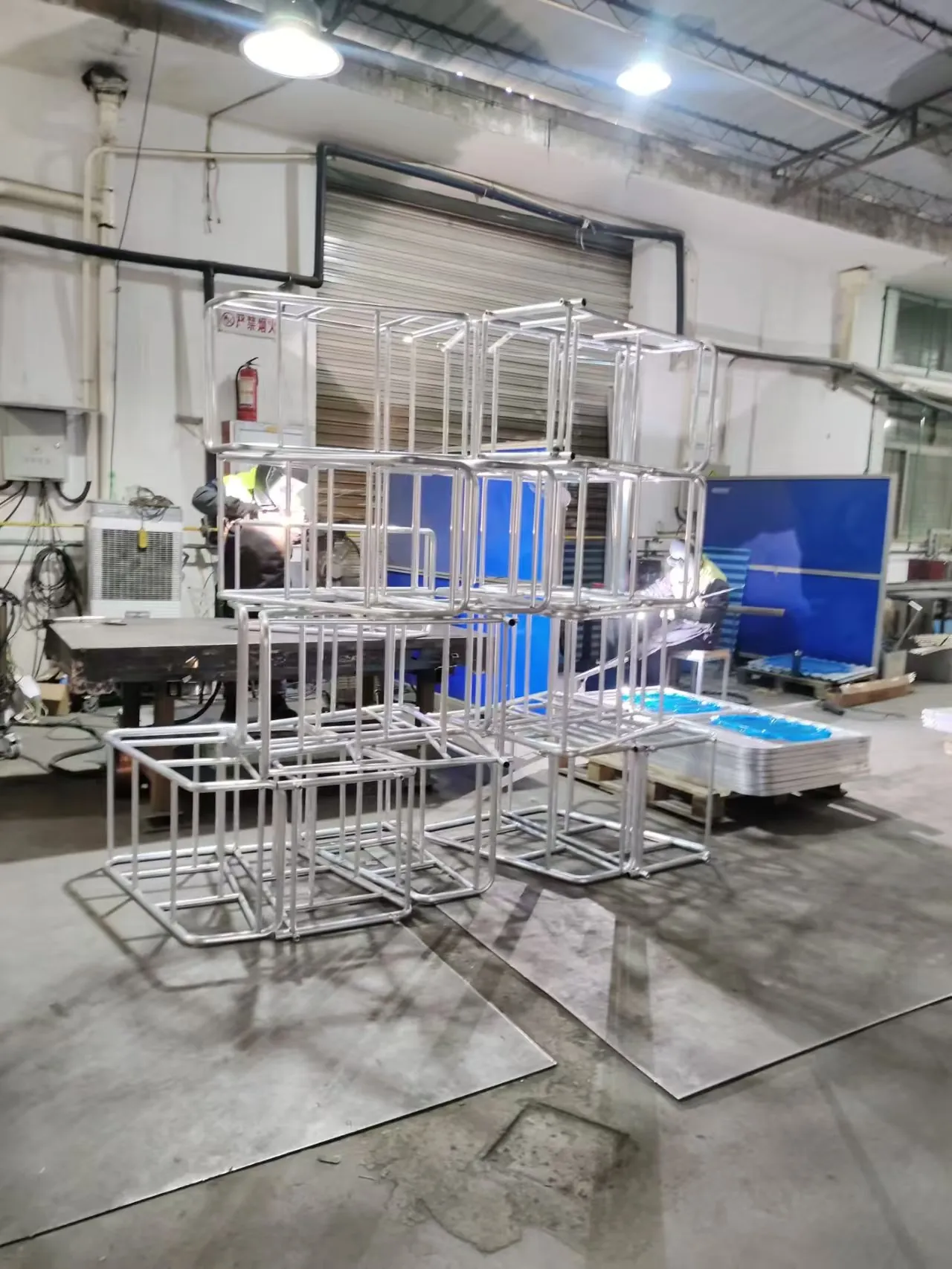
Revisions That Skip New Tooling on Hay Rack Horses
Bar spacing and mounting are the two decisions a buyer usually needs to make; the frame follows from them.
| What can be changed | What it affects | What it does not affect |
|---|---|---|
| Width, height and capacity | Tube lengths, bar count and how much hay it holds | The bar spacing, provided it stays inside the safe range |
| Bar spacing | Whether a hoof or a muzzle can be caught, and how easily the hay is pulled out | The frame section |
| Wall bracket or freestanding | The load path into the wall, and whether the rack can be moved | The frame |
| Bar profile: round tube or flat bar | Comfort for the animal, and how the hay is gripped | The frame |
| Colour and finish | Powder specification, and how it reads in a stable | Nothing structural |
| A lid or a top rail | Whether hay is kept in and whether the rack can be leaned on safely | The bar layout |
Questions Buyers Ask About Hay Rack Horses
Why is the bar spacing so important?
Because it is the dimension that decides whether a horse can pull hay out comfortably or get a hoof or a shoe caught. It is measured as a clear opening rather than as a bar centre distance, and it is checked through the whole frame, because a single wide gap near the bottom is where the accident happens.
Why are all the tube ends closed?
An open tube end is a thin, sharp edge at exactly the height a horse’s head and shoulders are, and it also collects feed and water. Closing or capping the ends is a small operation that removes both problems, and it is one of the things worth checking on a delivered rack.
The powder coating is rubbed through after a season – is that normal?
On a hay rack it is expected, because a horse rubs its muzzle and teeth on the bars. The coating is there for appearance and for the mild corrosion protection that goes with it, and site touch-up is a normal maintenance item. Where the frame itself is in a wet environment, the finish underneath is what decides how long it lasts.
Bar spacing and tube ends are what make a hay rack safe, and the wall bracket decides whether it stays up. Send the animal it is for and the wall construction through the RFQ form and the rack is made to suit. Related: welding, tube bending and surface finishing.
A Hay Rack Is Specified by How Much the Horse Wastes
The point of a wall-mounted hay rack is not to hold hay, it is to stop hay being trampled. That makes the geometry a behaviour question rather than a capacity question. A rack that is too deep lets a horse bury its head and pull out more than it eats; a rack that is too shallow makes the horse work at it and drop most of what it pulls. The bars that hold the hay in have to be close enough to slow the animal down and far enough apart that it can still get a mouthful, and that spacing depends on the size and the type of animal.
- Round tube is used rather than flat bar because there is no edge for the animal to work against and no flat face for moisture to sit on.
- Waste collects under the rack, which means the area below it gets wet and stays wet. The finish has to be specified for that, not for how the rack looks on day one.
- Wall mounting puts the whole load, plus the pull of an animal tugging at it, into a small number of fixings. The fixing specification is part of the product, not an installation detail.
Powder Coating Over Tube: Where It Fails First
A welded tube rack is coated after fabrication, which is the right sequence – the welds get covered as well. What the coating does not cover well is the inside of the tube. An open tube end is a path for moisture into a section that nobody will ever inspect, and on outdoor equipment that is where corrosion starts and where it stays invisible until the paint blisters from underneath. Closed or capped ends are a specification item on this product for that reason.
The other predictable failure is at the wall. A rack fixed flat to a wall traps damp and hay dust against both surfaces, and that combination holds water against the coating permanently. Standing the rack off the wall by even a short distance lets it dry, and it is a change to the bracket rather than to the rack. Tell us whether the rack goes inside a stable or outside against a wall, and the material, the finish and the mounting all change. Lead time is quoted after drawing review and process confirmation.
Payment Terms
How a project is paid for is agreed before production starts, and the structure that applies to your order is stated on the quotation and on the order confirmation, so there is no ambiguity later.
- 30% advance payment with the order and the 70% balance before shipment — our standard structure.
- 70% advance payment with the order and the 30% balance before shipment — used for some projects.
- 100% payment in advance before production starts — used for some projects.
If your finance team works to a fixed structure, say so in the first enquiry and we will confirm what applies to your order before you commit. Request a quotation.
Questions buyers ask before sending drawings
The questions that come up most often before a project starts, answered the way we answer them by email.
What do you need from me to quote Hay Rack for Horses?
2D drawings as PDF, DWG or DXF, or 3D files as STEP, IGES or SolidWorks, together with material grade, sheet thickness, surface finish, quantity and destination country. If the drawing is not finished yet, send a photo, a sketch or the existing part instead — we review what can be measured from it and reply with the questions that still need answering.
How long does a quotation take?
Enquiries are answered within one business day. Simple laser-cut and bent parts are quoted within 24 hours. Welded frames, assembled units and multi-part structures are quoted after the drawing review and process confirmation, and the date is confirmed in our reply.
Is there a minimum order quantity?
Prototypes are made from a single piece and small batches of 10–50 pieces are routine. Prototype, first batch and repeat volume are quoted together so the numbers stay consistent as the project scales.
Can you work from a sample or a photo if I have no drawing?
Yes. Send the part itself, clear photographs with a rule or caliper in frame, or a dimensioned sketch. We measure what can be measured, list what is still undefined, and confirm it with you before production.
Need a Similar Part?
Most enquiries that start on a page like this are not an order for Hay Rack for Horses — they are a search for a factory that can make something like it. Send us your drawing, 3D model or sample and we will review the manufacturing process and the quotation requirements, then come back with a process plan, a price and a lead time.
We work from 2D drawings, STEP / DWG / DXF / PDF files, or a physical sample if that is all you have.
No complete drawings yet? Describe the part, send photos or a sketch, or send a sample — we can start from there. Discuss your project.
Trade Terms and Delivery
We quote under the standard Incoterms your logistics team already works with, and build the packing and documentation around the one you choose.
- EXW — you collect from our Ningbo facility and run export clearance through your own forwarder.
- FOB Ningbo — we deliver to the vessel at Ningbo port and handle export clearance.
- CIF — we cover carriage and insurance to your named destination port.
- DDP — we handle carriage, insurance, import clearance and duties through to your door.
Send your destination country, target delivery date and preferred trade term together with the drawing. Request a quotation.
Quotation Time
We quote from your drawings. How long that takes depends on what the part asks for:
- Simple parts — quoted within 24 hours. Laser-cut blanks and bent components, supplied with complete 2D or 3D drawings. Mon–Fri, GMT+8.
- Complex assemblies — quoted after the drawing review. Payment kiosks, multi-part welded frames, enclosures with purchased hardware, or anything needing a coating or assembly trial. We confirm a quotation date once the scope is clear.
Production lead time is quoted separately, after drawing review and process confirmation. Send your drawings.
What stands behind this quotation
- Manufacturing since 20162,500 m² Ningbo plant — 3 laser cutting machines (including newer TRUMPF), 4 CNC press brakes and 10 welding stations.
- Shipped to more than 30 export marketsEnclosures, cabinets and formed parts supplied to OEM buyers across Europe, North America and Asia.
- 123 documented product casesMedical device housings, HVAC and heat pump enclosures, agricultural and livestock equipment, industrial hydraulics, material handling trolleys and EV charging cabinets.
- Factory evidence you can checkTUV Rheinland audit reference MIC-ASI243729 and Bureau Veritas reference MIC-ASR263630 available for buyer review under NDA.
Before you send drawings: an NDA is signed on request · first-article inspection is carried out before a batch continues · pricing is staged from prototype quantity to repeat volume · pre-shipment photos and packing records are prepared when the project needs them.