
Explore how bookends are fabricated from sheet metal for libraries and home bookshelves. Learn about material selection, stability design, and real-world products.
Introduction
Bookends are simple but essential accessories that keep books upright on shelves. While small, well-designed bookends require precise fabrication to provide adequate stability, prevent book damage, and complement shelf aesthetics. At Fulei Metal, we fabricate bookend components for library suppliers and home goods brands across Europe and Japan.
Bookend Types
Standard L-shaped bookends use a vertical panel and horizontal base, the most common type. Heavy-duty bookends use thicker material for large or heavy books. Decorative bookends feature artistic designs or custom shapes. Library bookends include additional features such as label holders or sign tabs. Magnetic bookends attach magnetically to metal shelving for secure positioning.
Material Selection
Powder-coated steel provides cost-effective bookends with color options and adequate stability for most applications. We use 1.0 to 2.0 mm sheet. For premium applications, stainless steel (grade 304) provides superior durability and a modern appearance. For heavy-duty bookends supporting large reference books, 2.0 to 3.0 mm steel provides necessary weight and rigidity.
Design Considerations
Bookends must be heavy enough or have sufficient base depth to resist tipping from book pressure. The vertical panel must be tall enough to support typical book heights (200-300 mm). The horizontal base must extend far enough under books for stability without wasting shelf space. All edges must be smooth to prevent book damage. Non-slip pads on the base prevent bookend sliding. Aesthetic design should complement shelf and book aesthetics.
Fabrication Process
Our TRUMPF fiber laser cuts bookend blanks from flat sheet stock with precise dimensions. CNC press brake machines form L-shapes with accurate 90-degree bends. Some designs incorporate additional bends for decorative effects or structural reinforcement. Component assembly may involve welding decorative elements or attaching label holders. Surface treatments include powder coating in client-specified colors and brushed finishes for stainless steel.
Case Study: Library Bookends for an East Asian Supplier
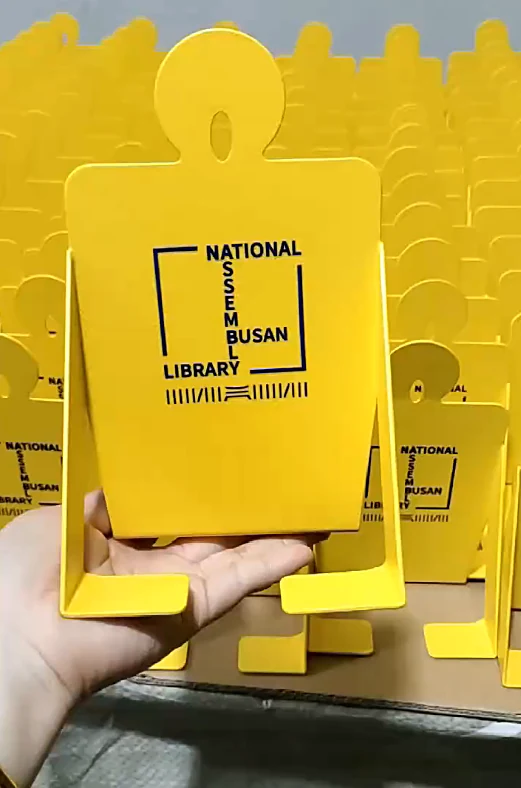
Bookends are the highest-volume part of the library programme supplied to an East Asian furniture supplier over the past two years, running at around 220,000 pieces a year. At that volume the design has to suit the process, because the cost is in the handling rather than in the steel. Bookends are therefore designed as a folded part that can be formed and finished in batches rather than as a machined item. The tolerance that matters is not the overall height but the flatness of the base: a bookend only holds by friction, and a base that rocks on a shelf will slide under load. Bases are checked for flatness and for burrs on the underside, since the underside is what sits on a finished shelf surface in a library.
Conclusion
Bookend fabrication requires precision forming, stability engineering, and aesthetic design. Fulei Metal’s capabilities make us a trusted partner for bookend projects.
If you are sourcing this type of part, our DFM engineering review page covers the tolerances, batch sizes and inspection we work to, and custom sheet metal fabrication shows the wider range we produce in Ningbo, China. For background reading before you request a quote, see Book Return Bin Fabrication.