
Public Distribution Cabinet
SKU: FL-PF-006
Stainless steel outdoor distribution cabinet. IP55, anti-vandal.
| Material | SUS 304 stainless steel (1.5mm) |
|---|---|
| Manufacturing Process | Laser cutting + bending + TIG welding + brushing |
| Surface Finish | Brushed stainless |
| Tolerance | ±0.5mm |
| Dimensions | 800×600×300mm |
| IP rating | IP55 |
| Anti-vandal | Yes |
| Lock | 3-point |
| MOQ | 20 units |
| Lead Time | Quoted after drawing review and process confirmation |
| Sample Time | Quoted after drawing review and process confirmation |
| Sample Fee | USD 250 |
| Price Range | USD 350-580/unit |
| Applications | Public utilities, electrical infrastructure |
| Compliance | IEC 62208 |
| Export Markets | USA, Germany, UAE |
How This Public Distribution Cabinet Is Fabricated and Checked
A stainless distribution cabinet outdoors has to do three jobs that pull against each other: keep water out, resist being forced open, and hold its shape while the door swings on its hinges. Where a cabinet is specified for an ingress protection rating and for anti-vandal construction at the same time, it is worth being clear about what each of those terms actually covers.
The welding and the gasket face work cannot be separated on a sealed cabinet, so both are covered under welding.| Stage | What happens | What is verified before the job moves on |
|---|---|---|
| Cutting | 1.5 mm 304 stainless is laser cut. Body panels, the door, the internal mounting plate and the gland plate openings are cut in one nest. | The door and the opening are checked as a pair rather than individually. The gap between them is what the seal works against, and it has to be consistent all the way round. |
| Bending | The body and door are folded, with the edges turned to give the door rigidity. | Door flatness is checked. A door panel that is not flat cannot seal, no matter how good the seal is, because the seal has to be compressed evenly and a dished door compresses it at the corners only. |
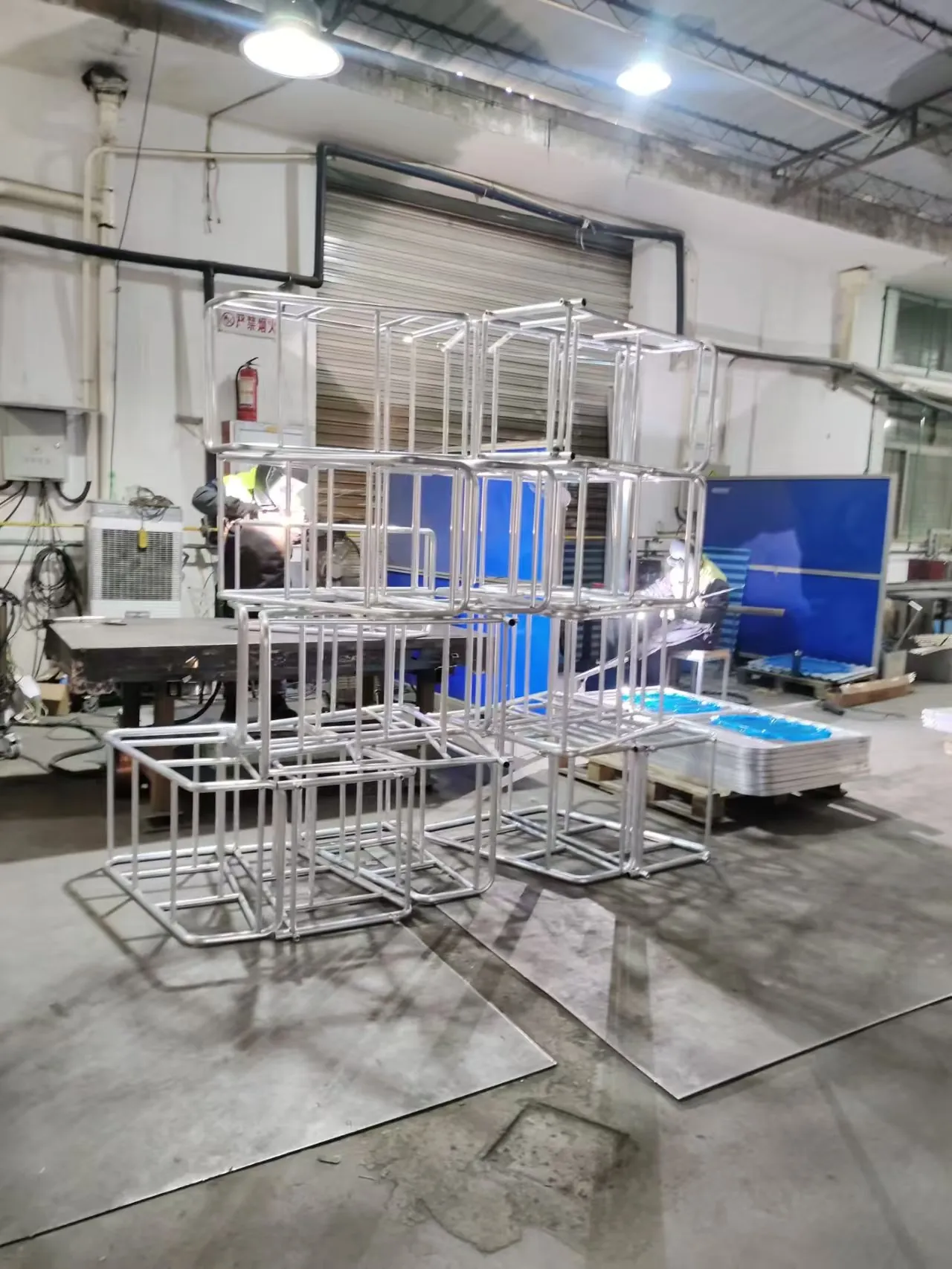
| Welding | TIG welding closes the body. Seams are positioned away from the gasket face wherever the design allows. | Welds are checked for full fusion and for distortion. A welded seam that has pulled the panel leaves the gasket face out of line, and gasket face flatness is the single most important dimension on a sealed cabinet. |
| Gasket face and door frame | The continuous gasket surface is established on the body, and the seal is fitted to the door or to the body depending on the design. | Gasket face flatness is checked with a straight edge around the whole perimeter. This is the step that decides whether the cabinet will keep water out in service. |
| Lock and rod mechanism | The three-point locking mechanism is fitted, with rods running to the top and bottom of the door. | Rod alignment and lock operation are checked with the door closed. A three-point lock that is even slightly out of adjustment will hold the door at the middle and let it stand off at the top or bottom, which breaks the seal at that point. |
| Anti-vandal details | Hinges are concealed or protected, fixings are internal where possible, and the door is stiffened. | The assembled cabinet is checked for the things that matter in service: that no fixing can be removed from outside, and that the door cannot be sprung far enough to reach the lock rods. |
| Finishing, cleaning and packing | Visible surfaces are brushed, welding residue and any polishing compound are removed, and the surface is passivated. | Stainless surfaces are checked for contamination from carbon steel tooling, which is a common cause of rust spots on a stainless assembly. Cabinets are packed with the door closed and the seal protected. |
What Can Change on Public Distribution Cabinet Without New Tooling
The cabinet is cut, folded and welded, so size and internal layout are open. Anything that affects the seal or the locking is where the engineering effort goes.
| What can be changed | What it affects | What it does not affect |
|---|---|---|
| Cabinet size and internal layout | Cut pattern and the door size | The material thickness |
| Single door or double door | The locking arrangement and the seal routing | The body |
| Lock type – key, padlock or specialist | The locking provision and the door hardware | The seal face |
| Mounting plate and gland plate arrangements | Internal cutouts and where the gland plate sits | The external seal |
| Coating over stainless, or stainless left natural | Whether a coated external finish is specified | The structural properties |
What Buyers Usually Ask About Public Distribution Cabinet
Is the IP rating tested or designed for?
The honest answer is that the rating is a claim about the design, and the formal proof is a type test carried out by a testing body on a sample. In production what we can guarantee is the structure that makes the rating possible: a continuous gasket face that is flat around the whole opening, a door stiff enough not to deflect under the seal load, a gasket of the right material and compression, and a gland arrangement that does not compromise the enclosure. Where a customer needs a certificate for their market, that is arranged as a separate exercise and we will say so at quotation rather than implying the production part is certified.
Does anti-vandal mean the cabinet cannot be forced?
No, and any supplier claiming that is overstating it. Anti-vandal construction delays and deters: concealed hinges, no external fasteners, stiffened door panels, and lock rods positioned so they cannot be reached. A determined attack with the right tools will always succeed against a sheet metal enclosure – the question is how long it takes and how much noise it makes. In practice the most effective measures are the ones that remove an easy opportunity: no exposed fixings, nothing to lever against, and a lock that cannot be picked quickly.
Will the door still seal after installation?
Only if the cabinet is not twisted when it is fixed. A sealed cabinet gets much of its rigidity from being a closed box, and if it is bolted to an uneven surface – a wall that is out of plumb, or four mounting points that are not coplanar – the body can be pulled out of shape. The door then lines up with the opening at three corners and stands off at the fourth. Fixing with shims, or mounting to a flat backing plate, avoids this. It is worth telling installers explicitly, because the symptom looks like a manufacturing fault when it is a fixing problem.
Send the internal dimensions you need, what will be installed inside, the lock type and whether the cabinet is to be surface mounted or recessed. The gasket face and the locking are designed around those answers. Send your specification for a quotation.
Where a formal ingress protection certificate is required for your market it is arranged as a separate exercise, and we will be clear at quotation about where our scope ends. What is verified in production is set out on our inspection page.
IP55 on a Public Cabinet Is Mostly About the Door, and the Door Is Mostly About Flatness
IP55 is written on this product as a design target and it is verified per order rather than assumed from the drawing. On a single-door cabinet the rating is decided at the door interface, and that interface fails for a reason that has nothing to do with the gasket: a door that is not flat does not compress the seal evenly. It seals along part of the perimeter and leaks at the rest, usually at a corner or at the latch side, and no amount of additional gasket fixes it.
- Door flatness on a 1.5 mm panel is achieved by the fold detail and by the hinge and latch positions, not by the thickness.
- A 3-point lock exists to pull the door down at three places. It is a flatness device as much as a security one, and a single-point lock on a tall door will leak at the free corner.
- Ventilation and IP rating pull in opposite directions. If the cabinet needs to dissipate heat, the vent path has to be designed rather than added.
Anti-Vandal, Public Access and the Difference Between the Two
A cabinet in a public space has two separate problems that get conflated: keeping the public out, and surviving the public. The first is a lock specification. The second is a construction question – how the door is hung, whether the hinge is internal, whether the lock housing is reinforced, and whether the cabinet can be levered off its mountings. A cabinet with a good lock and an external hinge is still easy to attack at the hinge, and it is a mistake made often enough to be worth stating on the drawing.
The second point is grounding. A stainless cabinet with powder-coated or insulated internal panels does not reliably ground through its own structure, and a grounding provision – a stud, a bonded hinge or a designated earth point – is a drawing item. IEC 62208 in the specification refers to the standard the empty enclosure is supplied to; the assembly and its electrical compliance are the responsibility of the assembler. Lead time is quoted after drawing review and process confirmation.
Payment Terms
How a project is paid for is agreed before production starts, and the structure that applies to your order is stated on the quotation and on the order confirmation, so there is no ambiguity later.
- 30% advance payment with the order and the 70% balance before shipment — our standard structure.
- 70% advance payment with the order and the 30% balance before shipment — used for some projects.
- 100% payment in advance before production starts — used for some projects.
If your finance team works to a fixed structure, say so in the first enquiry and we will confirm what applies to your order before you commit. Request a quotation.
Questions buyers ask before sending drawings
The questions that come up most often before a project starts, answered the way we answer them by email.
What do you need from me to quote Public Distribution Cabinet?
2D drawings as PDF, DWG or DXF, or 3D files as STEP, IGES or SolidWorks, together with material grade, sheet thickness, surface finish, quantity and destination country. If the drawing is not finished yet, send a photo, a sketch or the existing part instead — we review what can be measured from it and reply with the questions that still need answering.
How long does a quotation take?
Enquiries are answered within one business day. Simple laser-cut and bent parts are quoted within 24 hours. Welded frames, assembled units and multi-part structures are quoted after the drawing review and process confirmation, and the date is confirmed in our reply.
Is there a minimum order quantity?
Prototypes are made from a single piece and small batches of 10–50 pieces are routine. Prototype, first batch and repeat volume are quoted together so the numbers stay consistent as the project scales.
Can you work from a sample or a photo if I have no drawing?
Yes. Send the part itself, clear photographs with a rule or caliper in frame, or a dimensioned sketch. We measure what can be measured, list what is still undefined, and confirm it with you before production.
Need a Similar Part?
Most enquiries that start on a page like this are not an order for Public Distribution Cabinet — they are a search for a factory that can make something like it. Send us your drawing, 3D model or sample and we will review the manufacturing process and the quotation requirements, then come back with a process plan, a price and a lead time.
We work from 2D drawings, STEP / DWG / DXF / PDF files, or a physical sample if that is all you have.
No complete drawings yet? Describe the part, send photos or a sketch, or send a sample — we can start from there. Discuss your project.
Trade Terms and Delivery
We quote under the standard Incoterms your logistics team already works with, and build the packing and documentation around the one you choose.
- EXW — you collect from our Ningbo facility and run export clearance through your own forwarder.
- FOB Ningbo — we deliver to the vessel at Ningbo port and handle export clearance.
- CIF — we cover carriage and insurance to your named destination port.
- DDP — we handle carriage, insurance, import clearance and duties through to your door.
Send your destination country, target delivery date and preferred trade term together with the drawing. Request a quotation.
Quotation Time
We quote from your drawings. How long that takes depends on what the part asks for:
- Simple parts — quoted within 24 hours. Laser-cut blanks and bent components, supplied with complete 2D or 3D drawings. Mon–Fri, GMT+8.
- Complex assemblies — quoted after the drawing review. Payment kiosks, multi-part welded frames, enclosures with purchased hardware, or anything needing a coating or assembly trial. We confirm a quotation date once the scope is clear.
Production lead time is quoted separately, after drawing review and process confirmation. Send your drawings.
What stands behind this quotation
- Manufacturing since 20162,500 m² Ningbo plant — 3 laser cutting machines (including newer TRUMPF), 4 CNC press brakes and 10 welding stations.
- Shipped to more than 30 export marketsEnclosures, cabinets and formed parts supplied to OEM buyers across Europe, North America and Asia.
- 123 documented product casesMedical device housings, HVAC and heat pump enclosures, agricultural and livestock equipment, industrial hydraulics, material handling trolleys and EV charging cabinets.
- Factory evidence you can checkTUV Rheinland audit reference MIC-ASI243729 and Bureau Veritas reference MIC-ASR263630 available for buyer review under NDA.
Before you send drawings: an NDA is signed on request · first-article inspection is carried out before a batch continues · pricing is staged from prototype quantity to repeat volume · pre-shipment photos and packing records are prepared when the project needs them.