
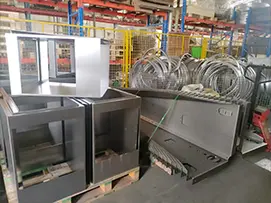
Custom Sheet Metal OEM
Sheet Metal Deburring Service for OEM Parts
Fulei Metal manufactures sheet metal deburring service for buyers that need safer edges, better coating adhesion, and cleaner assembly after cutting or punching.
Request a Quote Review manufacturing capabilities
Deburring Is Specified by What the Edge Has to Do Next
Deburring is one word for several different jobs, and the price difference between them is large. An edge that has to be safe to handle needs the burr broken and the sharpness removed. An edge that has to be powder coated needs to be clean and slightly radiused, because a coating pulls back from a sharp edge and leaves it thin. An edge that has to seal against a gasket needs to be flat and consistent, not merely free of burrs. Naming the downstream requirement is the whole specification.
- A burr left on a part lifts it off the surface it is meant to sit on. On a mounting face that is a fit problem, not a cosmetic one.
- Coating adhesion at an edge is a radius question. A sharp edge is a thin-coating edge, and thin coating is where corrosion starts.
- Parts that get handled by hand are the ones where deburring is a safety item rather than a finish item, and those should be specified as such.
Where Deburring Time Actually Goes
On a flat part with an accessible edge, deburring is fast and cheap. The cost rises with the awkward cases: internal holes on a large sheet, edges on both faces of a part that has to be turned over, small parts that have to be handled individually, and parts where only some edges need treating. Two parts of the same size can differ by a factor of several in deburring time purely because of where the edges are.
The practical saving is usually in the drawing. If only the edges that matter are specified, the rest can be left alone, and the part gets cheaper without being worse. If a part has holes that are hidden inside an assembly and never touched, they probably do not need deburring – and saying so on the print removes the work. Lead time is quoted after drawing review and process confirmation.
Sheet Metal Deburring Service for OEM Parts Specifications
| Material Options | carbon steel/stainless steel/aluminum |
|---|---|
| Thickness Range | 0.5-6.0mm |
| Typical Tolerance | – |
| Manufacturing Process | Deburring / Electropolishing / Powder Coating / Anodizing |
| MOQ | Quoted per part |
| Lead Time | Quoted after drawing review and process confirmation |
| Drawing Formats | PDF, DWG, DXF, STEP, IGES or SolidWorks files |
| Trade Terms | FOB Ningbo, EXW, CIF or project-based terms after quotation |
How Deburring Fits Into the Finishing Sequence
Deburring is not a cosmetic afterthought. A burr left on a laser-cut or punched edge holds coating unevenly, tears gloves and seals, and stops parts from seating flat during assembly. We treat edge condition as a specified feature: the edge break, radius or rounding is agreed against the drawing before the first part is processed.
The method depends on material and on what happens next. Carbon steel blanks usually go through belt or brush deburring before coating. Stainless parts that will be electropolished need a smoother pre-finish, because electropolishing removes metal uniformly and will not hide a torn edge. Aluminium parts destined for anodising need consistent edge rounding, otherwise the anodic layer builds unevenly at sharp corners.
Because deburring sits between cutting and finishing, we ask which operation follows it. A part going into powder coating, into welding, or straight into assembly each needs a different edge condition, and that sequence is what we confirm during RFQ review.
From Cut Blank to Coating-Ready Edge
Parts arrive as laser-cut, punched or sheared blanks. We look at the edge the previous operation produced first, because heavy dross from a slow cut needs more than one pass and can change the edge geometry.
Carbon steel and stainless parts are processed on belt or brush machines with the abrasive grade selected for material and thickness. Flat parts are handled on the line; smaller or already-formed parts are worked by hand so the bend geometry stays intact.
After deburring, parts move to the specified finish — powder coating, anodising or electropolishing — or are packed as bare parts when the customer applies the finish themselves. Edge condition is checked again before release, since a part can pick up handling marks between deburring and packing.
What We Check on a Deburred Part
Edge condition is verified visually and by hand against the agreed edge break, looking for missed edges, rolled burrs and abrasive marks on faces that will be visible.
Flatness is checked on parts that must seat against a mating surface, because aggressive deburring can round an edge further than the drawing allows. On parts going to coating, we confirm the surface is free of oil and abrasive dust before it enters the coating line.
Where a project needs documented inspection, we can provide incoming material checks, first-article inspection, in-process checks and final inspection photos. If your drawing defines an edge radius or a surface preparation requirement, send it with the RFQ so it is built into the quotation.
Parts That Commonly Need Deburring
- Laser-cut blanks before powder coating or anodising
- Punched and sheared parts with sharp pierced holes
- Stainless assemblies that will be electropolished
- Aluminium panels and covers for outdoor equipment
- Parts handled by operators during assembly
What Speeds Up a Deburring Quote
- Material, thickness and the operation that produced the edge
- Required edge break, radius or rounding, if the drawing specifies one
- The finish that follows — coating, anodising, electropolishing or none
- Whether parts are flat blanks or already formed
- Quantity, destination and lead-time expectation
Deburring Questions From Buyers
Can you deburr parts we cut ourselves?
Yes. Send the parts or the blank drawing; the edge your cutting process left affects how much work is needed.
Will deburring change part dimensions?
Edge breaking removes a small amount of material at the edge. If a hole position or edge dimension is critical, mark it on the drawing so the method is chosen accordingly.
Do you deburr formed parts as well as flat blanks?
Yes, though formed parts are often worked by hand to protect the bend geometry.
Should deburring happen before anodising or electropolishing?
Yes, and the order matters. Both finishes follow the existing surface condition rather than hiding it.
Getting a Sheet Metal Deburring Service OEM Parts Project Moving
Send material, thickness, quantity and the following finish through the RFQ form. We will confirm the method and the next quotation step.
Request a Quote for Sheet Metal Deburring Service for OEM Parts
Send your drawings and quantity requirement. Fulei Metal will review the manufacturing route and reply with the information needed for quotation.
More on Sheet Metal Deburring Service OEM Parts
Trade Terms and Delivery
We quote under the standard Incoterms your logistics team already works with, and build the packing and documentation around the one you choose.
- EXW — you collect from our Ningbo facility and run export clearance through your own forwarder.
- FOB Ningbo — we deliver to the vessel at Ningbo port and handle export clearance.
- CIF — we cover carriage and insurance to your named destination port.
- DDP — we handle carriage, insurance, import clearance and duties through to your door.
Send your destination country, target delivery date and preferred trade term together with the drawing. Request a quotation.
Payment Terms
How a project is paid for is agreed before production starts, and the structure that applies to your order is stated on the quotation and on the order confirmation, so there is no ambiguity later.
- 30% advance payment with the order and the 70% balance before shipment — our standard structure.
- 70% advance payment with the order and the 30% balance before shipment — used for some projects.
- 100% payment in advance before production starts — used for some projects.
If your finance team works to a fixed structure, say so in the first enquiry and we will confirm what applies to your order before you commit. Request a quotation.
Quotation Time
We quote from your drawings. How long that takes depends on what the part asks for:
- Simple parts — quoted within 24 hours. Laser-cut blanks and bent components, supplied with complete 2D or 3D drawings. Mon–Fri, GMT+8.
- Complex assemblies — quoted after the drawing review. Payment kiosks, multi-part welded frames, enclosures with purchased hardware, or anything needing a coating or assembly trial. We confirm a quotation date once the scope is clear.
Production lead time is quoted separately, after drawing review and process confirmation. Send your drawings.
What stands behind this quotation
- Manufacturing since 20162,500 m² Ningbo plant — 3 laser cutting machines (including newer TRUMPF), 4 CNC press brakes and 10 welding stations.
- Shipped to more than 30 export marketsEnclosures, cabinets and formed parts supplied to OEM buyers across Europe, North America and Asia.
- 123 documented product casesMedical device housings, HVAC and heat pump enclosures, agricultural and livestock equipment, industrial hydraulics, material handling trolleys and EV charging cabinets.
- Factory evidence you can checkTUV Rheinland audit reference MIC-ASI243729 and Bureau Veritas reference MIC-ASR263630 available for buyer review under NDA.
Before you send drawings: an NDA is signed on request · first-article inspection is carried out before a batch continues · pricing is staged from prototype quantity to repeat volume · pre-shipment photos and packing records are prepared when the project needs them.