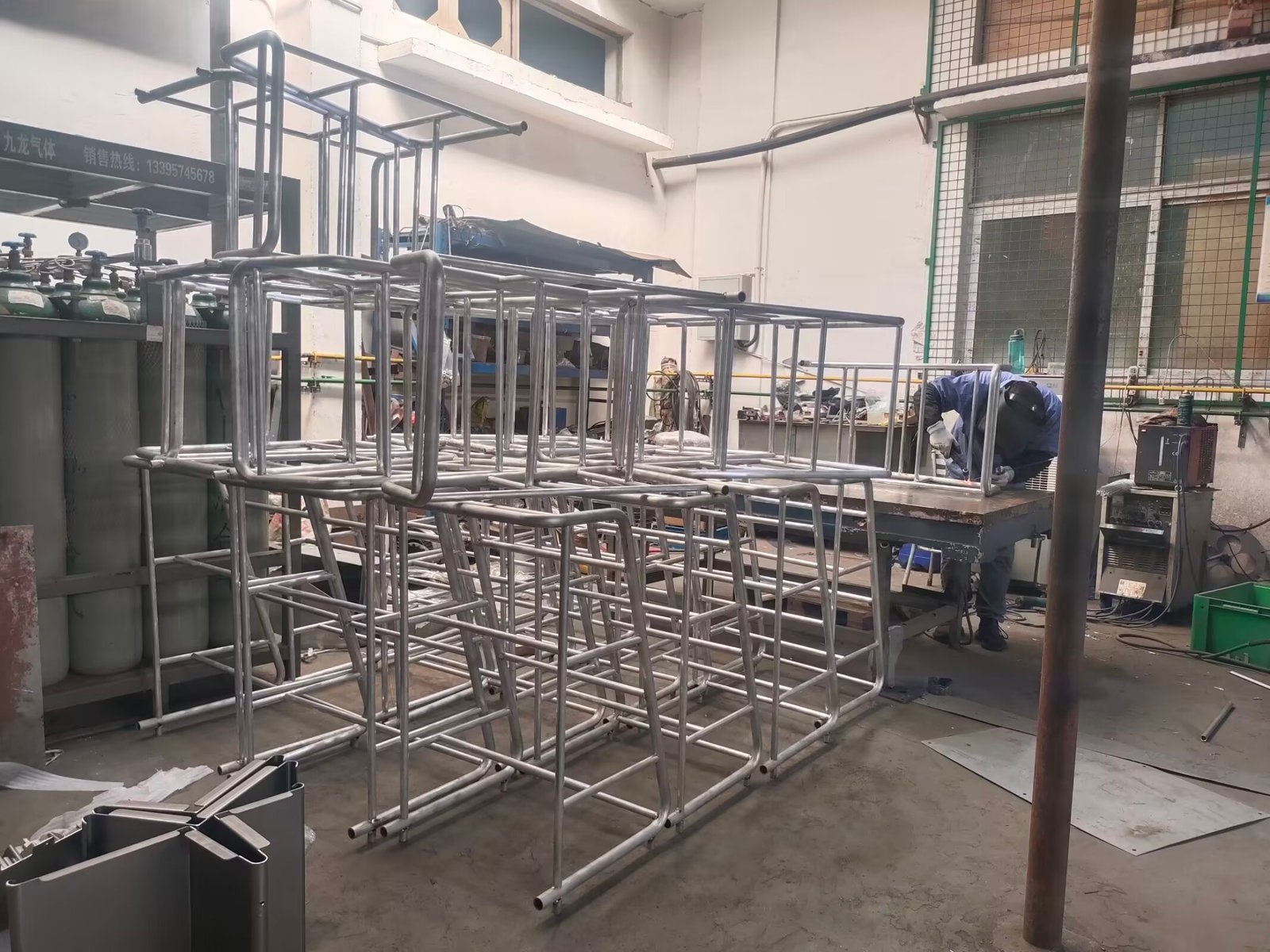
Of the 10 welding stations at our Ningbo factory, four are dedicated to aluminum work. We weld aluminum every single day — for go-kart chassis, library cart frames, electrical enclosures, and a dozen other OEM products. The question I get most often from customers and engineers is: “Should we be using TIG or MIG for this part?” Here’s how we actually answer that question, with real data from real production.
The 30-second answer
- Choose TIG when weld cosmetics matter, when the part is thin (≤3 mm), when the joint is short or has a complex shape, or when you need the lowest possible heat input.
- Choose MIG when you have long, straight or simple-curved welds, when the part is thicker (≥4 mm), when production volume is high, or when deposition rate matters more than cosmetics.
The mistake is treating this as a one-or-the-other decision. On a real production line, you’ll often use both on the same assembly. Let me show you how we decide.
The data: same plate, same joint, two processes
To put real numbers on this, we ran a controlled test in our shop. Same batch of 3 mm 5052-H32 aluminum plate, same butt-joint geometry, same filler wire (ER4043, 1.2 mm), same Argon shielding. One weld done with TIG (AC, 140 A, 50% argon/helium mix), one with MIG (pulse, 180 A, 100% argon). Here’s what we measured:
| Metric | TIG (GTAW) | MIG (GMAW-P) |
|---|---|---|
| Weld time (300 mm butt joint) | 9 min 20 s | 3 min 40 s |
| Deposition rate | 0.6 kg/h | 2.1 kg/h |
| Heat input (kJ/mm) | 0.55 | 0.85 |
| Distortion after welding | < 0.2 mm bow over 1 m | 0.8–1.5 mm bow over 1 m |
| Tensile strength (transverse) | 195 MPa | 188 MPa |
| Bead profile | Smooth, narrow, cosmetic | Wider, pronounced ripple |
| Spatter / cleanup | None | Moderate, requires brushing |
| Operator skill required | High | Moderate |
Notice: tensile strength is essentially the same. The differences are about time, heat, cosmetics, and operator skill. Both welds are structurally sound for the same application.
When TIG is the right call
Here are the situations where we default to TIG on our shop floor, no discussion:
1. Thin aluminum under 3 mm
Aluminum thinner than 3 mm is very difficult to MIG without burn-through. TIG’s lower heat input and more controllable puddle lets a skilled operator walk along a thin edge without blowing through. Most of our library cart frame welds (1.2–1.5 mm wall tube) are TIG, period.
2. Cosmetic or visible welds
If the weld is on a visible surface — like the top of a powder-coated cart frame, or a structural aluminum bracket that’s anodized after welding — the smoother TIG bead saves finishing time and looks better. We TIG-weld every visible weld on go-kart chassis for exactly this reason.
3. Complex geometry or short welds
For a bracket with 4–5 welds each 30 mm long, the MIG arc start/stop time eats the speed advantage. TIG wins on short, intermittent welds because the operator can precisely control the arc on every start.
4. Dissimilar aluminum alloys
When you have to weld 6061 to 5052, or aluminum to a thinner gauge of the same alloy, TIG gives you the heat control to avoid cracking in the heat-affected zone. MIG’s higher heat input makes HAZ cracking more likely on trickier alloy combinations.
When MIG is the right call
1. Thick aluminum over 4 mm
On 5 mm and thicker plate, MIG’s higher deposition rate cuts weld time dramatically. The heat input is higher, but on thick plate you can afford it because the section is stiff enough not to distort badly.
2. Long, straight or large-radius welds
For a 2-meter seam on a tank, a truck bed, or a long enclosure, MIG is the only economic answer. We run a 400 A pulse MIG on a long seam welder for exactly this kind of work. TIG would take 5–6x as long.
3. High-volume production
If you’re making 10,000 of something and the weld is straightforward, MIG is faster, more repeatable with a fixture, and lower-skill. We run robotic MIG cells for one of our UK customers’ bracket families — same weld on every part, hundreds per shift.
4. Production where the weld will be hidden
Inside a cabinet, behind a brace, on a face that gets covered — use MIG. Nobody will see it, and the structural performance is equivalent.
The gas question
One of the most common technical questions I get. For aluminum:
- TIG: 100% Argon for most work. Add 25–50% Helium for thicker plate or when you need a hotter, more fluid puddle. Pure helium is sometimes used for thick sections but is expensive.
- MIG: 100% Argon for standard spray arc and pulse MIG. 75% Argon / 25% Helium for thicker plate. Never use CO2 or CO2 mixes on aluminum — you’ll get porosity and bad bead shape.
If your factory is using CO2 or Ar/CO2 mix on aluminum, that’s a sign they’re not set up correctly for aluminum work.
The most common defects and what causes them
After 10 years of welding aluminum, here are the issues I see most often and what they tell me:
Porosity (small holes in the bead)
Cause: Contaminated base metal (oil, oxide, moisture) or insufficient shielding gas coverage. Aluminum oxide melts at 2,000°C vs aluminum at 660°C — any oxide in the weld zone turns into a gas pocket. Always clean with a dedicated stainless brush and acetone before welding.
Cracking in the HAZ
Cause: Wrong filler alloy, or too-rapid cooling on a crack-sensitive alloy like 6061. Use ER4043 for general purpose, ER5356 for higher strength, and never air-cool thick 6061 welds.
Burn-through on thin material
Cause: Too much heat, no backing, or no fixturing. Solution: use pulsed MIG, use a copper backing bar, or switch to TIG.
Excessive distortion
Cause: Too few tacks, no clamping sequence, too much heat input. Solution: more frequent tacks (every 50–100 mm), a balanced welding sequence, or stitch welding instead of continuous.
What we use on a real project: the CNClib library cart
To make this concrete, here’s exactly what we do for one of our long-running products, the library cart for CNClib in Korea:
- Frame tubes (1.2 mm 6061-T6): 100% TIG with ER4043 filler. Cosmetic, thin, complex shape.
- Shelf panels (2 mm 5052-H32): Pulse MIG with ER5356 filler. Longer seams, hidden after assembly.
- Wheel brackets (4 mm 6061): Pulse MIG with ER4043 filler. Thick enough to take the heat, hidden under the cart.
- Decorative top trim: Hand TIG. The single most cosmetic weld on the whole product.
Same product. Four different welding decisions, all made for specific reasons. The right answer to “TIG or MIG” is almost always “it depends on this specific joint.”
If you’re specifying welds on a drawing
Here’s how to write a weld callout that gives your OEM factory the right information without over-constraining them:
- Specify the process family, not the exact parameters: “GTAW (TIG) or GMAW (MIG) per AWS D1.2 / ISO 9606”
- Specify the filler alloy: ER4043 or ER5356 (or specify which to choose based on base material)
- Specify the inspection: visual per AWS C3.2, dye-penetrant for critical joints
- Specify the cosmetic standard if it matters: “weld shall be ground flush and polished” or “as-welded, no grinding required”
- Don’t specify the exact amps, voltage, or travel speed — that’s the factory’s job based on their equipment and the actual joint fit-up
If you specify parameters, you take responsibility for them. If you specify outcomes (strength, cosmetics, inspection), you let the factory optimize.
The bottom line
There’s no universal answer to TIG vs MIG for aluminum. Both processes, in skilled hands on properly maintained equipment, will deliver structurally sound welds. The right choice depends on the joint geometry, the material thickness, the cosmetic requirements, the production volume, and the cost target.
At Fulei Metal, we run both — daily — and the best factories will tell you the same thing. If a prospective supplier tells you they only do one or the other, they may be limited by their equipment, not by the right answer for your part.
If you want to see real samples of both processes on your part, send us a drawing and your material spec. We’ll weld a sample with each, cut a cross-section, and ship both to you with a recommendation.
Need a Welding Sample or Cross-Section Report?
Send your part drawing and we’ll weld a sample, cut and polish a cross-section, and ship a metallographic report. Free for serious OEM projects.