
At Fulei Metal, we run three laser cutters — a Trumpf TruLaser 3030 and two Chinese fiber lasers (6 kW and 12 kW). Over thousands of production jobs, we’ve learned one thing about cutting parameters: speed and quality are always in tension. Push speed up and you save machine time, but dross, kerf wander, and edge roughness creep in. Slow down too much and you waste capacity — and sometimes burn the edge worse, not better. This guide covers how we balance the two for carbon steel, stainless, and aluminum.
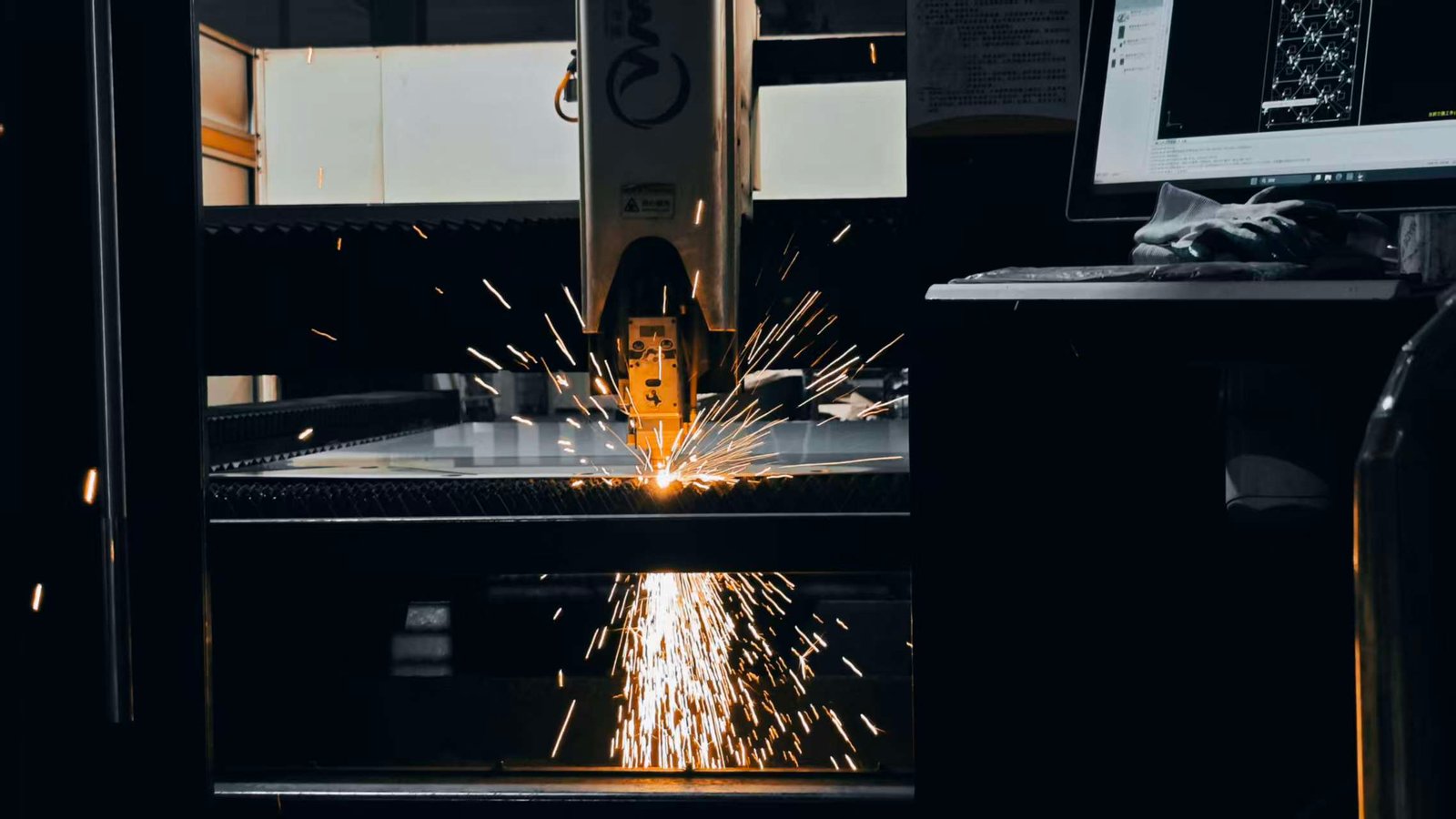
How laser power (kW) sets your speed ceiling
The first thing to understand is that laser power directly determines your maximum cutting speed for a given material and thickness. More kilowatts means more energy delivered per unit time, which means you can vaporize and blow away material faster — up to a point. But that “up to a point” is where most of the engineering judgment lives.
Here’s a rough rule we use on our 6 kW fiber laser for carbon steel cut with O₂:
| Material Thickness | Max Cutting Speed (mm/min) | Quality Speed (mm/min) | Min Speed Before Burn (mm/min) |
|---|---|---|---|
| 1 mm carbon steel | 18,000 | 12,000–14,000 | 6,000 |
| 3 mm carbon steel | 8,500 | 6,000–7,000 | 3,000 |
| 6 mm carbon steel | 4,200 | 3,200–3,800 | 1,500 |
| 10 mm carbon steel | 2,200 | 1,600–1,900 | 800 |
| 12 mm carbon steel | 1,800 | 1,200–1,500 | 600 |
Notice the gap between “max speed” and “quality speed.” That gap is where most of your unit-cost optimization happens. On our 12 kW machine, those numbers roughly double for thin gauge (1–3 mm), but the advantage shrinks for thick plate because you run into thermal limits — the material simply can’t absorb and shed heat fast enough.
The “speed threshold”: where quality drops off a cliff
Here’s the concept that matters most in practice. Cutting quality doesn’t degrade linearly with speed. It stays roughly flat across a wide range, then drops off a cliff past a threshold. Below that threshold, you get clean cuts. Above it, you get dross, rough edges, and dimensional drift.
We characterize this as three zones:
- Quality zone (below 70% of max speed): Clean edge, minimal dross, kerf width stable, dimensional accuracy within ±0.05 mm. This is where we run cosmetic parts, visible enclosures, and anything that feeds into precision bending.
- Productive zone (70–95% of max speed): Slightly more edge roughness, small dross on the bottom edge (easily deburred), kerf widens by 0.05–0.1 mm. Good for structural parts, brackets, and anything that gets welded or painted later.
- Burn zone (above 95% of max speed): Heavy dross, ragged edge, kerf unstable, parts may not meet dimensional spec. We never run here for production, but it’s useful to know where the cliff is.
The threshold isn’t fixed — it shifts with material type, assist gas, nozzle condition, and focal position. That’s why experienced operators are worth their weight in gold. A good operator can feel when the machine is approaching the cliff and back off 5% before the scrap starts.
How speed affects kerf width and edge quality
Kerf width — the width of the cut slot — is directly tied to cutting speed. As you speed up, the laser spends less time on each point, which means less heat spreads laterally. Counterintuitively, this can actually narrow the kerf at moderate speeds. But push too fast and the beam can’t fully penetrate before the head moves on, causing the kerf to become inconsistent and the bottom edge to drag.
On 3 mm stainless steel cut with N₂ on our 6 kW machine, we’ve measured:
- At 5,000 mm/min (quality zone): kerf = 0.32 mm, edge roughness Ra ≈ 3.5 μm, zero dross
- At 7,000 mm/min (productive zone): kerf = 0.28 mm, Ra ≈ 5.2 μm, light dross on bottom 0.2 mm
- At 9,000 mm/min (burn zone): kerf = 0.22–0.38 mm (unstable), Ra ≈ 12+ μm, heavy dross
For parts that go into assembled products where fit-up matters — our library furniture, for example — we stay in the quality zone. The 15–20% extra machine time is far cheaper than rework on a welded frame that doesn’t square up because the cut edge was ragged.
Assist gas pressure and nozzle condition
Assist gas does two things: it blows molten metal out of the kerf, and (for reactive cutting with O₂) it chemically participates in the cut. Get the gas wrong and no amount of speed tuning will save you.
Gas type by material
- Carbon steel: O₂ for thick plate (≥3 mm) — the exothermic reaction adds cutting energy. N₂ or air for thin sheet (≤2 mm) when you want a clean, oxide-free edge for painting.
- Stainless steel: N₂ is standard. For thick stainless (≥10 mm), some shops use N₂+O₂ mix, but we prefer straight N₂ at high pressure for consistency.
- Aluminum: N₂ or air. Aluminum reflects IR heavily, so you need higher power and clean optics. We cut aluminum up to 8 mm on our 12 kW machine.
Gas pressure and speed interact
Higher gas pressure lets you run faster because it clears the kerf more aggressively. But it also costs more (N₂ consumption is a significant per-part cost) and can cause turbulence that degrades edge quality if the nozzle is worn. We check nozzle orifice condition weekly — a nozzle that’s 0.05 mm out of round will produce visible edge quality drift on stainless before the operator notices.
Typical gas pressures we run (measured at the nozzle):
| Material | Thickness | Gas | Pressure (bar) |
|---|---|---|---|
| Carbon steel | 1–3 mm | O₂ | 0.5–0.8 |
| Carbon steel | 6–12 mm | O₂ | 0.8–1.2 |
| Stainless steel | 1–3 mm | N₂ | 12–16 |
| Stainless steel | 6–10 mm | N₂ | 18–22 |
| Aluminum | 2–6 mm | N₂ | 14–18 |
Practical recommendations by material
Carbon steel
Carbon steel is the most forgiving material. O₂ cutting gives you a wide productive zone — you can push speed to 85–90% of max and still get acceptable parts for most applications. The main quality concern is the oxide layer on the cut edge, which must be removed before painting or powder coating. For visible parts, switch to N₂ cutting on thin gauge (the edge stays bright and paint-ready). Our quality process requires deburring and oxide removal on all painted carbon steel parts regardless of cut speed.
Stainless steel
Stainless is where speed discipline matters most. The productive zone is narrower than carbon steel — about 10% narrower in our experience. Push too fast and you get a rough, gray edge with visible striations. For cosmetic stainless (our library furniture rails, food-grade equipment), we run at 65–70% of max speed and accept the extra cycle time. For structural stainless that will be welded, we push to 80–85%.
Aluminum
Aluminum is the trickiest. It has high reflectivity and thermal conductivity, which means the laser needs to deliver enough energy to maintain the cut but not so much that it creates a rough, ridged edge. We run aluminum at 60–75% of max speed, and we pay close attention to focal position — a 0.5 mm focus drift on aluminum will produce noticeably worse edge quality than the same drift on steel. If you’re specifying aluminum laser cutting, ask your supplier what focal length and power they use, and request a first-article sample before approving production.
The bottom line for buyers
If you’re sourcing laser-cut parts from a Chinese OEM, here’s what to ask:
- What speed are they running relative to max? A factory that always runs at 95%+ of max speed is sacrificing quality for throughput. The right answer is “it depends on the part” — cosmetic parts run slower, structural parts faster.
- What gas do they use for each material? If a supplier cuts all stainless with air to save gas cost, your edges will have oxide tint and may not pass a salt-spray test. N₂ cutting costs more but produces paint-ready edges.
- How often do they check nozzles and optics? Weekly is the minimum for a production shop. A worn nozzle is the #1 cause of gradual quality drift that operators don’t notice until a customer complains.
At Fulei Metal, we document cutting parameters for every part number and store them in our job database. When you reorder, you get the same speed, gas, and focal settings that produced your approved first article. Send us your drawing and we’ll quote it with the exact parameters we’ll use in production.
Need a Laser Cutting Quote?
Send us your drawing and material spec. We’ll quote with exact cutting parameters — speed, gas, power — so you know exactly what you’re getting.