If you’re reading this, you’re probably about to source custom sheet metal parts from China for the first time — or you’re burned from a previous bad experience and looking to do it better this time. Either way, you’ve come to the right place. My name is Jianan Gao and I run the sales and engineering side of Ningbo Fulei Metal Products Co., Ltd. — a sheet metal OEM factory in Ningbo, China that’s been making custom metal parts for overseas brands since 2016.
Over the past 10 years I’ve personally managed OEM projects for livestock equipment going to Hog Slat in the United States, library carts going to CNClib in South Korea, and industrial brackets going to distributors in the United Kingdom. I’ve also seen a lot of buyers make the same avoidable mistakes. This guide is the playbook I wish every new customer would read before they sent their first inquiry.
1. Decide What “OEM Sheet Metal” Actually Means in Your Case
“OEM” gets thrown around loosely. In our world, there are really three levels of partnership, and the supplier you need depends on which one matches your situation:
- Make-to-Print (the most common): You have a finished STEP/DXF/PDF drawing set. We manufacture exactly to your drawing. No design input needed from us beyond DFM review. This is where 80% of our customers sit.
- Make-to-Print + DFM: Same as above, but you want our engineering team to review your drawing for manufacturability and suggest changes that save cost or improve quality. We do this for free on every project — it’s part of how we work.
- ODM (Original Design Manufacturing): You bring a rough concept, sketch, or a competitor’s product, and our team designs it for you, then manufactures it. This is the deepest partnership and the highest-value work. We do a lot of this for our UK and Korean customers.
Knowing which one you need saves weeks of miscommunication. If you have drawings, don’t hire a Chinese factory that insists on “designing it for you” — you’ll pay for engineering you don’t need.
2. The Three Things That Actually Predict a Good Chinese Sheet Metal Supplier
Forget certifications, fancy websites, and Alibaba Gold Supplier badges. After 10 years and hundreds of projects, here’s what actually predicts whether a factory will deliver for you:
2.1 Equipment list, not certificates
Ask for a specific equipment list with model numbers and ages. A factory running two second-hand Amada lasers from 2007 is fundamentally different from a factory running a 2022 Trumpf TruLaser 3030. Both can cut steel, but the tolerances, the edge quality, the uptime, and the engineer who can program it are completely different.
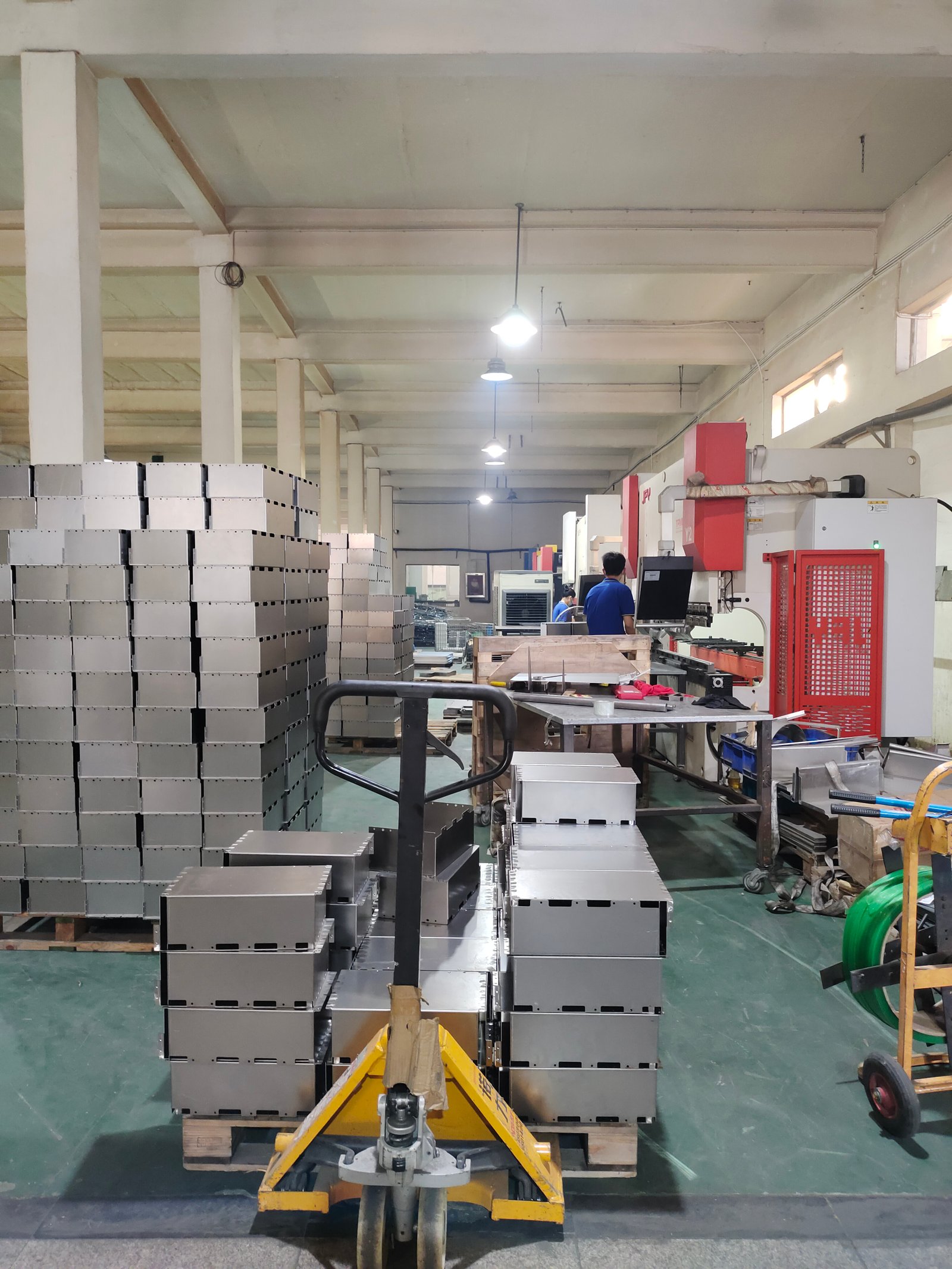
At our facility in Ningbo, we run three laser cutting systems (one of which is a Trumpf), four CNC press brakes, ten welding stations covering TIG/MIG/laser/spot, and full in-house surface treatment. The names of the machines and the year of manufacture tell you more than any ISO certificate.
2.2 The person who replies to your email
Pay attention to the first 3 emails. Are you talking to:
- A sales rep who can answer technical questions? (good sign)
- A sales rep who says “let me check with the engineer” and replies the next day with a real answer? (acceptable)
- A sales rep who can’t tell you the kerf width of their laser? (run)
Communication at RFQ stage predicts communication at mass-production stage. If they’re slow now, they’ll be glacial when there’s a real problem on the line.
2.3 How they handle a problem
This is the test you can only run on a real project, but you can simulate it. Send a drawing with a small ambiguity — say, an unclear tolerance on a hole. The way the factory responds tells you everything:
- Assumes a tolerance and tells you (good — they’re thinking)
- Asks a clarifying question (good — they’re careful)
- Quotes it without asking and hopes you don’t notice (bad — this is how 30% defects happen)
Real example: On our first project with CNClib in 2020, the customer sent a drawing for a library cart with a tolerance of “±0.5 mm” on a hole pattern. We noticed their mating bracket had ±0.3 mm and asked. They changed the drawing to ±0.3 mm to match. That single question saved a 6-figure assembly problem two years later when they designed the second-generation cart.
3. The Sourcing Process: A Realistic Timeline
Here’s a typical timeline for a mid-complexity project (say, 1,000 units of a 2 mm steel bracket with powder coating):
| Phase | Duration | What Happens |
|---|---|---|
| RFQ & DFM review | 1–3 days | You send drawings, we review and quote. Free. |
| Sample/prototype | 7–14 days | We cut, bend, and ship a 3–5 piece sample. Air freight. |
| Sample approval | 5–10 days | You inspect, test, and approve. Iterate if needed. |
| Mass production | 20–35 days | Cutting → bending → welding → surface finish → QC → packing. |
| Ocean freight | 16–35 days | Port-to-port, varies by destination. |
End-to-end, a typical first-time project takes 10–14 weeks from “I found this factory” to “goods on my dock.” Repeat projects with the same supplier are usually 6–9 weeks because tooling, programming, and trust are already in place.
4. Pricing: How to Compare Quotes Apples-to-Apples
This is where most buyers lose money — not because Chinese factories are expensive, but because two quotes that look the same on the surface hide huge cost differences. Here’s what to check before you compare line items:
- Material grade and origin: “Cold-rolled steel” can mean anything from a Chinese mill to Baosteel to imported POSCO. There’s a 20%+ price spread.
- Thickness tolerance: Chinese standard is GB/T 708, which allows wider thickness variation than ASTM A1008. If you need true 2.0 mm, ask for a mill certificate.
- Surface finish spec: Powder coating is not powder coating. What’s the pretreatment? What’s the film thickness in microns? What’s the salt-spray test rating? These matter.
- Inspection scope: First article only? 100% dimensional? AQL sampling? CMM on critical features? The most expensive part of a quality system is the inspection, and that’s often what’s missing from the cheapest quote.
- Tooling and setup: Are dies, jigs, and fixtures included in unit price, or one-time charges? Are programming charges included?
- Payment terms: 30% T/T deposit + 70% against B/L copy is the most common fair term. Anything more front-loaded is a red flag.
- Incoterm: EXW vs FOB vs CIF vs DDP can move 10–20% of your landed cost between the lines.
Rule of thumb: If a quote is 25% cheaper than three other quotes, one of three things is true: (1) they made a mistake, (2) they’re quoting a different spec, (3) they’ll surprise-invoice you later. None of these end well.
5. Quality: What to Actually Verify (and When)
ISO 9001 is table stakes. Every decent Chinese factory has it. What you actually want to see is how they implement quality control in practice. Here’s what we do, and what I’d ask any factory to do:
Pre-production
- Material certificates (mill certs) for every coil or sheet, kept on file
- First Article Inspection (FAI) report on the first part off the line, signed off before production continues
- PPAP-style documentation for automotive-adjacent work
During production
- In-process dimensional checks at defined intervals (e.g., every 50th part)
- Visual inspection at every stage: cut, bent, welded, finished
- Weld inspection — visual, dye-penetrant, or X-ray depending on criticality
Pre-shipment
- AQL sampling inspection (we typically use ANSI/ASQ Z1.4 Level II, 1.0 AQL)
- Full function test if applicable (e.g., a hinged part needs to actually open and close 100 times)
- Photographic documentation of finished goods, packaging, and container loading
If your factory doesn’t do all of this, either accept lower quality or pay for third-party inspection (SGS, Bureau Veritas, or our in-house QC team can all do this for you).
6. Logistics: Don’t Let Freight Eat Your Savings
The dirty secret of OEM manufacturing from China is that freight, duties, and last-mile delivery can easily add 15–30% to your landed cost. Here’s the 90-second version of how to think about it:
- EXW (Ex Works): You arrange everything from our loading dock. Maximum control, maximum hassle.
- FOB Ningbo: We deliver to the port, you arrange ocean freight. The most common and usually the best balance.
- CIF Your Port: We arrange ocean freight and insurance. Slightly more expensive, much less hassle.
- DDP Your Warehouse: We handle everything including duties. Convenient but the most expensive option. Best for smaller shipments where you don’t have a customs broker set up.
For a 40HQ container (about 65–75 m³) of welded steel parts going from Ningbo to Long Beach, you’re looking at roughly $4,500–7,000 in ocean freight in 2026. To Felixstowe, around $5,500–8,500. Get a quote from a freight forwarder (we work with several and can introduce you) before you commit to FOB vs CIF.
7. The Single Biggest Mistake I See Buyers Make
Choosing a factory based on the lowest first quote, and then spending the next two years paying for that decision.
The math almost always works out in favor of the mid-priced, well-equipped factory that communicates well. A factory that quotes 20% more but delivers on time with zero defects costs you less than a factory that quotes 20% less and causes one container of rework.
I’ve watched customers burn $200,000 on a “great deal” that turned into a $400,000 project. I’ve also watched customers save 40% on a mid-priced quote and pocket the difference. The factory you pick is the single biggest variable in your project.
8. How to Get Started With Fulei Metal
If you’ve read this far, you’re probably either evaluating us or thinking hard about OEM manufacturing in general. Either way, here’s the next step:
- Send us your drawings (STEP, DXF, PDF, or even photos of hand sketches) to violet@fuleimetal.com, or use the quote form.
- We’ll come back within 24 hours with a DFM review and a price.
- If the price works, we move to a 3–5 piece sample. Air freight, 7–14 days.
- Sample approval, then mass production. You can visit the factory in Ningbo, send a third-party inspector, or rely on our QC documentation — your call.
We do a free DFM review on every project because the cheapest way to make a part is to design it right the first time. Sometimes we save a customer 15% on unit cost just by suggesting a thicker gauge, a different bend radius, or a hole relocation.
Whether you work with us or not — I hope this guide helps you make a better decision. Good sourcing is the foundation of good products, and the foundation of good sourcing is asking the right questions.
Ready to Get a Quote?
Send your drawings to violet@fuleimetal.com and get a detailed quote within 24 hours. Free DFM review on every project.