
A custom steel trolley might seem like a simple product, but taking it from a CAD file to a container on a ship involves ten distinct phases. Here is the complete journey, using the kind of project we run regularly at Fulei Metal — so you know exactly what happens after you send us your RFQ.
Phase 1: Quotation and DFM Review
You send STEP files and a 2D PDF. Within 48 hours our engineers review the design for manufacturability: bend radii vs. material, weld access, tolerance feasibility and cost drivers. You receive a DFM note (what we can improve and what it saves) together with a firm quotation covering tooling, unit price and lead time.
Phase 2: Sample / First Article
Before committing to batch production, we build a first article — typically 1–3 units. This is where design intent meets reality: shelf clearances, caster fit, handle ergonomics and finish color are verified. You approve the sample, usually with a few small revisions that we fold into the drawing.
Phase 3: Material and Tooling
On approval we order the specified steel (SPCC, SGCC or stainless), and prepare dedicated bending tooling and welding fixtures. Fixtures guarantee that every unit in the batch is square and consistent — this is the hidden secret behind repeatable quality.
Phase 4: Laser Cutting
All profiles are cut on TRUMPF or domestic fiber lasers: tube notches, shelf blanks, bracket patterns and logos. Nesting software minimizes material waste, which keeps your unit price competitive.
Phase 5: Bending and Forming
CNC press brakes fold shelves and panels. For frame tubes, we use precise tube bending or mitre cutting + welding depending on the design. First-piece inspection per bend angle is standard.
Phase 6: Welding and Assembly
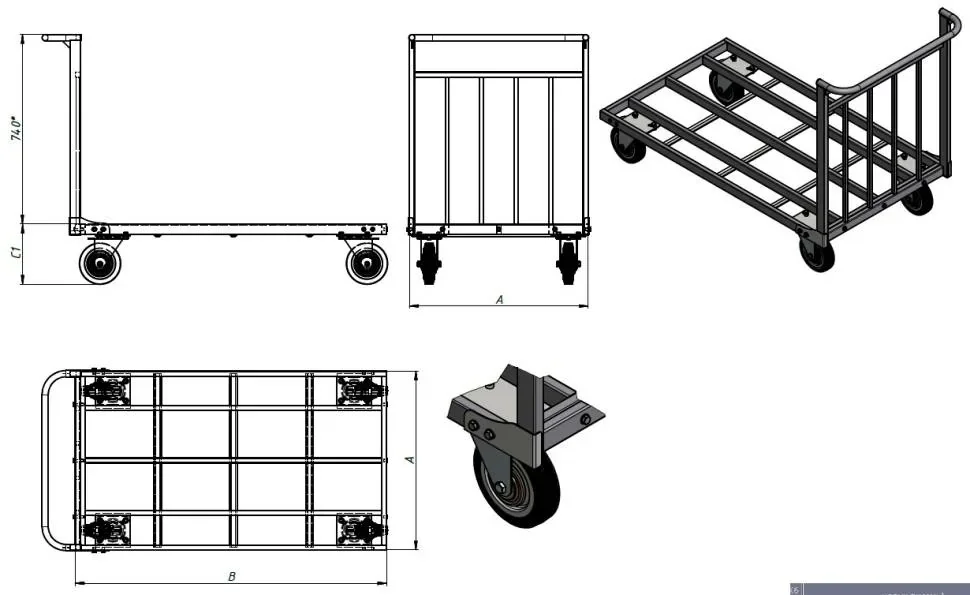
Qualified welders assemble frames and sub-assemblies in fixtures using MIG/TIG/spot welding. Weld joints are ground and finished where visible. Then hardware (casters, handles, shelves, drawers) is fitted and adjusted.
Phase 7: Surface Treatment
Depending on specification: degrease → zinc phosphate → powder coating (60–100 µm) in your RAL color, or zinc plating for hardware. Cured parts are inspected for thickness and adhesion.
Phase 8: Final Inspection
Every unit goes through dimensional checks, weld inspection, coating inspection, and a functional test (wheel rolling, brakes, shelf fit). A batch inspection report is issued and kept on file.
Phase 9: Packing
Units are wrapped with protective film, corner protection and cardboard or wooden pallets, configured for efficient container loading. Flat-pack designs ship with hardware kits and assembly instructions.
Phase 10: Export and After-Sales
We handle packing lists, commercial invoices and all export documentation (FOB Ningbo or CIF as agreed, with Incoterms specified up front). After shipment, our team remains available for assembly support and any quality follow-up.
Start Your Project
Whether you need 50 or 5,000 trolleys, the process is the same — rigorous, documented and transparent. Email your drawings to us and we will walk you through every phase with photos and reports.
For OEM buyers the practical next step is a drawing review — see our DFM engineering review for what we need and how fast we turn it around. This work sits inside our custom sheet metal fabrication capability, and Lean Manufacturing in Sheet Metal Assembly explains the technical background in more detail.
What stands behind this quotation
- Manufacturing since 20162,500 m² Ningbo plant — 3 laser cutting machines (including newer TRUMPF), 4 CNC press brakes and 10 welding stations.
- Shipped to more than 30 export marketsEnclosures, cabinets and formed parts supplied to OEM buyers across Europe, North America and Asia.
- 123 documented product casesMedical device housings, HVAC and heat pump enclosures, agricultural and livestock equipment, industrial hydraulics, material handling trolleys and EV charging cabinets.
- Factory evidence you can checkTUV Rheinland audit reference MIC-ASI243729 and Bureau Veritas reference MIC-ASR263630 available for buyer review under NDA.
Before you send drawings: an NDA is signed on request · first-article inspection is carried out before a batch continues · pricing is staged from prototype quantity to repeat volume · pre-shipment photos and packing records are prepared when the project needs them.