
We added laser welding at Fulei Metal in 2022, largely because our Korean and Japanese customers kept asking for it on sealed enclosures and stainless housings. After three years of running it alongside TIG and MIG, I can tell you exactly where laser welding earns its keep — and where it doesn’t. Here’s the practical breakdown.
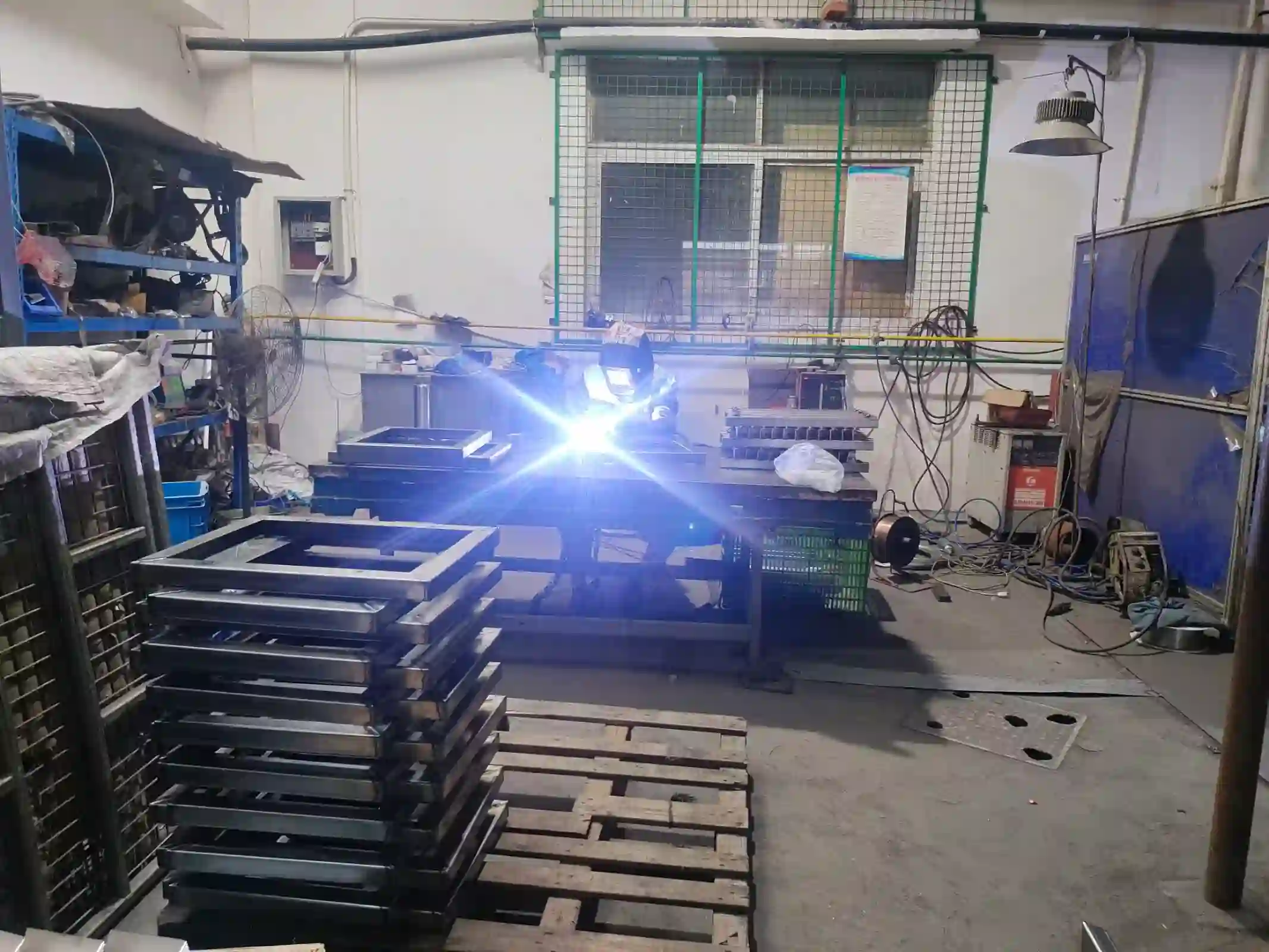
How laser welding is different from TIG and MIG
Laser welding uses a focused beam of coherent light — typically a fiber laser in the 1–6 kW range for sheet metal work — to melt the joint. The beam is delivered through a fiber optic cable to a welding head, where focusing optics concentrate the energy into a spot 0.2–0.6 mm in diameter. The power density at that spot is in the range of 10⁶–10⁷ W/cm², which is two orders of magnitude higher than a TIG arc.
This ultra-concentrated energy produces three key differences from arc welding:
- No filler metal in autogenous mode: For tight-fitting joints (gap < 0.2 mm, or about 10–15% of material thickness), laser welding fuses the base metal directly — no filler rod needed. The weld is essentially a re-melted and re-solidified zone of the parent material.
- Very narrow heat-affected zone: On 1.5 mm 304 stainless, our laser welds produce a HAZ 0.3–0.8 mm wide. The same material TIG-welded has a 4–6 mm HAZ. This is the single biggest advantage of laser welding for sheet metal — the part stays flat and the microstructure around the weld is barely altered.
- High travel speed: A 2 kW fiber laser can weld 1.5 mm stainless at 2–4 m/min. TIG on the same material runs at 0.12–0.15 m/min. That’s a 15–30× speed difference.
The advantages: why customers push for laser welding
Minimal distortion. The energy input per unit length of weld is low — typically 20–60 J/mm for laser vs. 200–500 J/mm for TIG on the same joint. A laser-welded 1.2 mm enclosure panel will be visually flat after welding. The same panel TIG-welded will need flattening or straightening. For cosmetic sheet metal parts, this is the decision-maker.
No post-weld finishing. A good laser weld on stainless produces a narrow, slightly raised bead with a smooth surface and no spatter or oxidation (assuming proper argon or nitrogen shielding). We frequently ship laser-welded parts with zero grinding, zero polishing — the weld is presentable as-is. This saves 5–15 minutes per part in finishing labor.
Precision on small features. Because the beam spot is sub-millimeter, we can weld within 2–3 mm of a bend line, a threaded insert, or a pre-installed component without damaging it. TIG can’t do that — the arc and heat spread too far.
| Factor | Laser Welding | TIG Welding |
|---|---|---|
| HAZ width (1.5 mm 304 SS) | 0.3–0.8 mm | 4–6 mm |
| Travel speed (1.5 mm 304 SS) | 2–4 m/min | 0.12–0.15 m/min |
| Energy input (J/mm) | 20–60 | 200–500 |
| Post-weld finishing required | Usually none | Often required (cosmetic) |
| Filler metal | Optional (wire feed add-on) | Required for most joints |
| Joint fit-up tolerance | <0.2 mm gap | <1.5 mm gap with filler |
| Equipment cost | $80,000–$250,000 | $3,000–$10,000 |
| Material thickness range | 0.5–4 mm (single pass, sheet metal) | 0.5–12 mm+ |
The limitations: where laser welding doesn’t make sense
Laser welding has real constraints, and we turn down laser work when the part doesn’t meet the requirements:
Tight fit-up is non-negotiable. The beam spot is 0.2–0.6 mm wide. If the joint gap is wider than the spot, the beam passes through without melting both sides. We require a gap of 0.2 mm or less for autogenous (no-filler) laser welding. This means our laser cutting and bending processes upstream need to deliver parts with tight dimensional control — the weld quality starts with the blank.
Thickness is limited. For sheet metal work, a 2–3 kW fiber laser can reliably penetrate 2–3 mm of steel in a single pass. For 4–6 mm stainless, you need 4–6 kW and possibly a filler wire feed. For anything above 6 mm, TIG or MIG is usually more practical and cost-effective in a production setting.
Equipment cost is high. A production-grade fiber laser welding system (laser source, chiller, welding head, motion system) runs $80,000–$250,000 installed. Compare that to a high-end TIG setup at $5,000–$10,000. The laser needs to run at high utilization to justify the capital cost. For low-volume, mixed-product shops, TIG usually makes more economic sense.
Reflective materials are tricky. Aluminum, copper, and brass reflect 80–95% of the 1 µm wavelength from a fiber laser. Welding these materials requires either higher power, special beam shaping, or green/blue laser wavelengths. We weld aluminum with our fiber laser, but the process window is narrower and more sensitive to surface condition than TIG welding aluminum.
Applications where laser welding wins
- Sealed enclosures and housings: When an electronics enclosure needs an IP65 or IP67 seal, laser welding produces a continuous, leak-tight seam with minimal heat input. The narrow weld doesn’t warp the sealing surface, so gasket compression stays uniform. We produce sealed stainless housings for Korean semiconductor equipment using laser welding — these parts have never failed a helium leak test.
- Battery boxes and trays: Thin-gauge CRS or stainless battery trays with lap joints. The low heat input keeps the tray flat, and the high speed makes 500+ units per shift practical. We laser-weld battery trays for a UK customer at 3,000 units per batch.
- Thin stainless housings (0.6–1.5 mm): Medical device housings, food equipment panels, architectural cladding — anywhere the part is thin and the appearance matters. Laser welding on 0.8 mm 304 produces a beautiful seam with zero discoloration when properly shielded.
- Parts with pre-installed components: When PEM inserts, studs, or electronic components are already installed near a weld joint, laser welding’s minimal heat spread prevents damage. TIG or MIG would overheat the adjacent component.
Distortion comparison: laser vs TIG on the same part
We ran a controlled test: 1.5 mm 304 stainless panels, 300 × 200 mm, with a 200 mm butt weld along the long edge. Identical fixturing. Same joint preparation. One panel TIG-welded at 80 A, 120 mm/min (400 J/mm). One panel laser-welded at 2 kW, 2.5 m/min (48 J/mm).
The TIG-welded panel showed 2.8 mm of angular distortion measured 50 mm from the weld centerline. The laser-welded panel showed 0.3 mm — barely measurable. Both welds met AWS D1.6 visual acceptance criteria. The difference was only in the distortion, and for a cosmetic panel, 2.8 mm of out-of-flatness is a reject.
Cost analysis: when the expensive machine is cheaper
At face value, laser welding looks expensive. But when you account for eliminated finishing steps, the total cost can flip. Here’s a real example from our shop:
A 1.2 mm 304 stainless enclosure panel, 400 × 300 mm, with two 300 mm seams that are visible in the finished product:
- TIG: Weld time: 5 minutes (2 × 300 mm at 120 mm/min). Post-weld grinding and polishing: 12 minutes. Total labor: 17 minutes. Cost: ~¥19/panel.
- Laser: Weld time: 15 seconds (2 × 300 mm at 2.5 m/min). Post-weld finishing: none. Total labor: < 1 minute. Cost: ~¥12/panel (including machine amortization at ¥200/hr).
Even with the higher machine rate, laser welding comes out 37% cheaper per panel because the finishing labor disappears. Over 10,000 panels, that’s a ¥70,000 savings. This is the math that justifies a laser welding system.
The decision framework is simple: if your part is thin (≤3 mm), the joint fit-up is tight, the appearance matters or distortion is unacceptable, and your volume is high enough to amortize the machine — laser welding is likely the right answer. If your part is thicker, the fit-up is loose, or volumes are low and mixed — stick with TIG.
At Fulei Metal, we offer both, and we’ll tell you honestly which one makes more sense for your part. Send us your drawing and we’ll quote it with the optimal process.
Is Laser Welding Right for Your Project?
Send us your drawing and we’ll recommend the optimal welding process — TIG, MIG, spot, or laser — with a detailed cost breakdown and lead time.